
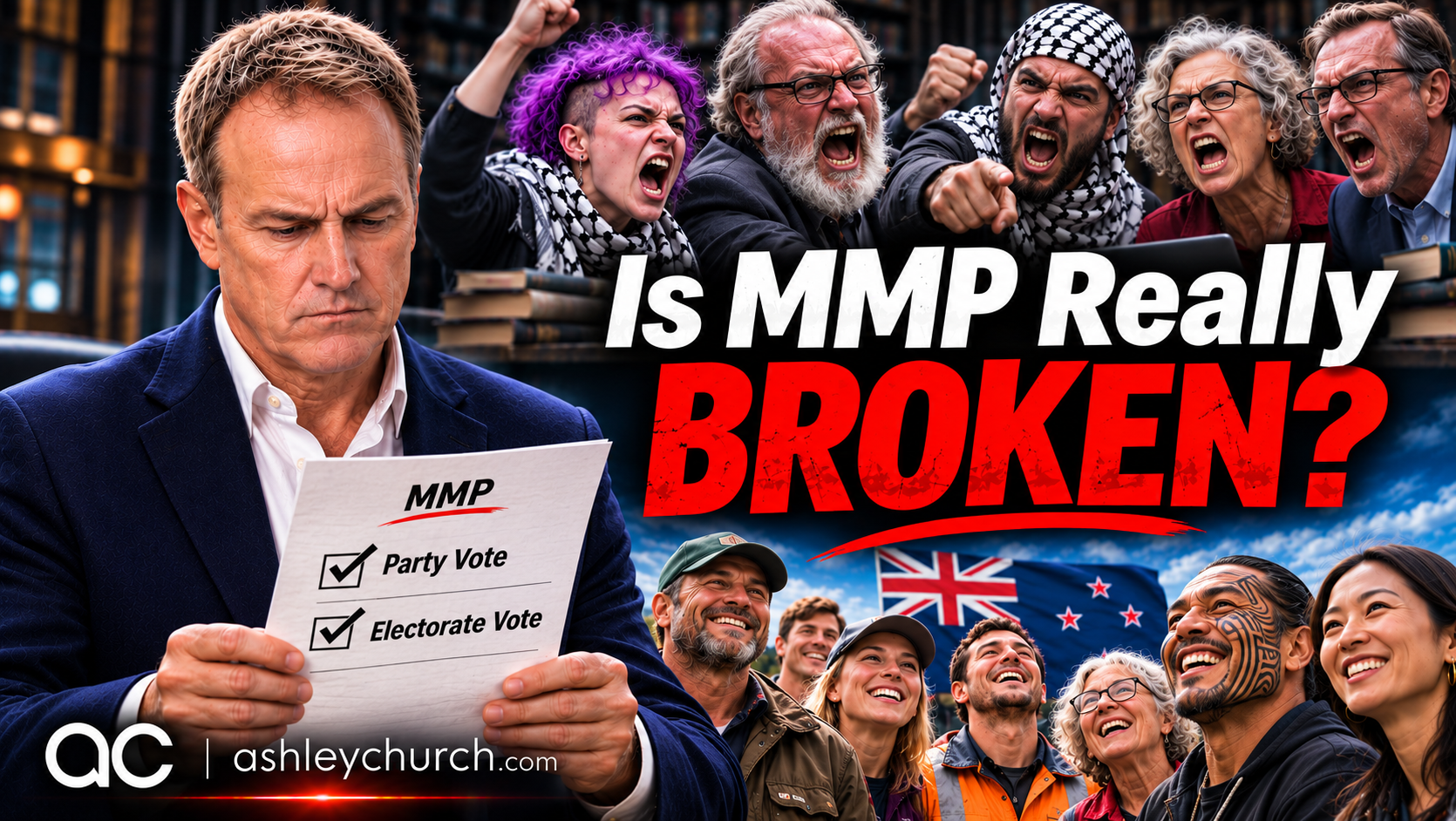
Is MMP really broken?
Or have voters just, finally, discovered their power?
I was never particularly a fan of MMP – in fact, back in 1993 I toured Hawkes Bay with Michael Laws debating its merits at public meetings.
Michael was in favour of MMP and, in those days, a considerably better public speaker than I was – so the audiences usually went away resoundingly in favour of the new electoral system.
As such, it was no surprise when, a few months later, New Zealanders voted to adopt the proposed new system by 53.9% to 46.1%.
In 2011, they were given another opportunity to reconsider their decision and they voted to keep it.
I voted against it both times and still have serious reservations about MMP. In my view it had several flaws – but my principal objection back then was that it would allow relatively small political parties to exercise power wildly disproportionate to their public support: “the tail wagging the dog”.
History, of course, has proven the wisdom of my concern. Winston Peters has turned small party leverage into something of an art form and Opportunity may yet find itself in a position to determine who governs New Zealand in 2026.
For that reason, I continue to maintain that a party with a relatively small share of the national vote should never have that much influence over the direction of an entire country. But that’s a separate argument – because I now find myself in the unusual position of defending an electoral system that I’ve never particularly liked in the wake of the extraordinary reaction to the election of 7 November.
No doubt you’ve seen it yourselves. Academics and political commentators who once championed MMP as the great equaliser are now falling all over themselves to tell us that MMP is suddenly broken and demanding reviews, reforms and for the major parties to work together to fix the problem. We’re told that the system has been gamed, that proportionality has been undermined, and that the original intentions of MMP have somehow been violated. Apparently, a system that was sufficiently functional to survive three decades, multiple elections and previous reviews has suddenly developed a catastrophic defect.
So why the sudden outrage? Overhangs have happened before. Te Pāti Māori has benefited from them in previous elections, most recently in 2023, when it won two more electorate seats than its party vote would ordinarily have justified.
And while there have been periodic discussions about changing the rules, overhangs have never previously produced anything resembling the political uproar we’re now witnessing. In fact, the Electoral Commission recommended changes that would have removed overhang seats in 2012, and another independent review addressed the issue in 2023 – but successive governments, National and Labour alike, have chosen, each time, to leave the existing provisions in place.
But are the critics right? Has this election actually exposed some previously unidentified defect in MMP? Is there an inherent problem with the system that we’ve somehow overlooked for the past 30 years and which now needs to be urgently corrected?
Not at all. What’s happened is much more interesting than that: MMP isn’t broken. New Zealanders have simply discovered how to use it.
To understand what’s happened, we need to go back to why MMP was introduced in the first place. Under the old First Past the Post system, some political parties could attract enormous public support and end up with almost nothing to show for it in Parliament. In 1981, Social Credit won nearly 21% of the vote and just two seats. In 1984, Bob Jones’s New Zealand Party attracted more than 12% and didn’t win a single seat. It was hardly a ringing endorsement of representative democracy.
MMP was intended to fix that by making Parliament more closely reflect the way New Zealanders voted. But it also gave us something else. Two votes.
One of those votes was designed to give us a choice over the person we wanted representing our electorate. The other was designed to choose the political party we wanted to support.
But because the public debate was about making Parliament more proportional, most of the focus went on the ‘list’ or ‘party’ vote and largely ignored the new power that the electorate vote gave to the voter. For this reason most parties have campaigned most strongly for the list vote or have simply asked for ‘two ticks’.
But used strategically, the electorate vote is just as powerful as the list vote – and has a different purpose. While the list vote allows us to ensure proportionality by getting smaller parties that exceed 5% of the vote into Parliament – the electorate vote allows us to support the traditional Parties of Government – parties that can be expected to win seats outright without the need for a proportional ‘hand up’.
The problem with this approach (if it ‘is’ a problem) is that it can create an overhang where a party wins more electorate seats than its share of the party vote qualifies it for – which increases the size of Parliament because more seats are required than the standard 120.
But let’s be clear – this wasn’t some accidental loophole that nobody noticed. It was specifically anticipated and provided for in the rules.
Indeed, the possibilities created by splitting the vote were understood long before New Zealand held its first MMP election in 1996. In the mid-1990s, an idea was circulating within the National Party to create two separate Parties – National A and National B. The origins of the proposal are somewhat murky, with both Murray McCully and Maurice Williamson associated with claims to its paternity. But who deserves the credit is less important than what the idea involved.
Under the proposal National would have had two parties: one which would concentrate on winning electorate seats, while the other would collect party votes. If enough people voted for the electorate version of National and gave their party vote to its companion, National would potentially win far more seats than it would otherwise receive. It was clever, but it was also regarded as something of an artificial manipulation of the system, and the idea went nowhere.
And there’s a very important distinction between that proposal and what’s happened in 2026. ACT and New Zealand First are not artificial versions of National. They’re genuine, independent political parties with their own leaders, values, policies and supporters. A voter choosing a National electorate candidate while giving their party vote to ACT or New Zealand First isn’t voting for the same party under two different names. They’re making two separate, legitimate political choices – exactly as MMP allows them to do.
Which brings us to the real problem for the chattering classes in Wellington: Voters have finally discovered their power.
For decades, National voters have supported National electorate candidates because they believed those candidates were best suited to represent their communities – even when they weren’t happy with the overall direction of the National Party. Now they’ve discovered something important – they don’t have to choose between those preferences. They can support the National candidate they know and trust in their electorate, while giving their party vote to another centre-right party whose policies more closely reflect their views.
And if enough people do that, the combined effect can be enormously powerful. It can change the parliamentary arithmetic and it can potentially determine who forms the next government. That’s not a breakdown of democracy: That’s democracy working.
There’s nothing inherently dishonest, improper or undemocratic about that and it’s not a strategy reserved for National voters. Labour supporters are just as free to vote for their preferred Labour electorate candidate and give their party vote to the Greens, Te Pāti Māori or another party.
Whether that produces an overhang depends on how many electorate seats their preferred candidates can win and how the party votes fall. But the voting rights are exactly the same.
So let’s not pretend that the sudden enthusiasm for electoral reform is a dispassionate academic exercise. Ask yourself this question: If the same electoral strategy had delivered a Labour-Green-Te Pāti Māori government, would we be witnessing the same extraordinary clamour to change the rules? Of course not – because this isn’t a principled concern for democracy. It’s political disappointment dressed up as constitutional outrage.
For decades, sections of academia, the media and the wider Wellington political establishment have exercised enormous influence over how political issues are framed and have become accustomed to setting the terms of political debate – treating their own interpretations of the public interest as though they carry some special authority in which ordinary New Zealanders need to be guided towards the correct political conclusions by people with the necessary education and expertise.
But voters have an annoying habit of thinking for themselves – and the election of 7 November has demonstrated just how inconvenient that independence can become.
Thirty years ago, I opposed MMP because I believed it contained serious weaknesses. I still do.
But the people of New Zealand chose this system, reaffirmed that choice, and have now demonstrated that they understand its possibilities better than many of the people who presume to lecture them about it.
MMP isn’t broken. The voters have just finally figured it out.
