
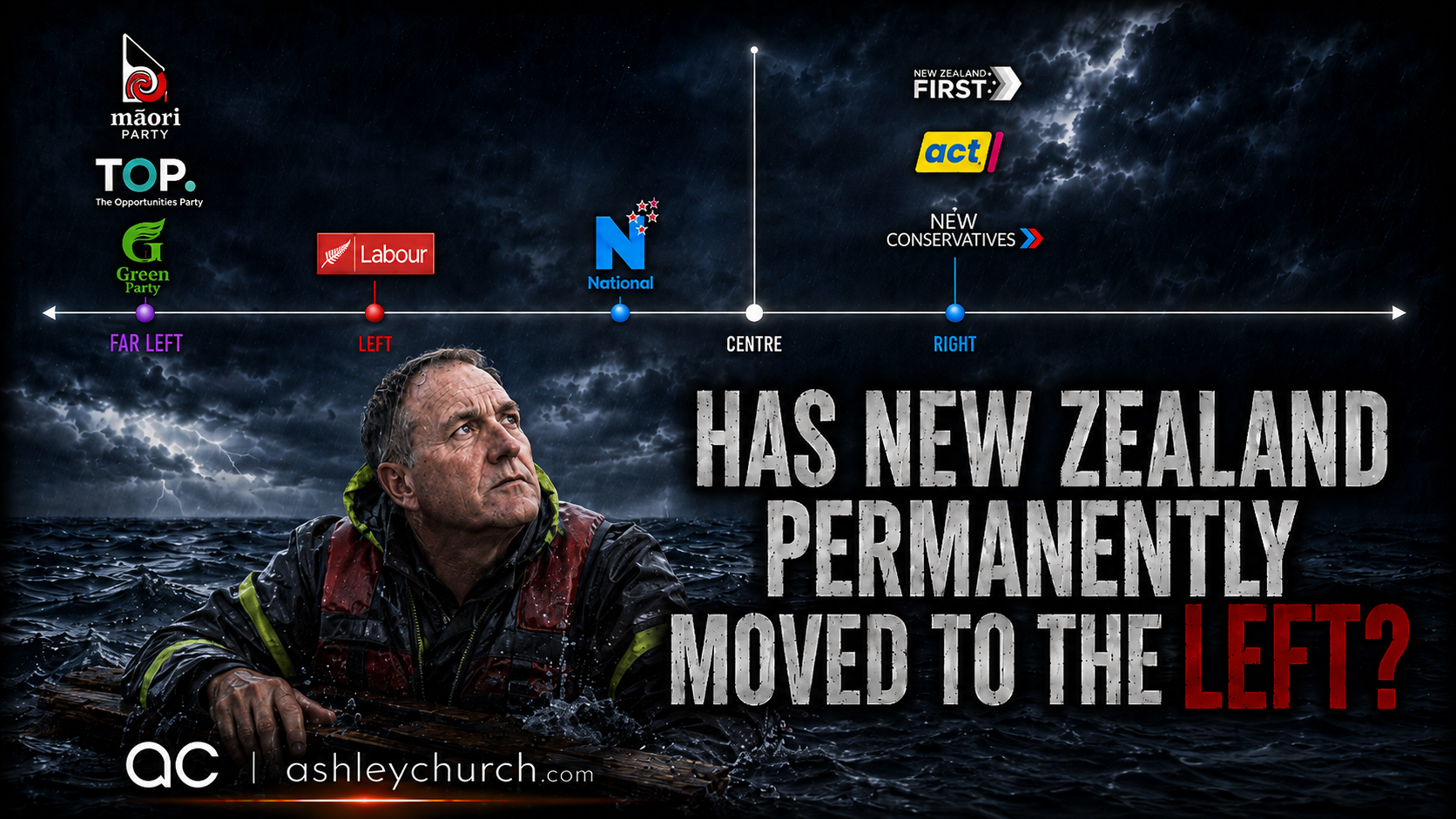
Has New Zealand permanently moved to the left?
Passing the point of no return
We’re all familiar with the mental image of a man, alone in the middle of the ocean, his ship gone beneath him, clinging desperately to a piece of wreckage and convincing himself that if he can just hold on a little longer, rescue will come.
I’m starting to wonder whether that’s me – hanging on to the belief that New Zealand had decisively rejected the direction of the previous Labour government and that the political drift since then was temporary, accidental, or simply the result of National failing to deliver what people thought they had voted for.
But looking at what’s happening around us now, and at the latest polling, I’m beginning to wonder whether I’ve been clinging to the wrong piece of debris all along.
It’s not a position that I come to lightly because, for the past three years, I’ve written a great deal about the direction of this country. I’ve criticised this Government when I thought it deserved it, warned about policies being advocated by the parties of the left, and repeatedly argued that New Zealanders are, at heart, a pragmatic and relatively centrist people who don’t particularly want ideological government of either stripe.
But perhaps I was wrong. Perhaps, at 62, I’m simply looking at New Zealand through the lens of a country that doesn’t exist anymore.
That thought occurred to me again this week in the wake of the extraordinary spectacle of a National Party leadership challenge just a few months out from an election. Christopher Luxon survived, Chris Penk did not, and National now has the unenviable job of persuading the country that everybody is completely united after demonstrating rather publicly that they weren’t.
And then came the latest 1News-Verian poll. National was sitting on 29 percent, Labour was on 30, the Greens were on 12, ACT had risen strongly to 9 percent, NZ First had fallen to 8 percent, and the Opportunity Party had also reached 8 percent.
Sure, it’s only one poll and it’s sample is relatively small – but it shouldn’t be dismissed, because it fits an increasingly persistent pattern which, until now, I’ve interpreted in a particular way.
I’ve assumed that National’s difficulties were primarily about National. I’ve assumed that New Zealanders elected a centre-right Government in 2023 because they wanted a decisive change of direction after six years of Labour, and that their subsequent dissatisfaction reflected frustration that they hadn’t seen that change.
And there’s still plenty of reason to believe that. National was elected with a strong mandate to bring government spending under control, liberate the economy from some of the constraints imposed between 2017 and 2023, and move back towards the pragmatic political centre.
Instead, much of the past three years has felt remarkably familiar. On spending, the Government has fallen well short of what many of the people who voted for it expected. People who voted for National to reduce government spending weren’t studying Treasury ratios or waiting patiently for an eventual improvement in the expenditure-to-GDP line. They expected a serious and visible reduction in the size and cost of government. Instead, spending remains enormous.
Yes, they’ve had to find an additional $5 billion per annum to pay the interest bill on Labours spending orgy (taking the total interest bill to $9 billion) – but they knew that going into government and still convinced us that they could get debt under control. They haven’t.
Christopher Luxon certainly hasn’t helped either. Whatever his other qualities, he has never developed the instinctive ability to communicate empathy or connect with the public that successful political leaders generally possess.
But this has never just been a Christopher Luxon problem. The wider National Party has spent much of its term behaving as though the election of 2023 was a request for a few tweaks rather than a demand for huge change. In economic policy, social policy and cultural policy, too much of what Labour left behind has either survived or been adapted rather than reversed – and on a whole range of issues this National-led Government has often looked less like a centre-right Government and more like a centre-left Government operating with a slightly different management team.
Indeed, perhaps it’s time to ask whether National itself can still meaningfully be described as a party of the right. On many of the issues which once defined the difference between National and Labour, today’s National Party appears more comfortable within the style of government of the Helen Clark era rather than with the traditional principles which characterised previous National governments. It may now be less a centre-right alternative to Labour than a more cautious and economically restrained version of the centre-left.
However, there is an important qualification to this, and it matters enormously when considering what might come next.
For all my criticism of National’s direction, this Government hasn’t been National governing alone. ACT and New Zealand First have acted as important brakes on some of National’s leftward instincts and have repeatedly pushed Government policy back towards positions which are more recognisably centre-right. They’ve forced changes, blocked others, and provided a moderating influence which means that the actual Government programme has often been less leftward than National’s own apparent inclinations might otherwise have produced.
That distinction becomes crucial when we look at the alternative – because the parties Labour would need to work with wouldn’t moderate Labour towards the centre. They would pull it much further left.
That’s where the rise of the Opportunity Party becomes particularly significant, and where much of the commentary around it has been so badly misleading.
Opportunity isn’t a centrist party sitting somewhere between the two blocs, waiting to decide after the election whether it prefers National or Labour. That choice doesn’t exist.
Opportunity is a party of the left and sits significantly to the left of Labour on almost all policy. It belongs politically in the same broad category as the Greens: a party whose policy programme places it firmly within the left bloc before a single coalition conversation has taken place.
Its tax policy alone makes that obvious, with a 1.75 percent annual land value tax and an explicit policy intention to reduce property values. Its wider policy framework is built around a much larger role for government, more redistribution and substantially greater state intervention in the economy.
That isn’t centrist politics, and presenting Opportunity as some kind of neutral kingmaker fundamentally misrepresents the political landscape. There aren’t two major blocs with Opportunity sitting between them deciding which way to jump. There are two blocs, and Opportunity is already part of the one on the left by virtue of its policies.
As such, Luxon was absolutely right to rule them out – if only to send a clear message to centre-right parties regarding what they would be getting if they voted TOP.
So make no mistake – if Labour is to form a government after the election, it will do so in partnership with three parties whose natural influence will be to push Labour much further to the left.
That is the mirror image of the present arrangement. National, despite its own centre-left instincts on too many issues, has had ACT and New Zealand First pulling it back. Labour would have parties pulling it further out.
That difference matters.
And perhaps that really is what New Zealand wants. Perhaps the relentless leftwing advocacy of the mainstream media has worked? Indeed, I can’t remember another period in my lifetime in which so much of the mainstream media has appeared so relentlessly hostile to a sitting centre-right Government. The scrutiny of Luxon, National and its coalition partners has been incessant, while controversies and scandals involving parties of the left, including Labour itself, have often received nothing like the same sustained attention. At times, much of the media doesn’t even seem particularly interested in maintaining the pretence of political neutrality, and that relentless imbalance must surely have had some impact on public perceptions of the Government.
Perhaps all of these factors have changed our nation?
Perhaps New Zealanders are comfortable with substantially higher taxation of income, property, assets and capital, and with a much larger role for the state in deciding how wealth is created, held and distributed. Perhaps they’re comfortable with policies which make investing in property deliberately less attractive and which are designed to reduce the value of the largest asset owned by hundreds of thousands of New Zealand households.
Perhaps they’re comfortable with successful New Zealanders, business owners, professionals and investors looking across the Tasman and deciding that Australia offers them a better future. Perhaps they’re also comfortable with another period of much higher government spending and borrowing, even while we’re already paying around $5 billion a year simply to service the cost of what Labour borrowed last time they had access to the nations chequebook.
But economics are only part of it.
Perhaps New Zealand also wants a return to governments which are much more willing to regulate speech, criminalise dissent and allow politicians and officials to draw increasingly narrow boundaries around what constitutes acceptable public debate. Perhaps it wants laws and institutions which progressively move away from the principle that citizens should be treated equally before the state and towards a system in which rights, representation, influence and access are increasingly determined by ancestry or group identity.
Of course, National hasn’t been innocent of that drift either, which is precisely the problem. Some of these ideas have survived a change of government and are in danger of becoming embedded regardless of who holds office. But the significant difference is that National has had coalition partners resisting that movement, whereas a Labour Government supported by the Greens, Opportunity or Te Pāti Māori would face exactly the opposite pressure.
Perhaps New Zealanders are comfortable with that. Perhaps they want governments to have greater authority over what can be said, greater influence over economic choices, a larger role in redistributing wealth and an increasing willingness to divide citizens into categories which receive different treatment from the state.
If that’s where the country wants to go, then at some point those of us who disagree have to acknowledge the will of the people. That’s democracy, and accepting a democratic choice also means accepting that people are entitled to choose a political direction which others believe will ultimately damage the country.
But democracy doesn’t suspend cause and effect.
If we choose substantially higher taxation, particularly concentrated on people with capital, assets and high incomes, some of those people will arrange their affairs differently and some will leave. That’s not an opinion – it’s the experience of every country which has tried it.
If we deliberately make investment less rewarding, we’ll eventually get less investment. If we create more universal entitlements and expand the role of government, somebody will have to pay for them, and if we borrow more, an interest bill which is already around $9 billion a year will continue to grow.
If we deliberately engineer lower property values, people who own those properties will, by definition, be poorer than they otherwise would have been. If we give governments greater power to regulate speech, we shouldn’t be surprised when that power is eventually used against opinions we happen to hold ourselves. And if we move away from equality before the state and towards different treatment for different groups, we shouldn’t be surprised when social cohesion begins to weaken.
None of that means these things can’t be chosen. Of course they can, and perhaps the mistake people like me have made is continuing to assume that New Zealanders don’t understand what’s being offered.
Maybe they understand perfectly well. Perhaps they’ve looked at the competing visions, considered the trade-offs and decided that they’re willing to accept them.
If so, fair enough.
Maybe this beautiful, extraordinary little country I’ve loved all my life really is moving towards a political, economic and social dystopia which I would never choose for it, but which a growing number of my fellow New Zealanders seem to genuinely prefer. If that’s true, there isn’t much point getting angry about it because, at some stage, a country gets to make its choice.
And then, we all have to live with it.
Comment on this article on Facebook
Discover more from ashleychurch.com
Subscribe to get the latest posts sent to your email.
