
Why we’ve become so cynical about Bible prophecy
Fifty years of failed predictions
Mention the words ‘Bible Prophecy’ and most people will roll their eyes. In fact, it’s an indictment on the Christian faith that a society of people that will consult a medium, believe a horoscope, or swear by the writings of Nostradamus now regard Bible prophecy as ‘quaint’ and outdated.
Even amongst Christians the mention of Bible prophecy will often elicit obvious indifference, or outright cynicism. Very few Christians now see Bible prophecy as something that should fundamentally shape the way that they understand God, history or even their own faith.
But it wasn’t always like that. Fifty years ago, the whole field of Bible prophecy looked completely different.
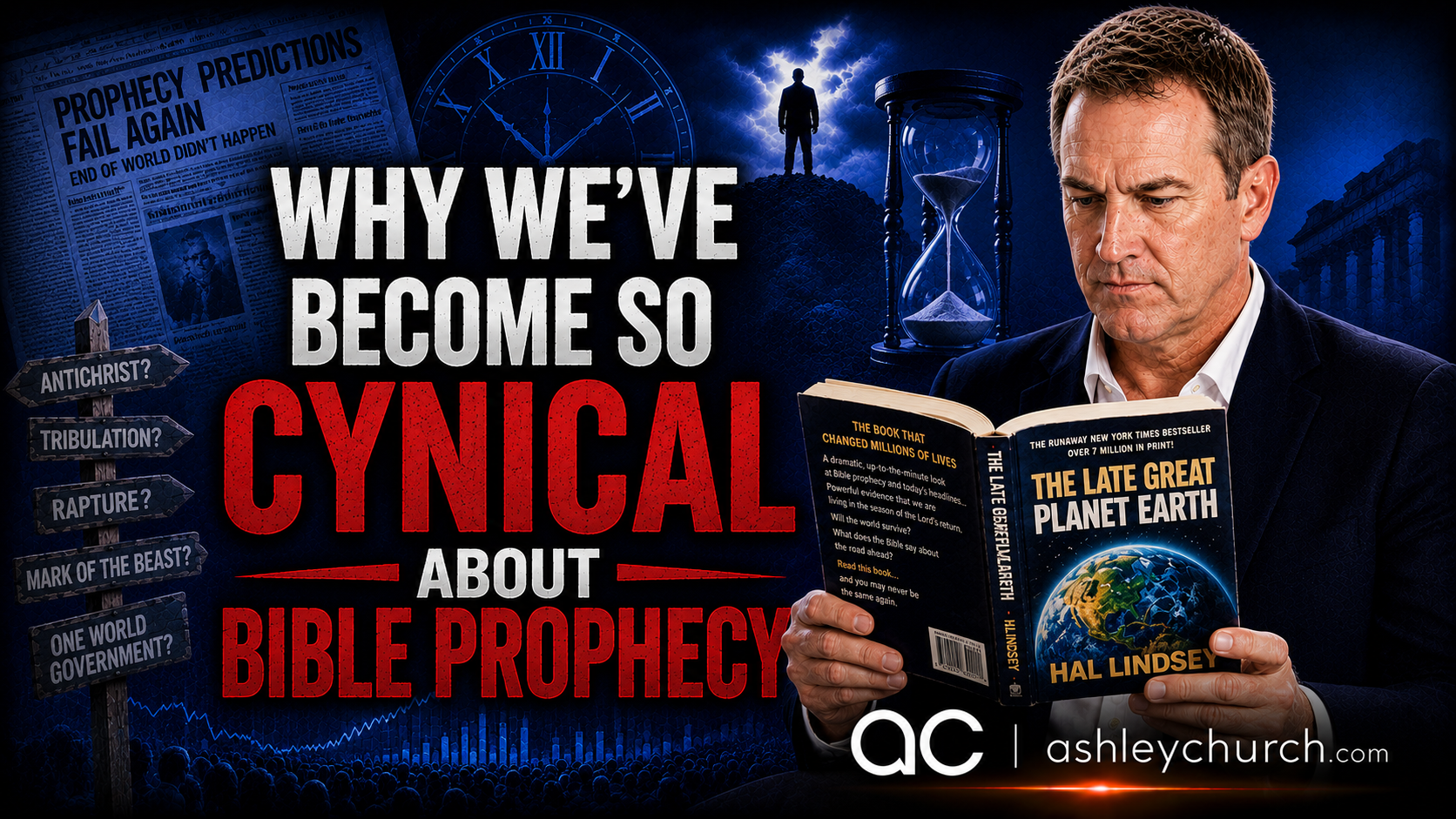
In the early 1970s millions of Christians around the world were captivated by prophecy following the publication of a book called The Late Great Planet Earth by Hal Lindsey. Lindsey’s book transformed Bible prophecy into something immediate and contemporary. He took an existing prophetic framework called Premillennialism that was hundreds of years old – and he used it to explain the world people were living in at that very moment.
At the time, it appeared to explain everything. The Cold War. The Soviet Union. The emerging European Economic Community. Conflict in the Middle East. Advances in technology. A developing global financial crisis.
For an entire generation, prophecy became exciting. Christians believed that they were watching bible predictions unfold before their eyes. An ‘Antichrist’ was coming. A persecution of Christians was near. A ‘Mark of the Beast’ was beginning to emerge. The Temple in Jerusalem would soon be rebuilt. The final world system was taking shape.
For many people, Lindsey’s book wasn’t simply an interesting approach – it shaped the way that they viewed the world and, in some cases, the way that they planned their lives.
But the events it predicted didn’t happen.
The Soviet Union disappeared. The Cold War ended. Europe changed beyond recognition. And the personalities, alliances and political realities that once appeared to fit the prophetic picture passed quietly into history, replaced by new leaders, new technologies, new conflicts and new international tensions.
The reaction was revealing.
Many Christians retained a passing curiosity but no longer devoted themselves to studying prophecy as they once had. These are the Christians who have watched decades of confident prophetic predictions come and go and have become disillusioned as one interpretation after another quietly gives way to the next.
Others abandoned the subject almost completely, concluding that it was either too confusing to understand; too speculative to take seriously; and simply not worth getting excited about.
The remainder stayed with the same prophetic framework but updated the details. New world leaders replaced old ones. New technologies became candidates for the Mark of the Beast. New international organisations became the revived Roman Empire. New conflicts became signs that the end was once again just around the corner.
Many in this last group still hold their views with absolute certainty – oblivious to the fact that, twenty years ago, other Christians subscribed to exactly the same prophetic framework and argued with precisely the same confidence but based on entirely different interpretations based on the events taking place at that time. Go back another twenty years and the details change again. The names change. The political events change. The technologies change. The fulfilments change.
Yet, the certainty remains – even as the interpretation changes.
That’s not a criticism of the people involved. Forty years ago I’d almost certainly have been one of them.
But surely there comes a point where we have to ask an honest question: If Scripture hasn’t changed, but our interpretation of current events keeps changing every generation, is the problem, perhaps, that we have misunderstood the prophecies themselves?
That question changed my life.
Like millions of other Christians I was captivated by The Late Great Planet Earth. Based on its premise, I spent twenty years trying to understand how current events fit the prophecies of Daniel and Revelation. But finally, in the early 2000’s, I realised that they didn’t and that we had misunderstood what the prophecies were telling us.
Part of that breakthrough came when I stopped treating all prophecy as though it belonged in the same category. Scripture contains many different kinds of prophecy – but there’s one type, in particular, that shows up over and over again in the Books of Daniel and Revelation.
I call these time-defined prophecies. They are the prophecies that contain actual numerical periods – time, times and half a time; forty-two months; one thousand two hundred and sixty days; two thousand three hundred evenings and mornings; one thousand two hundred and ninety days; one thousand three hundred and thirty-five days. If you’ve read Daniel and Revelation you’ll be familiar with them.
Those numbers aren’t decorative – they’re chronological markers – and over more than twenty years of study I reached two conclusions about them that completely transformed my understanding of prophecy:
The first is that almost all of the prophecies in Daniel and Revelation are about the Jewish people and the nation of Israel – not Christians. They describe God’s dealings with Israel across more than two and a half thousand years of history in extraordinary detail.
The second conclusion changes everything.
Every one of these time-defined prophecies has already been fulfilled. Without exception.
That means that the issue is much bigger than identifying the wrong Antichrist or attaching the Mark of the Beast to the wrong technology. It means the entire framework built on those assumptions needs to be re-examined. The constantly changing interpretations aren’t the problem. They’re the symptom of a framework that has misunderstood the purpose of the prophecies themselves.
I realise many readers will find this difficult to accept – and I understand why because I once believed exactly the same things that they do. My purpose isn’t to offend these people, but simply to encourage them to ask whether the framework we’ve inherited really explains Scripture as well as we’ve assumed.
The irony is hard to miss.
At precisely the point in history where these prophecies have become capable of being fully understood because the events they describe have unfolded, many Christians have quietly concluded that prophecy has little relevance to their lives. Remarkably, Scripture itself anticipated this time – a time when people would lose their appetite for sound teaching and look elsewhere for what they wanted to hear.
For the rest, these prophecies can now be easily and clearly understood. Recently, I brought decades of work together into my book – Prophecy Shock – which lays out the twenty-two time-defined prophecies in Daniel and Revelation and explains why they’re centred overwhelmingly on Israel and the Jewish people. It also shows how each one has already been fulfilled in recent history.
It’s the book that I wish someone had been able to hand me forty years ago.
The tragedy of the last 50 years isn’t that so many Christians disagree about prophecy – it’s that so many more have stopped believing it has anything important to say to them.
Because if these conclusions are correct, prophecy isn’t an endless exercise in trying to predict tomorrow’s headlines – it’s one of the greatest demonstrations in all of Scripture of God’s sovereignty over history, His faithfulness to His promises, and His extraordinary plan for all of us, played out through Israel and the Jewish people.
Prophecy has never been more relevant – for those who have ears to hear…..
(‘Those who are wise will understand’: Daniel 12:10)
Interact with this article on Facebook by clicking here and check out my new book www.prophecyshock.com to learn how all of this was predicted over 2,000 years ago
Discover more from ashleychurch.com
Subscribe to get the latest posts sent to your email.
