
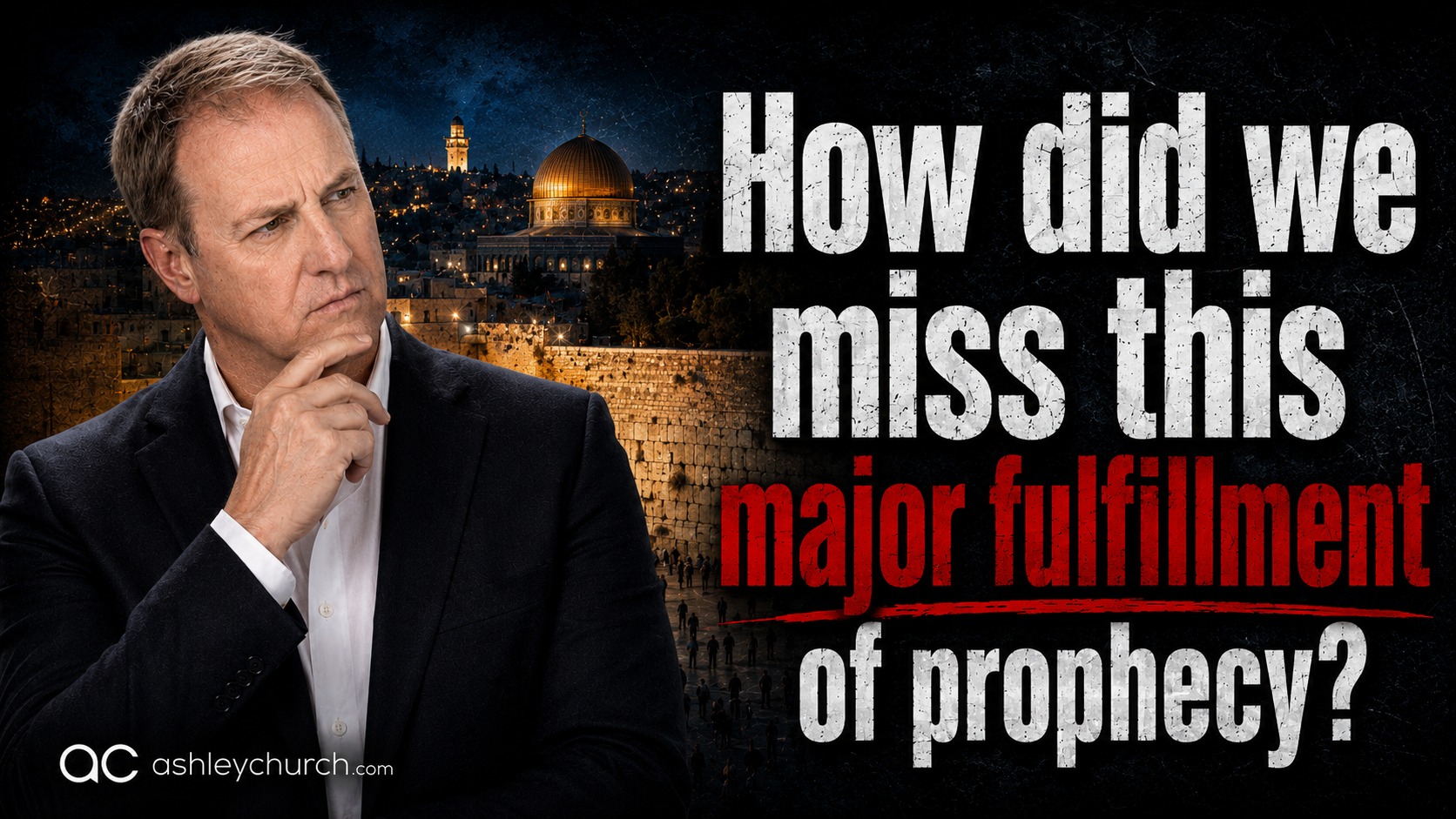
How did we miss this major fulfilment of prophecy?
We're not waiting for the last days - we're living in them
Today, June 7, marks the 59th anniversary of one of the three or four most significant events in human history – and you’re probably not even aware of it.
Why would you be? It’s not the subject of a public holiday. It’s not a big part of what we learn at school, and it’s not surrounded by festive preparations or national commemoration in the way that other, lesser, events are. So for most people, today will come and go as an ordinary day.
But on June 7, 1967, Israeli paratroopers entered the Old City of Jerusalem and, for the first time in over two thousand years, the Jewish people had control of their ancient capital, including the Western Wall and the Temple Mount.
To the world, it was a dramatic military moment in the Six-Day War. To the Jewish people, it was the recovery of the heart of their national story. But to Christians who take bible prophecy seriously, it should be understood as something even larger: one of the most significant events God foretold in Scripture.
That is a big claim, so let me be very clear about what I mean. I’m not just describing the liberation of Jerusalem as prophetic fulfilment in the sense that it is ‘indicative’ of the times in which we live. I’m describing it as a literal, timed, mathematical fulfilment of several bible prophecies – and that its fulfilment can be tested against Scripture with a calculator and a little understanding of history.
This is all the more remarkable because Israel did not set out to take the Old City – it was simply responding to a series of provocations by then Egyptian President Gamal Abdel Nasser.
In May 1967, Nasser had moved Egyptian forces into the Sinai Peninsula and closed the Straits of Tiran to Israeli shipping. That closure cut off Israel’s southern maritime access through the Gulf of Aqaba and was treated by Israel as an act of war – inflamed even further by the fact that Egypt had signed defence pacts with Iraq and Jordan.
Facing the prospect of imminent war on multiple fronts, Israel launched a pre-emptive strike on June 5, destroying much of Egypt’s air force on the ground and changing the military balance in the space of a few hours.
Even then, Jerusalem didn’t figure in Israels plans. That didn’t happen until Jordanian forces started shelling West Jerusalem, despite Israeli warnings to stay out of the conflict – making a battle over Jerusalem unavoidable. The Old City came back into Jewish hands because the war moved there.
The fighting was fierce, but on June 7, Israeli paratroopers entered the Old City through the Lions’ Gate and Commander Motta Gur’s famous message crackled over the radio: “The Temple Mount is in our hands.”
The soldiers present that day knew that they were living through something extraordinary. Many wept. Some prayed. Others simply stood in silence. But even then, the full scale of what had just happened was barely understood.
The world saw a military victory, Israel saw the reunification of its capital, and fifty nine years later, most of the Church still hasn’t grasped that this event sits at the centre of the prophetic timeline.
And that raises an uncomfortable question. Why are Christians, in particular, not far more aware of the overwhelming prophetic significance of this event? Why is June 7 not marked, remembered and taught among people who believe bible prophecy, and who actively await the return of Jesus Christ?
The answer is that many (most) Christians who follow prophecy have misunderstood the prophecies that point to 1967 and have followed the teachings of those who have misappropriated those prophecies and applied them to events which (they believe) are still yet future.
That is another big claim and it may offend some people – but those who have read my recently published book Prophecy Shock will understand exactly what I mean. In trying to understand prophecy many of us are looking in the wrong direction.
In Daniel and Revelation, God points repeatedly to a specific prophetic structure that resolves in the modern restoration of Israel and Jerusalem. He went to extraordinary lengths to make sure that we would not miss this and reinforces it through timed prophecy, repeated imagery and parallel passages that converge on the same two events. But many of us have missed it anyway.
The same theme also runs through the major and minor prophets of the Old Testament under a word Christians often use but have not understood: Restoration.
Restoration is not simply a warm spiritual idea about God fixing things generally. In the prophetic writings, restoration repeatedly points to the reestablishment of Israel, the return of the Jewish people, and the recovery of Jerusalem as the centre of Israel’s national and covenant story.
I will expand on this much more fully in the follow-up to Prophecy Shock, which I hope to release next year – but the point here is simple: the restoration language of the Old Testament and the timed prophecies of Daniel and Revelation are part of the same prophetic architecture.
That is why June 7 matters so much. In 1948, the Jewish people were restored to national sovereignty. In 1967, Jerusalem was restored to Jewish hands. Those two events are connected, but they are not the same.
Israel’s biblical story is about land, people, covenant, exile, return and restoration – and Jerusalem sits at the centre of that story.
But Jerusalem’s restoration was not only about the city. It was also about the Temple Mount. For the Jewish people, the Temple Mount is the holiest site on earth: the place of the First and Second Temples, the centre of ancient worship, sacrifice, priesthood and national identity. Its loss was not merely political. It represented the long interruption of Jewish sovereignty over the very heart of their biblical story.
In Prophecy Shock, I argue that this is why the Temple Mount matters so much in the prophetic timeline. Revelation speaks of the holy city being trampled by the Gentiles. Daniel speaks of Jerusalem as a sanctuary. Both use time-defined terms that allow us to know the exact years of fulfilment – and both converge in 1967, when Israel regained sovereignty over Jerusalem and the Temple Mount.
Some will point out that the Islamic Waqf still administers the Temple Mount day to day – which is true – but it doesn’t alter the larger point. That arrangement was a political decision made after the war and continues because Israel permits it. The Waqf administers – but Israel holds sovereignty – so while the current arrangement is untidy, frustrating and politically loaded, it doesn’t change 1967 in any way.
In the years since 1967, the world has responded to Jerusalem’s reunification in a way which continues to fulfil prophecy. For decades, most of the world has refused to recognise Jerusalem as Israel’s capital and in more recent years nation states, the United Nations and NGOs have demanded everything from the division or relinquishment of Jerusalem to the end of Israel.
None of that is going to happen.
The God who declared the 1967 restoration of Jerusalem over 2,500 years ago did not do any of this by accident. He didn’t bring the Jewish people back to Jerusalem so that the United Nations, hostile governments, activist movements, terror organisations or confused theologians could overrule Him by resolution, slogan, pressure campaign or peace plan.
But He knew that they would try.
Zechariah 12 says that Jerusalem would become “a cup of trembling” and “a burdensome stone” for the nations. Joel 3 says that God will ‘enter into judgement with the nations’ because they scattered His people and “divided up His land.” Those passages are not loose religious decoration. They describe the very argument now taking place before our eyes – so the world’s reaction to Israel and Jerusalem is not an obstacle to prophecy. It is part of prophecy.
In 1948, the Jewish people were restored to national sovereignty. In 1967, Jerusalem and the Temple Mount came back under Jewish sovereignty. These two events are two of the three most important modern fulfilments of all bible prophecy (the return of Christ will be the third) and are the culmination of things that God warned us about, promised and timed across more than two thousand years of history.
So if you are a Christian waiting for the fulfilment of some of the key prophecies in Daniel and Revelation, I would encourage you to look behind you as well as ahead. We are not living in anticipation of a series of key prophetic events – we’re living in the years after they were fulfilled. The Jewish people are back in the land. Jerusalem is back under Jewish sovereignty. The Temple Mount is back under the authority of the nation to whom God gave it. And the nations are reacting exactly as Scripture said they would.
The Reformation, the printing press, the Enlightenment, the American and French revolutions, the Industrial Revolution, the world wars, and the ideological convulsions of the twentieth century – are not the main story of history. They are the scenery, machinery and movement of a much larger story in a history which is not random, and it is not finally controlled by kings, emperors, presidents, generals, philosophers, revolutionaries, bureaucrats or global institutions. It is directed by God.
If Scripture is true (and it is), then the restoration of Israel in 1948 and the restoration of Jerusalem in 1967 were not side-events in modern history. They were the two key moments toward which God had been moving history for more than two thousand years.
June 7 1967 isn’t just the anniversary of a military victory or even a reunited capital. It is the anniversary of the day that one of the great prophetic clocks of history struck its appointed hour.
Most of the world missed it.
Much of the Church still has…..
You can interact with this article on Facebook by clicking here
Find out more about my book Prophecy Shock by clicking here
Discover more from ashleychurch.com
Subscribe to get the latest posts sent to your email.
