
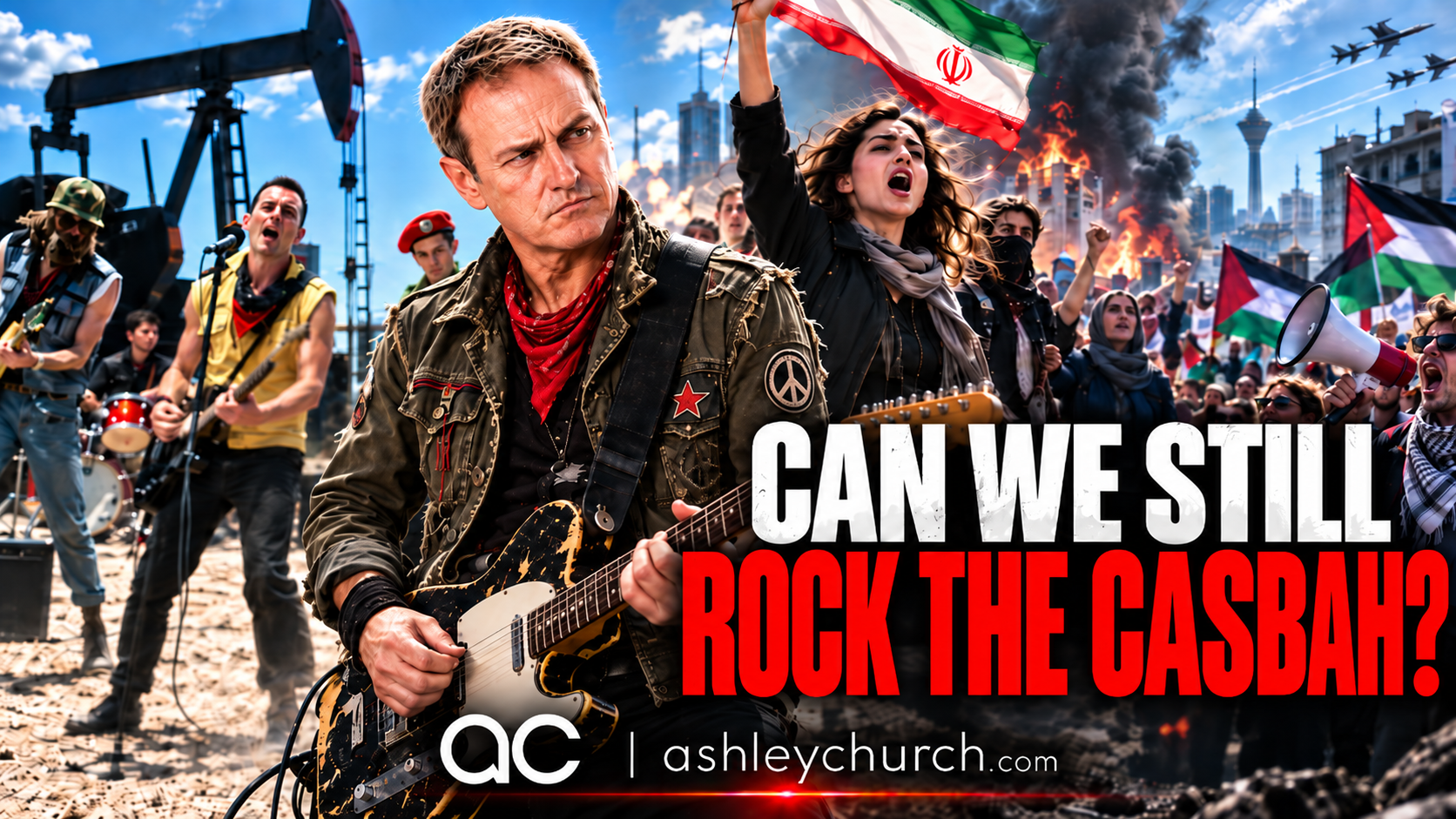
Can we still rock the Casbah?
Why has the left turned its back on the Iranian people?
Those of us of a certain age will hear the words Rock the Casbah and be immediately transported back to 1982 and one of the most distinctive songs of that era.
Released by British Punk band, The Clash, it went on to become one of their biggest international hits – but behind the cheesy video (which you can easily find on YouTube) and the ridiculously catchy chorus was something much more serious because the song was inspired by what was happening in Iran in the years immediately following the Islamic Revolution of 1979.
Joe Strummer, the singer and principal lyricist for The Clash, later recalled being told that someone in Iran could be lashed for owning a disco album, and said that he’d transferred that idea into a song about religious leaders trying to stop people listening to music. In other words, Rock the Casbah was essentially an anthem to ordinary people who refused to submit to the restrictions imposed on them by Iran’s new Islamic rulers.
Technically, a ‘casbah’ is a North African fortress, citadel or the fortified old quarter of a town – but The Clash were making a point, not defining geography, and the term stuck. What’s important is what the song represented – and to grasp the significance of that you need to understand who The Clash were: one of the most overtly political left-wing bands of their generation. That matters because they weren’t conservatives or part of some early anti-Islam movement – they were simply recording music during a period of history during which there was nothing remotely unusual about a left wing band ridiculing Islamic religious repression and siding with the people underneath it.
The song wasn’t a detailed human-rights manifesto and it didn’t set out a programme for Western intervention. But its moral sympathies were obvious. The rulers imposing religious restrictions were the villains and the people refusing to accept those restrictions were the heroes. The underlying idea was that people had a right to live freely and that resisting those who tried to deny them that freedom was something to celebrate. In 1982, that wasn’t a difficult position for the Left to take.
Despite this, nothing changed for the Iranian people for the next 44 years – but that didn’t stop the Iranian people themselves from trying to challenge it. Students protested. Dissidents protested. Women protested. The extraordinary Woman, Life, Freedom movement that followed the death of Mahsa Amini in 2022 brought Iranian women onto the streets in open defiance of compulsory hijab rules and the wider authority of the regime.
But each time, the response was much the same. The protests were suppressed, people were arrested or killed, and the outside world expressed concern – but eventually grew bored and attention moved somewhere else.
Then, at the end of 2025, something changed. Protests fuelled by economic hardship and the collapse of the Iranian currency, began on 28 December, and quickly developed into a much broader rejection of the Islamic Republic itself.
This wasn’t entirely new because Iran had seen major uprisings before, but this time there was an additional factor which made the equation different. On 2 January, while the protests were still developing, Donald Trump publicly warned the Iranian leadership that if it began killing protesters the United States would intervene.
The Iranian protesters took Trump’s rhetoric seriously and by January 8th the demonstrations had grown dramatically with enormous numbers of Iranians taking to the streets across the country demanding the end of the regime.
The response was deadly. Iran shut down the internet and security forces opened fire, indiscriminately killing hundreds, then thousands, of Iranian people and, as information slowly escaped the country it became clear that the scale of the killing was horrific. Senior Iranian Health Ministry officials subsequently told TIME that as many as 30,000 people may have been killed over those two days, while separate reports went as high as 50,000.
TIME described protesters being shot by snipers and heavy machine guns while hospitals were overwhelmed and communications with the outside world were severed. Its subsequent examination of the uprising concluded that Trump had promised America would “come to the rescue”, but it didn’t.
Instead, the rhetoric continued. On 13 January, Trump urged Iranians to continue protesting, telling them to “take over your institutions” and cruelly continuing to declare that “help is on its way”.
But the help never came. Yes, American military forces moved into the region, but the immediate intervention many protesters clearly hoped for didn’t eventuate while the uprising was being crushed – and, instead, thousands were arrested, and families across Iran began burying their dead.
Then, only weeks later, the situation changed again when the United States and Israel went to war against Iran. Once again, Trump openly encouraged Iranians to ‘take back their country’ and, in the early stages of the conflict, regime change was still plainly part of the political conversation.
But Trump’s language became progressively less ambitious as the conflict continued and what had begun with talk that encouraged Iranians to believe that the Islamic Republic itself might be approaching its end became increasingly focused on more limited objectives that mostly served US interests.
But this isn’t really a story about Donald Trump. It’s a story about the political movement which once gave us Rock the Casbah – because while Iranian men and women were risking their lives against one of the most repressive religious regimes in the world, something remarkable was happening in the West.
The political descendants of the Leftwing activists who had once celebrated the idea of Iranians defying the mullahs suddenly seemed to lose their voices!
Here in New Zealand, the Green Party provides an almost perfect illustration of this change. As recently as 2023, Green MPs wrote directly to Ayatollah Khamenei condemning the imprisonment, torture, sexual violence and killing of Iranian protesters declaring that the Green Party would continue to support the struggle of the Iranian people “until all of Iran is free”.
But just three years later, in March 2026, the message had completely changed. In the wake of the murder of over 30,000 Iranians Green co-leader Marama Davidson issued a statement declaring the attack on the Iranian regime as “illegal and unprovoked” and directing much of her criticism toward America, Israel and Christopher Luxon for failing to condemn them.
This dramatic change in messaging was extraordinary. What happened to “until all of Iran is free”?
The same tension can be seen more broadly across the Western activist Left, where there has been enormous energy directed toward condemning Israel and America, while the extraordinary brutality inflicted on Iranian protesters has struggled to generate any sustained attention.
So what changed? What has so decisively caused the left to put aside their outrage at the actions of the repressive Iranian regime?
My answer to that is easy: Israel.
Over the past few years Iran has become one of the principal enemies of the Jewish state and has spent decades supporting organisations dedicated to destroying it, while Israel itself has become one of the defining objects of hostility for large parts of the Western activist Left.
And that changes everything – because if there’s one thing that the left hates more than anything else, it’s Israel.
And ‘hate’ is the appropriate word because this isn’t a conflict born of moral outrage at ‘genocide’ or human rights abuses. Such claims are merely cover for what really underpins the lefts venom toward the Jewish state: deep seated antisemitism.
This extraordinary transformation also means that causes which were traditionally championed by the left are now increasingly viewed through the lens of Israel and the Jews and are either recalibrated to promote an antisemitic narrative or jettisoned where they conflict with this broader objective. Don’t take my word for it – look around you. It’s everywhere and it helps to explain the extraordinary inversion we’ve witnessed.
That’s why, in 1982, the Left could look at Iran and see ordinary people being oppressed by religious authoritarianism and turn their resistance into one of the biggest songs in the world – yet condemn, or even ignore, that uprising when it finally came a little over 40 years later. Attacking the Iranian regime, in 2026, doesn’t serve the bigger goal of hating Jews.
And that’s what makes Rock the Casbah such an interesting song to revisit in 2026. The question isn’t simply whether the Iranian people can still rock the casbah. They’ve already shown us that they’re prepared to try.
The more uncomfortable question is whether we in the West can still recognise what they’re fighting for when one of the countries standing against the oppressors of the Iranian people happens to be Israel.
In 1982, that moral equation seemed remarkably simple.
Today, it’s apparently a lot more complicated….
Comment on this article on Facebook
Comment on this article on LinkedIn
Discover more from ashleychurch.com
Subscribe to get the latest posts sent to your email.
