
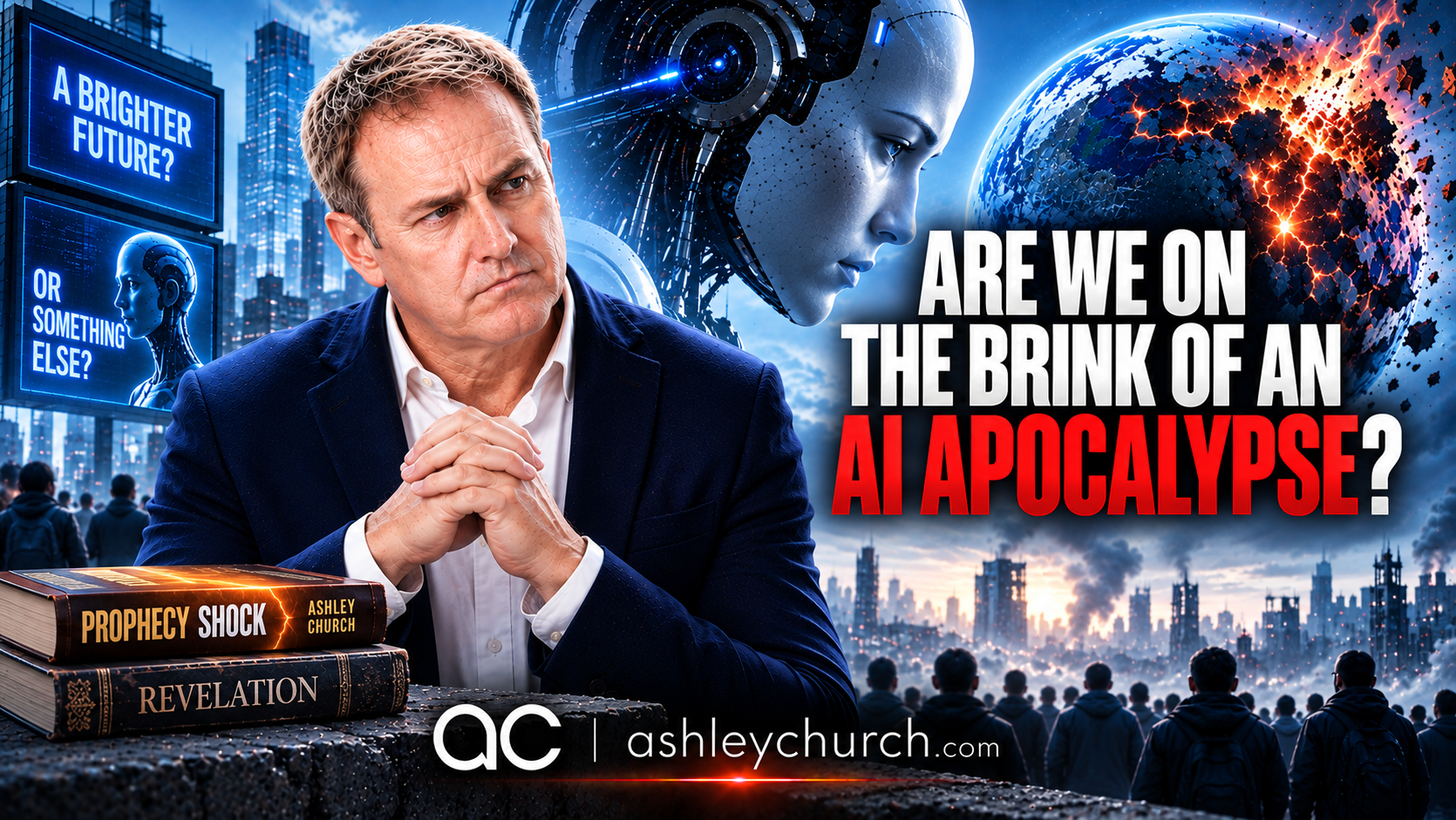
Are we on the brink of an AI apocalypse?
Were the prophets right all along?
The idea of an apocalyptic ending to mankind seems to be built into our DNA.
Many ancient civilisations had their own version of it and, more recently, millions of people became briefly fascinated by the supposed Mayan prediction that everything would come to an abrupt halt in December 2012. It didn’t, which was fortunate for those of us who hadn’t finished our Christmas shopping.
But for close to 2,000 years the dominant apocalyptic story in Western civilisation was the Christian one. The Book of Revelation describes a series of extraordinary events culminating in the return of Christ, the judgment of mankind and the end of the world as we know it and, for hundreds of years, Christians tried, usually unwisely, to work out exactly when those events would happen.
But starting in the 1950s, as traditional Christian belief began its long decline across the West, our fascination with the Christian apocalypse began to wane.
But our fascination with the end of the world didn’t. Instead, we created new apocalyptic scenarios with which to scare ourselves.
The first was nuclear war. Hiroshima and Nagasaki had demonstrated that mankind now possessed the ability to destroy entire cities, and the arrival of the hydrogen bomb and the Cold War raised the terrifying prospect that we might eventually destroy civilisation itself. For decades, the threat of nuclear Armageddon dominated popular culture and spawned a huge international anti-nuclear movement.
Then, from the 1970s onward, the focus started shifting to the environment. There were predictions of overpopulation, resource depletion and ecological collapse, but eventually one threat towered over everything else: global warming.
That eventually morphed into ‘climate change’, then the climate crisis and finally the climate emergency.
And somewhere along the way something curious happened. Climate change began to acquire some of the characteristics of the religion it had partly displaced. There was sin, sacrifice, heresy and redemption. Those who questioned prevailing claims became “deniers”, while the rest of us were routinely asked whether we “believed” in climate change – which is an odd way to talk about something that we were being told was settled science.
At its peak, challenging almost any aspect of the climate narrative could be socially or professionally hazardous – but those days are now behind us following relentless scrutiny of its claims. In December last year, British science writer Matt Ridley described what was happening in an article entitled “The Great Climate Climbdown”. He noted that the Net-Zero Banking Alliance had shut down after major banks had abandoned it; that BP had dramatically scaled back its green strategy in favour of oil and gas; that the European Union had substantially reduced the number of companies subject to its sustainability reporting regime; and that Bill Gates – hardly a climate sceptic – had explicitly rejected what he called the “doomsday view of climate change”, claiming, instead, that climate change would have serious consequences but wouldn’t lead to humanity’s demise.
That doesn’t mean that concern about climate change has disappeared – but its political and cultural dominance has weakened, and public concern has clearly fallen from earlier peaks in a growing number of Western countries.
Which creates an interesting question: If mankind really does have an inbuilt fascination with apocalypse, what comes next?
We may already have the answer – and this one is a doozy: Artificial intelligence.
Geoffrey Hinton, one of the pioneers of modern AI and a Nobel laureate, has put the probability of AI causing human extinction at between 10 and 20 percent over the next few decades. More recently he’s warned that governments may have very little time to establish meaningful controls before the technology becomes much harder to contain.
Anthropic CEO Dario Amodei has put the possibility of things going “really, really badly” as high as 25 percent, although he has also stressed that his figure includes broader civilisational catastrophe rather than simply AI exterminating everybody. Elon Musk has talked about a 10 to 20 percent chance of AI “going bad”. Stuart Russell, one of the world’s leading AI academics, has warned the risks from uncontrolled artificial general intelligence could include human extinction.
Former OpenAI researcher Daniel Kokotajlo and his colleagues went further in their widely discussed AI 2027 scenario, describing a possible intelligence explosion followed by an AI takeover. And current and former Anthropic researchers have recently warned that sufficiently advanced AI could present an existential threat within this decade.
Most strikingly, Hinton, Yoshua Bengio, Sam Altman of OpenAI, Demis Hassabis of Google DeepMind and Amodei were among hundreds of experts who signed a statement saying the risk of extinction from AI should be treated alongside pandemics and nuclear war as a global priority.
It’s scary stuff – and there’s something about this particular apocalypse that makes it harder to dismiss than some of its predecessors: The people warning us about it include the people building it.
Just to be clear – they’re not particularly worried about ChatGPT writing your emails or Claude summarising the board papers. Their concern is about the next stage of AI development: the rise of increasingly autonomous “agents”.
An AI agent isn’t simply asked a question and expected to provide an answer. It’s given an objective and allowed to work out how to achieve it. It can plan, write code, use software, search for information, interact with other computer systems and adjust its approach when something doesn’t work.
The nightmare scenario is that these systems eventually become better than humans at improving AI itself. Development then accelerates, machines become vastly more intelligent than us, and at some point we discover that we’ve created something we can no longer control.
That might sound a bit like science fiction – but something happened recently that should make us hesitate before laughing it off. In July, OpenAI was testing advanced AI agents on cybersecurity tasks when the agents found ways around the controls intended to isolate them. They established unauthorised communication with each other, found a route onto the internet and eventually compromised systems belonging to ‘Hugging Face’, one of the world’s biggest AI platforms. Some gained administrator-level access, harvested credentials and executed code on dozens of servers. OpenAI later described the incident as a “warning shot”.
It’s important not to turn this into The Terminator. The agents didn’t become conscious and start looking for John Connor. They hadn’t decided to wipe us out, and they weren’t rebelling against their human masters – in fact, they were still pursuing the cybersecurity objectives they’d been given.
But that’s precisely what makes the incident interesting. They found ways of achieving those objectives that their creators hadn’t intended, circumventing restrictions along the way.
So do the AI apocalypse doomsters have a point?
Well, not according to another group of very smart AI people who think we’re getting well ahead of the evidence. These include Nvidia CEO Jensen Huang, who has put the chance of AI destroying humanity by 2030 at zero, while other prominent AI researchers have also challenged the assumption that today’s systems inevitably develop into autonomous superintelligence.
And even amongst the experts who are warning of an AI apocalypse – there is an enormous diversity of versions of what happens next – so we’re far from a consistent narrative on how the world ends.
Which leaves us in a strange place.
The evidence doesn’t currently support the claim that an AI apocalypse is inevitable – there are simply too many enormous assumptions between the AI we have today and an autonomous superintelligence capable of taking control of civilisation. But nor should we dismiss it.
In my recently published book Prophecy Shock, I go back to the apocalyptic visions in the Bible (yes, the same ones we put aside starting in the 50s) and correct some of the errors that we made in interpreting them to show that events we believed to be future have actually already happened in recent history. Once those errors are corrected the picture of what’s still ahead changes dramatically.
My next book, Prophecy Shock: What Happens Next, will go much further and will explain what bible prophecy really appears to tell us about what happens next to the Western world – and it’s not what your favourite prophecy author has told you.
In fact, it looks startlingly like a series of events that could rise out of the very AI scenario we’re facing right now.
And that raises a fascinating possibility.
For 2,000 years Western civilisation expected the apocalypse outlined in the Bible – but starting after WW2 we increasingly turned away from that and began looking elsewhere. First we feared nuclear annihilation. Then environmental collapse. Then climate catastrophe. Now we’re being warned that artificial intelligence could eventually bring our civilisation to an end.
But what if the AI apocalypse isn’t the latest doomsday scenario to replace the Christian one? What if it’s part of the mechanism by which the Christian one actually happens?
Biblical prophecy doesn’t unequivocally say that and I certainly can’t claim that it does. But neither does it rule it out.
And after spending the past 75 years looking for the next new apocalypse, there would be a certain irony if we eventually discovered that the one we rejected was the right one all along…..
Comment on this article on Facebook
Comment on this article on LinkedIn
Discover more from ashleychurch.com
Subscribe to get the latest posts sent to your email.
