
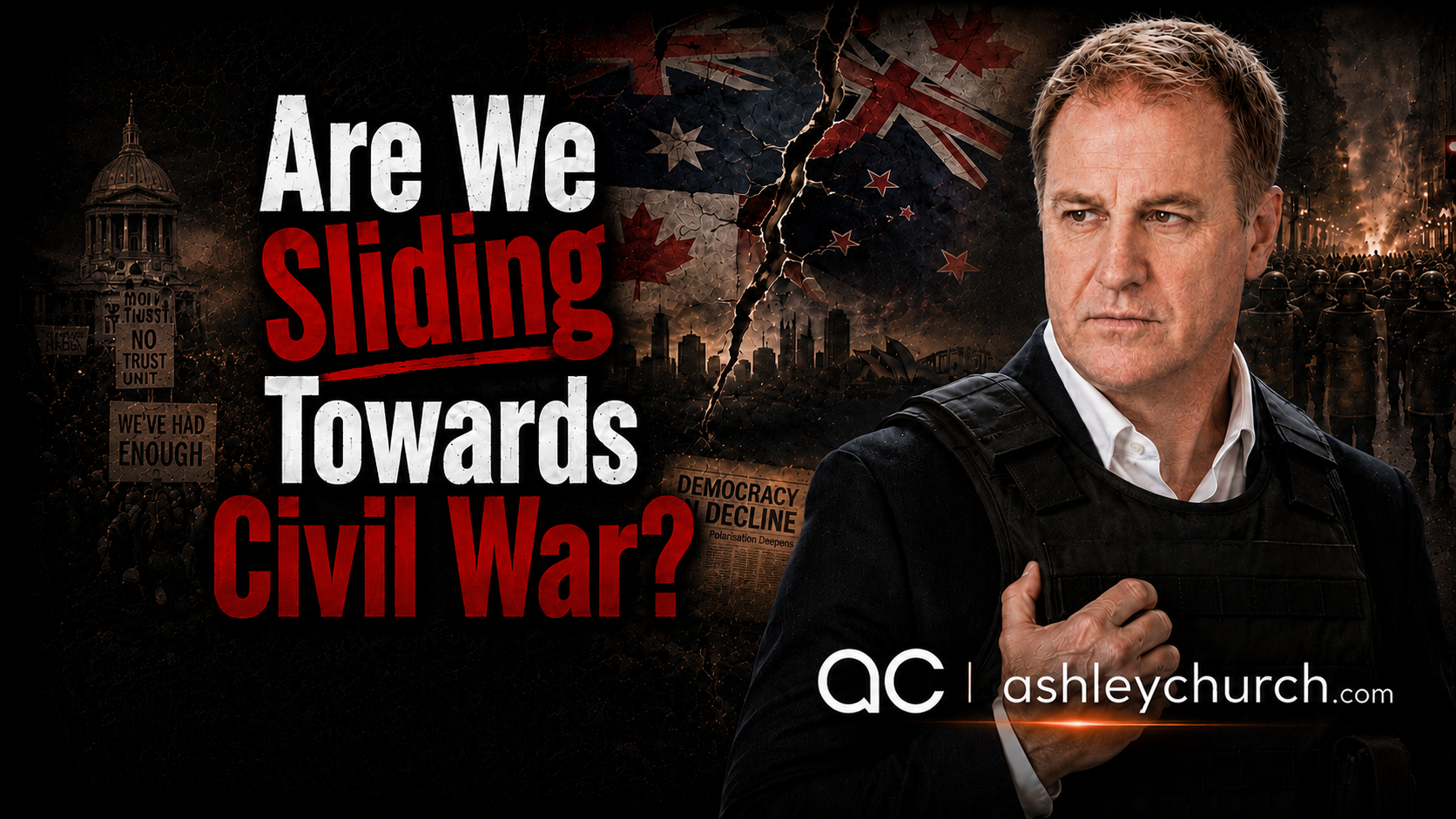
Are we sliding towards civil war?
Warning signs from an unexpected source
Spend enough time on social media and it’s hard not to conclude that a large number of people are deeply angry about the direction of Western society.
That anger is particularly obvious on the centre-right where many believe that the institutions and values which sustained the West for generations are being steadily dismantled. They see faith, family, national identity, freedom of speech and equality before the law giving way to identity politics, cultural guilt, group entitlements and an increasingly intrusive state.
They vote for governments that they hope will reverse that direction – but little changes. Even when Parties traditionally associated with the right win office they don’t appear to change much of what the previous (left wing) government did. They may slow its progress or soften its language, but they rarely reverse it.
Meanwhile, the media, universities, the public service, the education system, corporations and professional organisations continue moving in the same direction regardless of who occupies the government benches.
This has produced a growing and potentially dangerous consensus: We can change the government, but we can’t change the country.
But how serious is this? Is it simply the normal frustration of people who feel that they’re losing the political argument – or are we on the cusp of something much more dangerous?
And are there any warning signs?
There are.
In the 1990s, researchers associated with the US Political Instability Task Force examined dozens of factors to discover what causes countries to descend into serious political instability.
They expected poverty, inequality, ethnic division or dictatorship to provide the answer. They didn’t. Instead, one of the strongest warning signs was a
country caught between stable democracy and stable dictatorship, where elections and institutions still existed but were no longer widely trusted.
The danger grew when that loss of trust was combined with factionalism: political opponents becoming enemies, compromise becoming betrayal and losing power being treated as an existential threat.
This study was reinforced by later research which also showed that ethnic and religious diversity alone, didn’t explain civil war either – and that the real danger came when division was combined with weakened institutions, political instability, exclusion, propaganda and leaders willing to mobilise fear.
That pattern appeared repeatedly throughout the twentieth century.
Before Yugoslavia tore itself apart in the 1990s, it was a modern, largely peaceful European society with functioning cities, schools, workplaces and a shared national identity. Serbs, Croats and Bosnian Muslims lived alongside each other, attended the same schools and frequently intermarried. Many simply called themselves Yugoslavs.
Before its political system collapsed into 15 years of war in 1975, Lebanon was prosperous, sophisticated and known as the Switzerland of the Middle East.
Before political leaders and propaganda transformed ethnic identity into an instrument of fear and genocide in Rwanda, Hutu and Tutsi shared a language, lived together and intermarried.
Likewise, in the early 20th century, the German Weimar Republic had elections, courts, political parties and a free press before confidence in the republic collapsed and political opponents began treating control of the state as a struggle for survival.
In most cases, these changes took only a few short years with a decisive shift occurring when institutions lost legitimacy, people were reduced to competing identities and political leaders convinced them that their neighbours represented a threat.
But could it happen here?
New Zealand isn’t Yugoslavia. Australia isn’t Rwanda. Canada and Britain aren’t Lebanon.
Our courts still function, elections remain peaceful, the state is strong and there are no large armed factions capable of challenging its authority. But that doesn’t mean that the warning signs should be dismissed.
Democracy provides a natural vent for political anger because it offers hope. You may lose this election, but you can organise, persuade the public and win the next one. But that only works while people believe winning can materially change the direction of their country.
Increasingly, many on the centre-right no longer believe that. They see each ‘progressive’ governments moving the country several steps in one direction. Then a new conservative government comes in, accepts most of the new baseline, and the whole process begins again – moving further left each time.
It isn’t an alternating direction. It’s one direction travelled at different speeds where the left appears to control the cultural narrative.
Meanwhile, distrust is deepened by the ideological culture of Western newsrooms where progressive positions which were only recently recognised as extreme are now being presented as neutral truth and traditional views are framed as controversial, dangerous or morally suspect.
All of this should be ringing alarm bells. When Government and media both act to reduce complicated human beings to being either ‘good’ or ‘bad’ based on an ideological definition of those terms, we’re in real trouble.
None of this began yesterday, of course – but there are two developments that have dramatically changed the balance of Western society over the past decade.
The first was COVID.
Whatever view people take of the public-health response, COVID demonstrated how quickly governments and institutions could restrict basic freedoms, divide citizens into approved and disapproved groups and exclude people from employment, travel, worship and ordinary social participation.
What started as a medical division was quickly framed in moral terms. One group was responsible and caring. The other was selfish, dangerous and undeserving of equal participation. Families split. Friendships ended. Trust in government and media collapsed among a substantial section of society.
COVID taught millions that the rights that they had assumed were secure could disappear almost overnight.
The second development has been the rapid institutional advance of identity politics.
Race, sex and sexuality have increasingly become organising principles of government, education, media and corporate life. Citizens are encouraged to see society not primarily as a community of equal individuals, but as a contest between groups ranked according to privilege, victimhood and historic grievance.
Some are told they carry inherited guilt. Others are taught to understand themselves primarily through oppression. Disagreement is increasingly treated not as a legitimate difference of opinion, but as evidence of prejudice, harm or moral failure.
The result is a steady weakening of common citizenship. People are no longer simply neighbours, colleagues or fellow citizens. They’re sorted into categories of victim and oppressor, protected and suspect, innocent and guilty.
These two developments aren’t the only causes of division. But they’re two readily recognisable examples of how quickly the relationship between citizens and institutions has changed.
Together, they have convinced many people that the institutions of democracy no longer belong equally to them.
So are we sliding towards civil war?
Probably not – at least, not yet. Western states remain strong. Governments change peacefully. Alternative political parties and media platforms can still be created. And most people continue to reject political violence.
But the seeds of deeper conflict are already present. Trust is falling. Political identity is hardening. The media is no longer accepted as a credible referee. Citizens are increasingly divided into competing moral groups. And a growing section of the population believes that democracy only creates change in one direction.
And they’re angry.
That doesn’t mean civil war is inevitable. But it does mean that the West is steadily dismantling the safeguards that have traditionally prevented political disagreement from becoming something much worse.
Governments and institutions must take that anger seriously – not by censoring it, dismissing it as extremism or lecturing people about their supposed moral failings, but by restoring genuine political choice, equal citizenship, free debate and confidence that the rules apply fairly to everyone.
Civil wars don’t begin when the first shot is fired. They begin much earlier – when ordinary people stop believing that the system belongs to them, that their voice matters, or that peaceful democratic change is still possible.
We’re not there yet.
But we’re much closer than we should be.
You can interact with this article on Facebook by clicking here
Find out more about my book Prophecy Shock by clicking here
Discover more from ashleychurch.com
Subscribe to get the latest posts sent to your email.
