
The real obstacle to a Palestinian State
Why have the peace talks always failed?
At the end of the First World War, the League of Nations gave Britain sovereign control over some of the Middle Eastern territory that had formed part of the defeated Ottoman Empire in the expectation that the Brits would resolve longstanding territorial and political issues between the various peoples who lived in this region.
This coincided with the British ‘Balfour Declaration’ which had already committed the Brits to providing a national homeland for the Jewish people and the original plan was to divide the land into an Arab nation, to the east, and a Jewish nation, to the west.
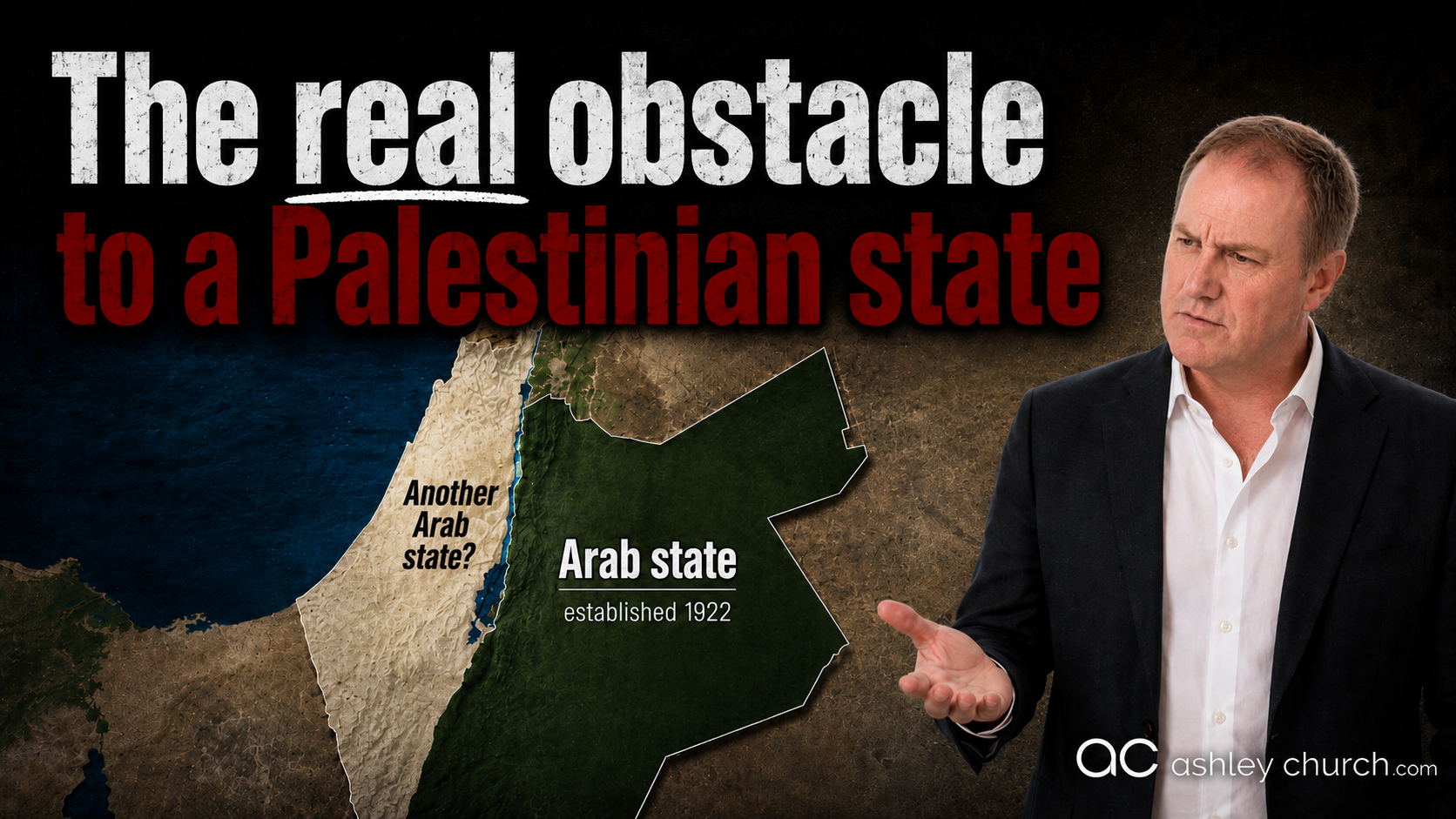
The Brits dealt with the first part of this plan quickly. By 1922 they had separated the territory east of the Jordan River and created an administrative district called ‘Transjordan’ – now known as the Hashemite Kingdom of Jordan.
This is important because, although the term ‘Palestinian’ was not used in the Arab nationalist sense in the early 20th century – the effect was the same. Transjordan represented Arab self-government over the bulk of the original Mandate territory leaving a smaller area for a potential Jewish state.
So you would think that, having established (what was to become) an Arab State – the Brits would tick that goal off and turn their attention to the establishment of a Jewish State – right?
Nope.
Inexplicably, over the next couple of decades they entered into protracted horse-trading with Arab parties to carve up the land that was left and give some of that to the Arabs too!!
This bizarre turn of events came to a head in 1937 when the British Peel Commission formally proposed a partition of the remaining land – recommending a further division into a Jewish State and (yet another) Arab state, with a British-controlled corridor around Jerusalem. Many Jews understandably regarded the proposed Jewish state as painfully small – but Jewish leadership accepted the principle of partition as a basis for negotiation.
However, Arab leadership rejected it outright because they refused to accept the idea of any Jewish state existing at all!
That intransigence killed the Peel proposal, and with it one of the earliest serious attempts to resolve the issue by partitioning the land into separate Jewish and Arab states.
During the next decade, Europe descended into one of the darkest chapters in human history. From 1933 to 1945, Nazi Germany and its collaborators carried out the systematic persecution and murder of Europe’s Jews. Six million Jewish men, women and children were murdered in the Holocaust, including almost two out of every three Jews in Europe.
That changed the moral and political context in which the question of a Jewish homeland was being considered. No longer was it about self-determination – now it was about survival – and the need for a Jewish state was no longer theoretical but brutally and unbearably obvious.
So, in 1947, with Britain on its knees and the world unable to ignore what had just happened to the Jews of Europe, the newly formed United Nations voted to partition the remaining Mandate territory into a Jewish state and (another) Arab state, with Jerusalem placed under international administration. The vote was 33 in favour, 13 against, with 10 abstentions.
The Jewish side accepted the plan – but the Arab side rejected it – so when Israel declared independence on 14 May 1948 it was immediately attacked on all sides by the surrounding Arab nations. The international community recognised the new Jewish state, in principle – but no one came to Israels aid and the tiny new nation was left to fight for its life.
The result was massive displacement on both sides. More than 700,000 Palestinian Arabs fled or were displaced from the territory that became Israel. Some fled in fear, most left because Arab leaders told them that Israel would quickly be destroyed and they could then return. The result was a large Arab refugee population on Israel’s borders to the east and west.
At almost the same time, a larger number of Jews were forced to flee from Arab and Muslim countries across the Middle East and North Africa. Roughly 850,000 Jews were uprooted from communities in which many of them had lived for centuries. But Israel did not inter these people in camps as permanent political exhibits. It absorbed them and built them into the life of the new Jewish state – along with the Arabs who did not flee during the war. Those people, and their descendants, are now full Israeli citizens.
That contrast matters. One refugee population was absorbed and became part of the country that took them in. The other was kept unresolved, because the Arab world and the international system quickly saw their value as political weapons against Israel.
More attempts to find a settlement followed. In 1949, the Lausanne Conference tried to turn the armistice agreements into a wider postwar settlement involving Israel, the Arab states, borders and refugees, but nothing lasting came of it. After the 1967 Six-Day War, UN Resolution 242 created the “land for peace” framework, while the Arab League’s Khartoum Summit issued its famous “Three Noes”: no peace with Israel, no recognition of Israel and no negotiations with Israel.
From the 19080s, onward, the process became more directly ‘Palestinian’. In 1988, Jordan gave up its claim to the West Bank, leaving the PLO as the new representatives of the Palestinians. The 1991 Madrid Conference led into the Oslo process, including Oslo I in 1993, the Gaza-Jericho Agreement in 1994 and Oslo II in 1995, all aimed at staged Palestinian self-government and later final-status talks. Further steps followed through the Hebron Protocol in 1997, the Wye River Memorandum in 1998 and the Sharm el-Sheikh Memorandum in 1999.
Then came the major final-status attempts: Camp David in 2000, the Clinton Parameters later that year, and the Taba talks in January 2001. After that came the Arab Peace Initiative in 2002, the Quartet Road Map in 2003, Israel’s Gaza disengagement in 2005, the Annapolis process and Olmert-Abbas talks in 2007–08, Obama-era direct talks in 2010, the Kerry talks in 2013–14, and the Trump “Peace to Prosperity” plan in 2020.
The details differed, but the aim was always the same: Arab/Palestinian self-government or statehood, and an end to the conflict.
So why was a resolution never reached despite all of these attempts? Was Israel intransigent? Did the Jews drag the chain on key points that might have allowed a lasting solution?
Nope. In fact, the repeated roadblock to a solution was never Israel. In every case, the talks failed because of the Arab and Palestinian refusal to accept a settlement that also required accepting a permanent Jewish state.
In 1967, the Arab League’s position was not a demand for better maps or more generous terms. It was no peace, no recognition and no negotiations. At Oslo, Israel accepted a process that gave the Palestinians self-government and brought the PLO into recognised political negotiations. At Camp David, Barak was prepared to negotiate the creation of a Palestinian state. When Clinton put forward his parameters, Israel accepted them with reservations, while the Palestinian response did not accept the framework as the basis for ending the conflict. At Taba, the talks again moved close to a possible deal, but no agreement was signed. In 2008, Olmert made Abbas an offer that would have required Israel to divide Jerusalem, remove settlements, accept a Palestinian state and make deep territorial concessions. Abbas rejected it.
And that’s the pattern. Israel repeatedly prepared to make painful concessions in pursuit of a settlement; the Arab and Palestinian leadership repeatedly refusing the one concession without which no peace agreement could ever work: accepting that the Jewish state was legitimate and permanent.
So these negotiations did not fail because Israel blocked them. They failed because, from the Peel Commission onwards, the argument has never been about the amount of land, the fairness of the borders, or the detail of the distribution. The core issue has always been the Palestinian refusal to accept the existence of a Jewish state.
The Western framing of this conflict as being a territorial dispute between two national movements fails to grasp the overwhelming religious issues at stake. The Palestinian leadership sees this conflict through an Islamic lens – a lens which will never accept a ‘dividing line’ because it cannot accept that any part of the land can be under anything other than Islamic rule.
That is what “from the river to the sea” means. The land east of the Jordan River had already been separated off as the Arab state that became Jordan. What remains is the land west of the river, the land in which the Jewish state was created.
So this was never simply about Palestinians needing a state. An Arab state already existed east of the Jordan. The demand has always been for the rest as well. Not a state beside Israel, but a state instead of Israel.
That’s why the peace talks failed. They were built on the Western assumption that Palestinian leaders wanted compromise, coexistence and two states. But the record says otherwise. Before 1948, the objective was to stop a Jewish state from coming into existence. Since 1948, it has been to remove the one that did.
Everything else is theatre…..
Discover more from ashleychurch.com
Subscribe to get the latest posts sent to your email.
