
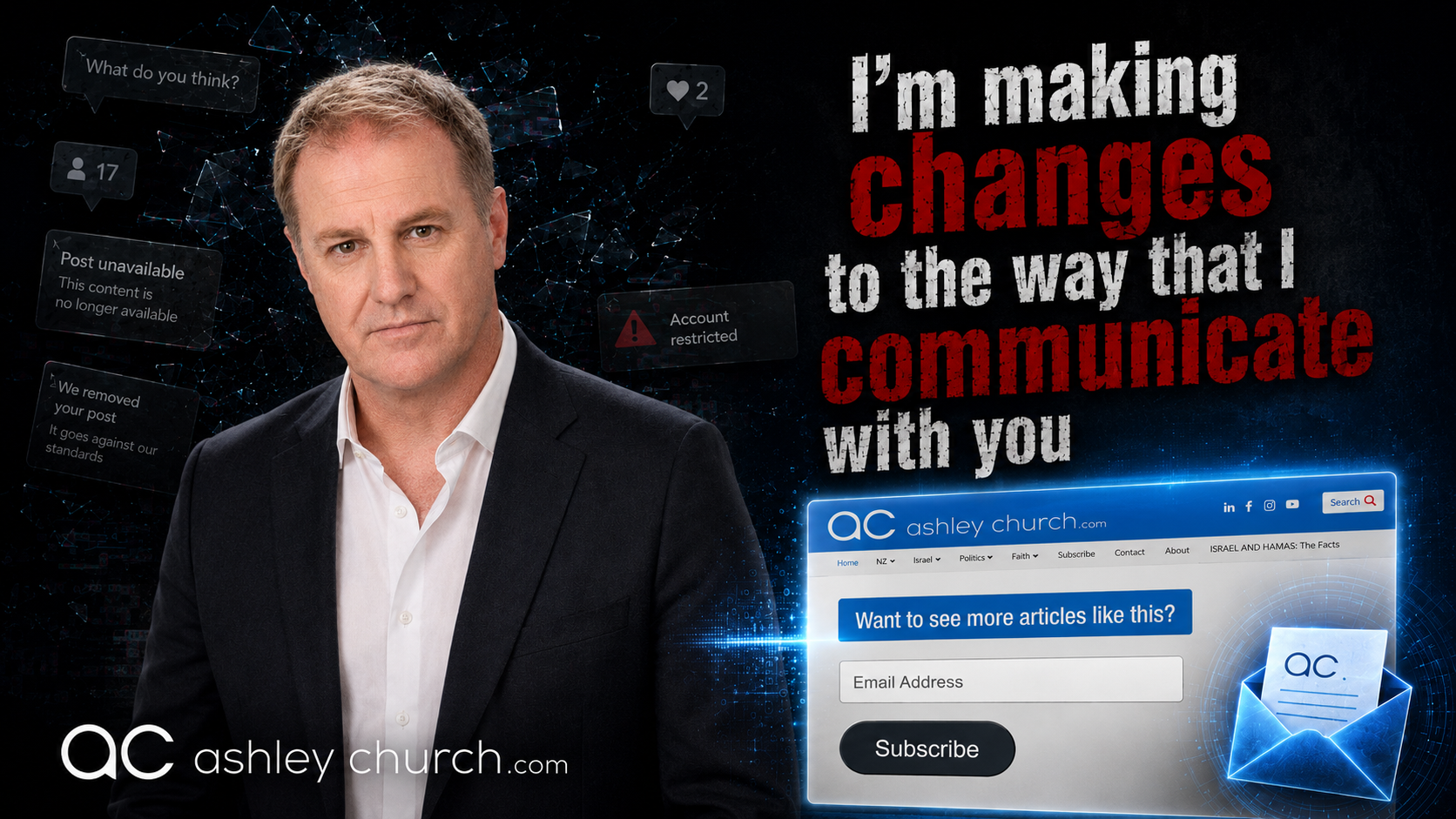
I’m making changes to the way that I communicate with you
Reducing the risk of social media oblivion
A few weeks ago, I wrote about something that happened to my friend Yifat Goodard – an Israeli New Zealander and one of the clearest public voices against antisemitism in this country.
Facebook had restricted Yifat’s access to her page in ways that were difficult to understand and impossible to justify and, at the time, I wrote about the absurdity of a woman who speaks against hatred being treated as though she was the problem, while the vile abuse directed at her and others seemed to continue almost unchecked.
Since I wrote that, things have got worse. Yifat’s appeal has now been rejected, and her Facebook account has been permanently closed. Gone. Years of connection, writing, advocacy, conversations, contacts and public work removed by a platform that has become far too powerful, far too opaque and, frankly, far too casual about the damage that it can do.
I have to be honest. The whole incident has shaken me.
For almost ten years now I’ve being talking to you about the Jewish people, antisemitism, bible prophecy, history, and the way these things connect to the condition of the world we now live in. That process didn’t begin with some carefully prepared master plan – I just followed the issues as I saw them and, over time, that developed into a fairly substantial audience across several different platforms.
But now realism is kicking in. If Yifat can lose her account, so can others. If someone as clear and careful as she is can be treated this way, then nobody who speaks publicly in this space should assume that they are somehow immune.
The whole thing has made me realise just how fickle the privilege of social media really is, and how tenuous our link can be with the audiences we build over many years. We like to think we are creating communities – and we are – but when those communities exist mainly on platforms controlled by companies that can restrict, suppress, suspend, or even erase an account with little real explanation, the relationship is more fragile than most of us want to admit.
Any one of us could wake up one morning and discover that our ability to communicate has simply vanished. That years of writing, argument, explanation, challenge, humour, history, prophecy and conversation could suddenly be cut off at the whim of a faceless social media platform.
So I have had to think seriously about my own online presence.
There are several options: I could retreat from the subject, soften what I say, avoid the controversial topics, or try to fit more comfortably into the acceptable opinions of the age.
But I’m not going to do any of those things.
If anything, what happened to Yifat has just made me even more aware of the enormity of the evil that we’re facing and has made me even more determined to persevere.
But there’s an important caveat: I need to do that in a way that reduces the power of social media platforms and strengthens my direct relationship with my readers.
Herein lies the serendipity. Over the past few days I’ve been watching and reading material from a highly successful online marketer who has been making exactly this point from a different angle: that the most important thing any writer, commentator, creator, or public voice can do is to build their own email list.
His point is simple. Social media platforms are useful, but they are not yours. Your email list is the one connection with your audience that you can properly control.
That landed with me because it matched what Yifat’s experience had already made painfully obvious.
So I’ve made a few decisions about how I’m going to communicate with you, going forward:
The first is that I’m going to put much more emphasis on getting people subscribed through ashleychurch.com.
This isn’t a plea for you to regularly visit my website – in fact the site is set up so that every new article I post there is automatically emailed to everyone on my subscriber list. It works in much the same way as a Substack column and it means that you don’t need to remember the website or hope that the social media algorithm happens to show you what I’ve written. If you’re subscribed, the article arrives in your inbox and you can read it, save it, forward it, ignore it until later, or do whatever else suits you.
If you’re receiving this by email, you’re already subscribed. If you’re not – I’d be grateful if you would visit ashleychurch.com, enter your email and click the big ‘subscribe’ button in the top right hand corner. That’s it – done.
This means that you’ll continue to have unbroken access to my articles – regardless of anything that might happen to my individual social media accounts.
I’ll still post on Facebook, LinkedIn and elsewhere, of course – and my email articles will usually carry a link to the same article on Facebook, so that you can interact as usual – but those platforms will be the back up, not the main event.
The second change is to respect my audience and write about what they most want to read: Israel and the Jewish people and on getting honest, factual and useful information into as many hands as possible. This focus will continue to incorporate articles addressing geopolitics and prophecy and my books (yes there are more coming) because these all relate directly to Israel – but there will be much less New Zealand political commentary on my own platforms because a large part of my audience is outside New Zealand, and those readers are not waking up desperate for another analysis of Christopher Luxon’s latest polling difficulties. On the rare occasion that I still do write about those things, it will only appear on Facebook or in third party podcasts – not in your subscriber email feed.
The next decision is that the tone and presentation of my writing will become more personal.
This has already started. The writing will be less formal, less like a newspaper column and more like a conversation with one person – and there will be more personal reflections, more anecdotes, and a clearer sense of the person behind the argument. The post imagery has also changed and now features a likeness of me within a broader theme. Trust me, putting your own pic out there is a bit of a mission for a kiwi bloke of a certain age but I’m doing it for a very specific reason: it makes posts and articles instantly recognisable.
I understand that these change in direction may not suit everyone. Some people originally followed me for New Zealand political commentary and others may not be especially interested in Israel, biblical prophecy, antisemitism, geopolitics, or the wider cultural themes I’ll be writing about more often. If that’s you, I completely understand if you decide to unsubscribe or stop following.
One last thought: if you are also a visible writer, commentator, advocate, or public voice on Israel and the Jewish people, I would strongly encourage you to think about adopting a similar strategy for yourself. Build your own list. Strengthen your direct connection with readers. Reduce your dependence on platforms that may not protect you when the mob comes calling. If that is something you’re thinking about, feel free to contact me and I’ll point you toward some of the resources I’ve found helpful.
Thank you for reading, sharing, challenging, encouraging, and occasionally correcting me when I deserve it – and I would be grateful if you would encourage others to visit ashleychurch.com and subscribe using the box at the top right-hand side of the page. As previously noted, once they are subscribed, they won’t need to go looking for new articles. Each one will arrive directly by email.
What happened to Yifat is a warning. I’m not backing away from the work, but I am going to be much more deliberate about protecting the connection that I have with those who want to keep reading it.
You can comment or ‘like’ this article on Facebook
Discover more from ashleychurch.com
Subscribe to get the latest posts sent to your email.
