
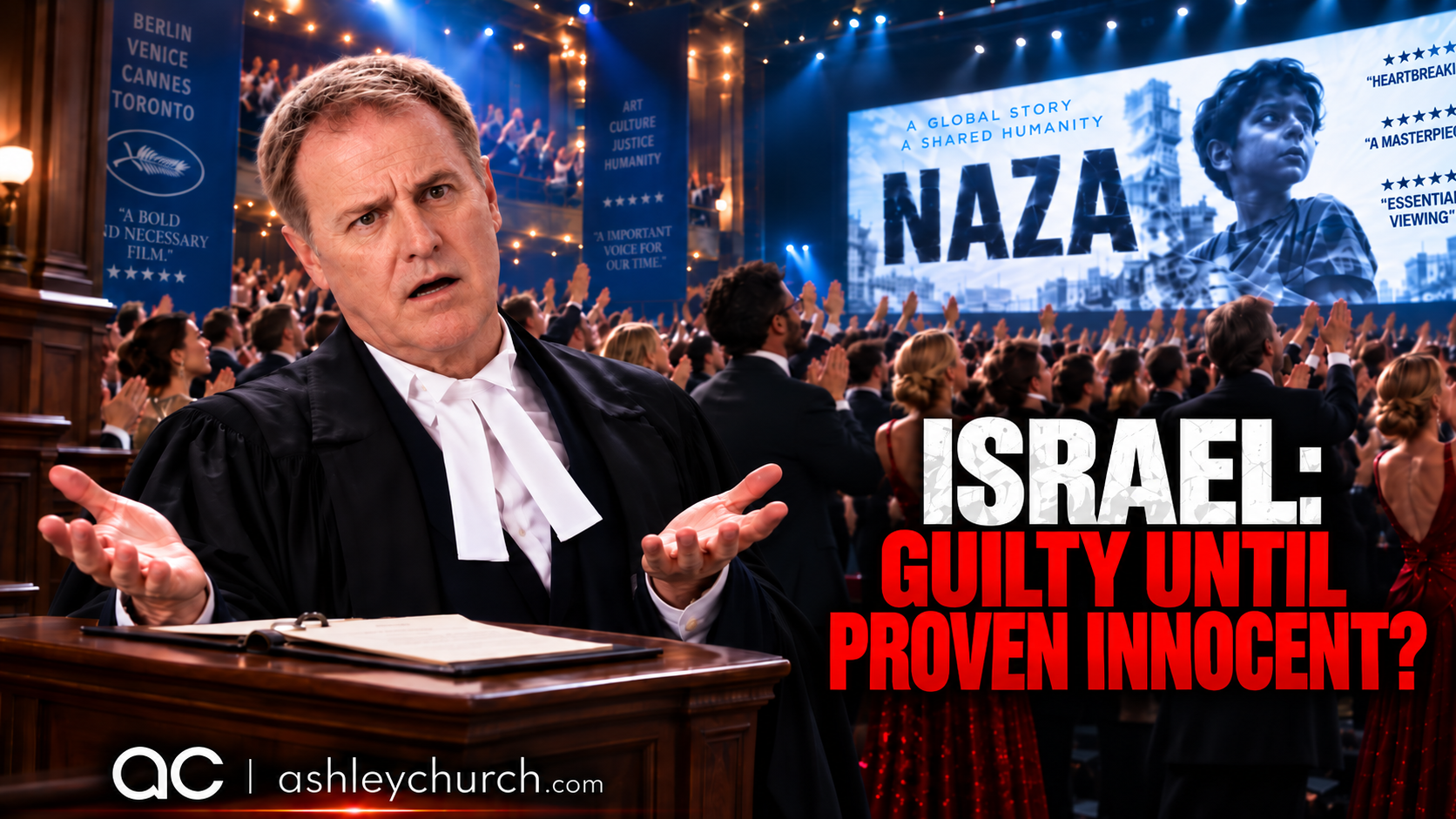
Israel: Guilty until proven innocent?
The hollow applause of the well-dressed mob
Imagine sitting in a courtroom listening to the opening statement in a murder trial. The prosecutor is compelling, the allegations are horrific, there are photographs of dead children, grieving families and destroyed homes, and by the time the prosecutor sits down you’re shaken.
Then something extraordinary happens. Before the defence has spoken, before a single witness has been cross-examined, before any documents have been tested and before any alternative explanation has been heard, the jury stands and applauds the prosecution for 25 minutes.
Shocking right? In such a case the judge would quite rightly dismiss the jury on the grounds that it had predetermined a verdict before ever hearing any evidence.
Yet that’s exactly what just happened at the Venice Film Festival held earlier this month. Following the screening of a new anti-Israel documentary called NAZA, the audience stood and delivered an almost 25-minute standing ovation.
So what was so compelling about this movie that it elicited such a powerful reaction?
Let’s hear the case for the prosecution.
At its heart, the movie – which derives its name from the Hebrew military abbreviation NAZA, referring to anticipated collateral damage – makes some pretty serious allegations. It claims that sophisticated computer and AI-assisted systems were being used by the IDF to identify potential targets in Gaza. It claims that civilian deaths were becoming increasingly accepted within the targeting process, that intelligence personnel sometimes knew homes contained children before strikes were carried out, and that Israeli planners approved attacks despite anticipating large numbers of civilian casualties. One anonymous witness in the movie even claims there was approval for a strike in which 500 civilians were expected to die.
The film claims to be based on testimony from 24 Israeli military and intelligence insiders whose identities have been concealed, with their faces and voices altered. So these aren’t Hamas spokesmen making accusations against Israel. They’re presented as Israeli soldiers and intelligence officers describing what their own military did.
This is all further compounded by the fact that the filmmakers were, themselves, Israelis – Yuval Abraham and Rachel Szor, who were both associated with the Oscar-winning No Other Land.
If all of this is true, it’s appalling, and the Venice audience certainly needed little persuading. Palestinian flags appeared in the theatre and two days later NAZA won the Special Jury Prize. Critics described it as a devastating exposé, with many treating its conclusions as settled fact.
So in our imaginary courtroom, the prosecution has delivered a spectacular opening statement.
Now comes the part that Venice seems to have skipped: Cross-examination.
The first problem appears before we even get to the substance of the allegations. The 24 supposed Israeli military and intelligence sources are anonymous.
The filmmakers and The Guardian (which was involved in producing the movie) say that their identities and testimony were verified, and that there is no reason to assume they’re lying. But The Guardian is an openly antisemitic publication which has a long track record of publishing anti-Israel claims without evidence – and, because the identities of these witnesses haven’t been disclosed, nobody outside the filmmaking team can independently establish whether each person actually served in the IDF, what role they held, when they served, or whether they were personally involved in the operations they describe.
That doesn’t make anonymous testimony worthless. Whistleblowers often need protection. But anonymity does change the evidential weight we can reasonably attach to extraordinary claims, particularly when the audience is being asked to draw conclusions about the intentions of an entire military establishment.
And there is an even bigger problem. The IDF says some of the claims attributed to these witnesses concern national strategy and high-level military policy that would simply be beyond the knowledge of junior soldiers. It also says that some testimony describes operational circumstances in which Intelligence Directorate personnel would not, by definition, have been involved.
That distinction matters enormously. An intelligence analyst may be able to tell you exactly what appeared on his computer screen, what information he processed and what instructions he personally received – but that doesn’t automatically mean that he knows what the war cabinet decided, what intelligence senior commanders possessed, what military advantage they were weighing, what legal advice they received or why a particular strike was authorised.
Being inside a large organisation might give you knowledge of your part of it – but it doesn’t necessarily give you knowledge of the whole.
Veteran Israeli investigative journalist Raviv Drucker challenged Abraham directly on this point. Abraham insisted that the identities of the witnesses and the incidents they described had been verified by the filmmakers and The Guardian, (which, as we’ve previously identified has a long pedigree of deliberate and institutional antisemitism) whose editors had access to the raw material. Drucker’s also noted that soldiers could sincerely describe events that later proved inaccurate or impossible to verify – so confirming that somebody served in an intelligence unit is not the same thing as confirming that their interpretation of military policy or strategic intent is correct.
Then we come to the central idea behind the film itself: NAZA treats Israel’s calculation of anticipated civilian casualties as something inherently sinister, as though attaching a number to possible civilian deaths demonstrates the existence of a machinery designed to kill civilians.
But there’s a large problem with that argument. Military forces operating under international humanitarian law are required to estimate anticipated civilian harm before attacking a legitimate military target. That is part of the proportionality assessment.
A commander is required to consider the military value of the target, estimate likely civilian harm and decide whether that harm would be excessive compared with the military advantage being sought. So calculating the likely number of civilian casualties isn’t evidence that civilians are the target – in fact that calculation exists precisely because they aren’t supposed to be.
Knowing civilians may die while attacking a military target is therefore fundamentally different from attacking civilians because you want them dead. Yet the film repeatedly blurs that distinction.
The 500-civilian claim is an even clearer example of why cross-examination matters. The IDF has flatly denied it, saying no attack was ever planned, approved or carried out in Gaza in which 500 civilians, or anything approaching that number, were anticipated to be killed.
So at present we have an anonymous witness making an extraordinary allegation, filmmakers saying the witness was verified, and the IDF categorically saying it never happened.
What we don’t have is anything that would settle the question: a targeting document, operational record, identifiable strike or other independent evidence showing that such an authorisation actually existed.
And 500 is hardly an incidental detail. It’s precisely the sort of number that makes an audience gasp, makes a headline scream, and helps establish the moral architecture of the entire film.
The same caution is needed with the film’s claims about artificial intelligence. Israel undoubtedly uses sophisticated computer systems to process huge quantities of intelligence and identify possible targets. The real question is whether AI itself chose people for attack or whether it generated intelligence that human analysts then assessed. Those propositions aren’t the same, yet they’re often presented as though they are.
Then there’s Hamas. Israel is in a war against an evil regime which routinely uses women and children as shields and it’s impossible to explain civilian casualties in Gaza while ignoring the fact that Hamas built military infrastructure through densely populated civilian areas, operated through tunnels beneath them and routinely fought without the normal separation between military and civilian space.
That context matters enormously when asking why civilians were close to military targets in the first place.
It’s also worth noting that we’ve seen this evidential shortcut before. A few months ago I wrote about a United Nations Commission of Inquiry report which claimed Israel was deliberately targeting Palestinian children. The report established that Palestinian children had died – but then made a much bigger claim, that Israel had deliberately targeted them.
Those aren’t the same thing. To establish deliberate targeting you need evidence of intent. You need to demonstrate that children were selected because they were children, rather than being tragically killed in attacks directed at military targets.
The UN report never convincingly crossed that evidential bridge and nor does NAZA. Both conflate civilian deaths with deliberate civilian targeting. Casualty estimates become evidence of an intention to kill civilians. Computer-assisted intelligence becomes AI choosing who lives and who dies. Testimony from individual personnel becomes evidence of institutional strategy.
The allegation gradually becomes the proof.
I’ve followed Israel and the Middle East closely for more than 25 years and one thing has become increasingly obvious to me. Much of the Western conversation about Israel isn’t built on detailed knowledge of how Israeli military operations actually work. It’s built on accumulated impressions. Headlines become assumptions, assumptions become accepted wisdom, and anything that confirms those assumptions is then received as revelation.
It’s a form of prejudice in which an audience is willing to believe something simply because it confirms what we already think about the accused – and that applies whether the audience is the placard waving crowd on the streets of western cities or the well-dressed mob at the Venice Film Festival.
NAZA isn’t evidence. In a truly evidential process, allegations are made, witnesses are tested, documents are examined, competing explanations are considered and only then should a verdict be reached.
Venice seems to have reversed that process – and the jury stood and applauded before the cross-examination had even begun.
Discover more from ashleychurch.com
Subscribe to get the latest posts sent to your email.
