
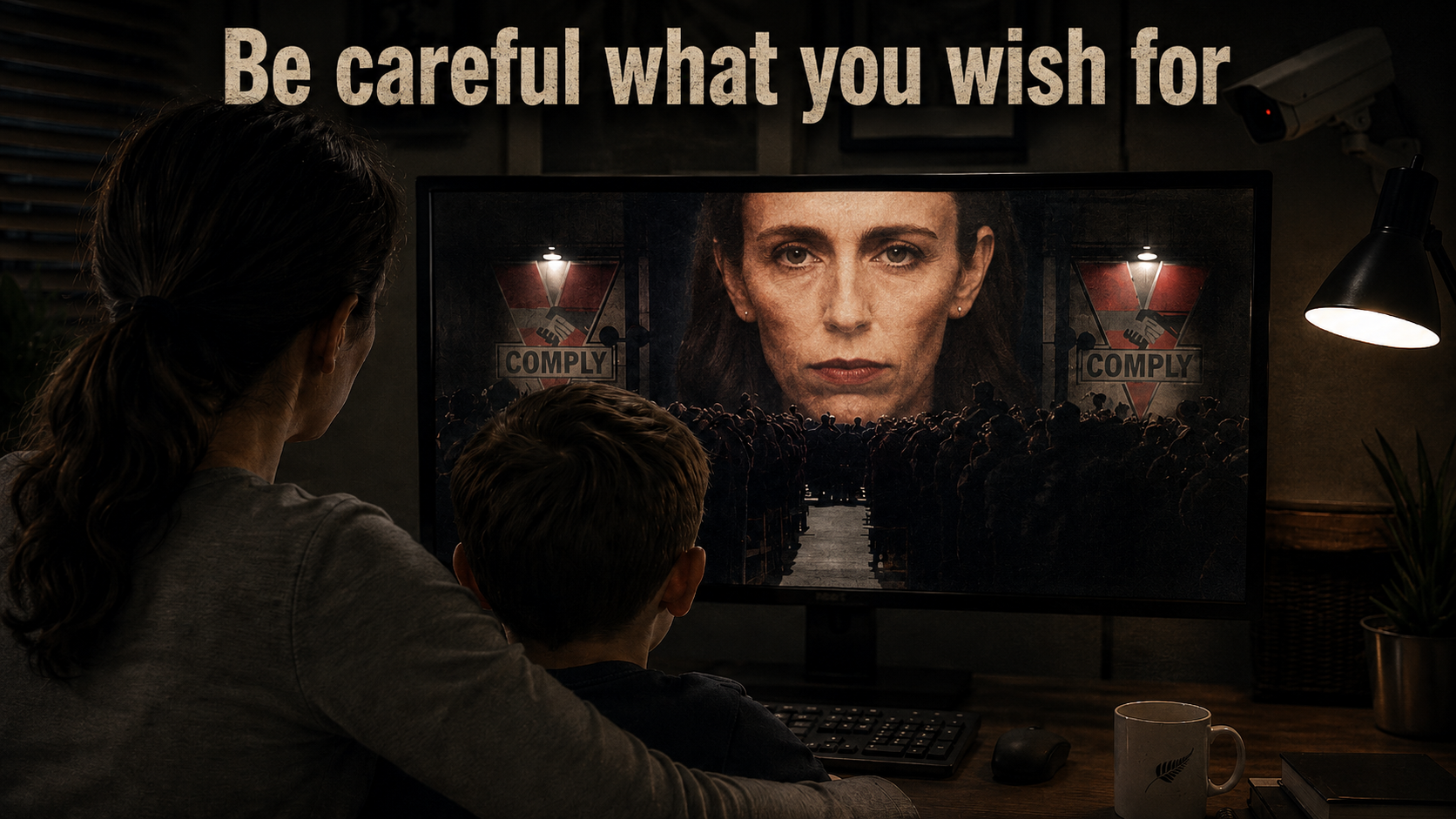
Be careful what you wish for
The frightening underside of digital reforms
New Zealand is in the early stages of a major debate about children, social media, digital identity and the future of online access.
Following the earlier introduction of a private member’s bill which would have required social media platforms to stop under-16s from creating accounts (now on hold), the Government is now moving toward the introduction of a much more comprehensive suite of digital ID measures to ‘address online harm’ and ‘introduce social media regulation’ – two phrases that should never appear in the policy platform of any centre right government, ever.
This program is also running in tandem with the introduction of digital driver licenses, the Govt.nz app, digital wallets and verification tools such as NZ Verify – all apparently harmless enough as separate initiatives but deeply concerning as a combined package.
And that’s the real issue.
Protecting our kids is a laudable goal – but not if it’s being used as the acceptable front door for a much larger digital identity and age-verification system, one that could eventually affect every adult New Zealander.
To be fair, it’s entirely possible that Erica Stanford’s intentions are good and that the Government believes exactly what it says: that this is about protecting children, simplifying services, modernising government, and making life easier for busy families.
But we won’t always have a centre right Government – and over the last 20 or 30 years, parties of the left have repeatedly shown that they do not have the same instinctive concern for free speech, public dissent, parental authority, religious conscience, or the right of ordinary citizens to resist official narratives, that the right does. The left is far more comfortable with state-directed solutions, regulatory control, speech policing, institutional coercion, and the idea that experts and officials should decide what is best for everyone else.
COVID proved that point. Jacinda Ardern’s Labour Government did not simply manage a health crisis. It showed how quickly a government convinced of its own virtue can run roughshod over the rights of the entire population.
Many New Zealanders have not forgotten that. They remember being told where they could go, who they could see, whether they could work, whether they could travel, whether they could enter public venues, and whether their private medical choices made them acceptable members of society.
That is why this issue is bigger than Erica Stanford’s intentions.
Once the state has digital identity tools, online age-verification systems, digital driver licenses, government wallets and verifier apps in place, a future government with a stronger appetite for speech control, behavioural regulation, ideological enforcement, “misinformation” management, or social compliance would not need to build the machinery from scratch. It would simply need to expand the permitted uses of machinery already in place.
That is a completely different debate, and it is one New Zealanders have not yet properly had.
It is not enough for ministers to say “trust us”, because New Zealanders have heard that before, and many have learned the hard way that trust should follow transparency, not replace it.
Which raises another important question – who asked for this?
If parents are demanding better tools to protect children online, then let us see the evidence. If the public is demanding digital identity systems, then publish the polling. If businesses and agencies are demanding verifier infrastructure, then disclose the submissions. If officials are already preparing implementation plans, then release the scope, providers, dates, costs and Cabinet papers.
Because, so far, the evidence points in the opposite direction. According to OIA material secured by The Centrist, digital driver license reforms were pushed as a major Government priority despite thin evidence of strong public demand and the government is building major identity infrastructure without a clear public mandate or serious democratic scrutiny.
Claiming that these initiatives are ‘optional’ doesn’t cut it. A digital driver license can be optional until venues prefer it. A government wallet can be optional until agencies process it faster. Age verification can be optional until platforms require it. Digital identity can be optional until banks, employers, insurers, travel providers or public services make it the practical default. So something can be legally optional and functionally compulsory.
No free society should casually build a system in which ordinary participation depends on state-approved digital verification. You don’t have to buy into an apocalyptic framework to see that a society in which people require a digital credential to buy, sell, work, speak, travel, bank, access services, or participate online is not something to be implemented frivolously.
That’s not a fringe view. It is the obvious implication of these measures and it deserves a serious answer.
The Government must now explain exactly what it is trying to achieve, what Erica Stanford’s wider programme involves and whether procurement to build the system has already begun. Has DIA recruited implementation staff? Is there a July 2027 implementation date?
If the Government wants New Zealanders to trust this process, it must start providing proof. It must stop the machinery, release the papers, explain the scope, protect anonymity, guarantee alternatives, and above all, avoid creating powers today that New Zealanders may bitterly regret tomorrow.
Protect children, yes. Give parents better tools, yes. Force platforms to take responsibility for genuinely illegal and harmful material, yes. But do not build a digital gate over public life and call it convenience.
Even if this Government has good intentions, that is not enough. Good intentions do not bind future governments, restrain future regulators, or protect citizens once the infrastructure is already in place.
And we’ve all seen where that goes…
Discover more from ashleychurch.com
Subscribe to get the latest posts sent to your email.
