
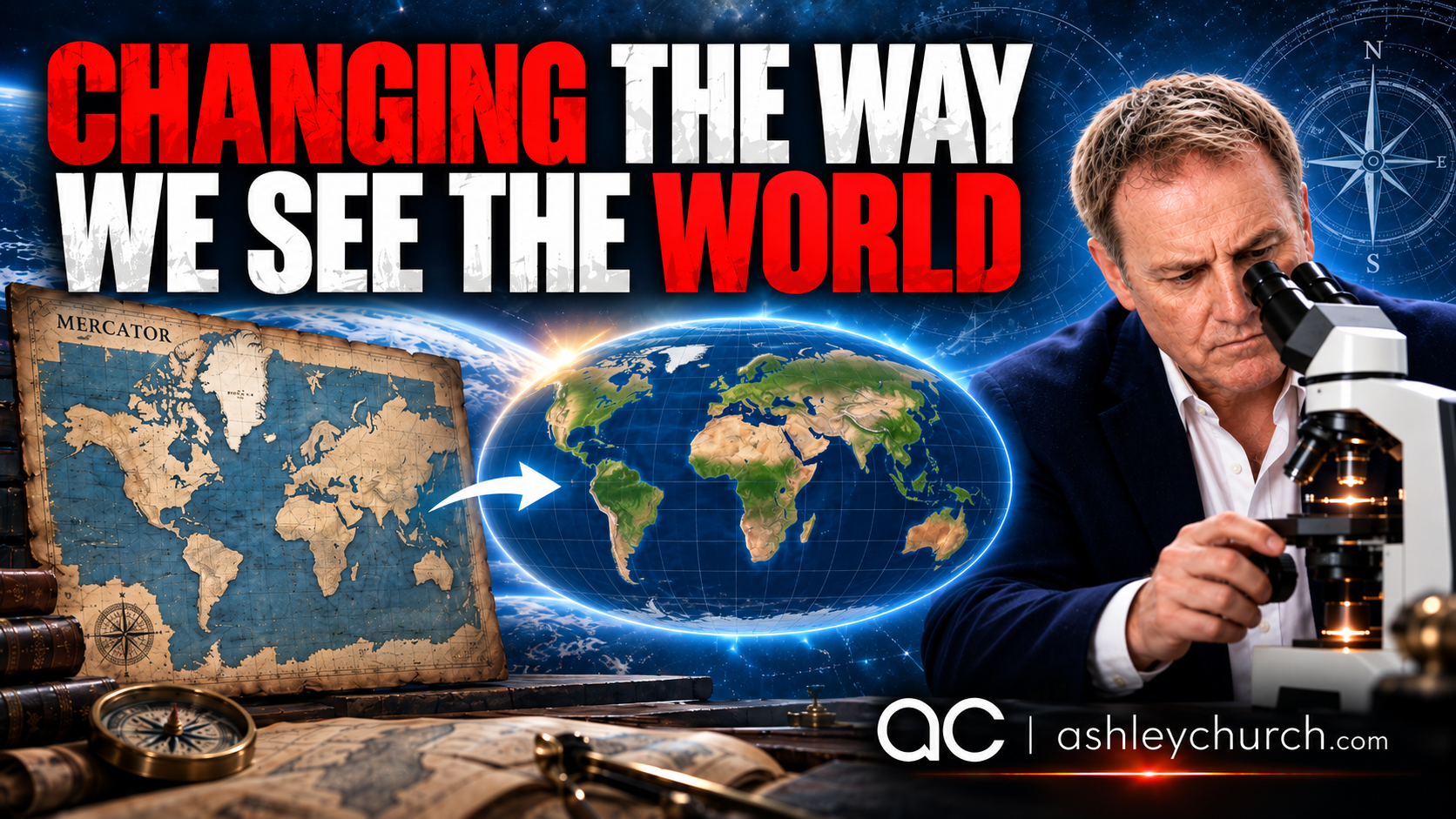
Changing the way we see the world
A lesson from a 16th century map.....
Over the past couple of weeks there has been an interesting development in the way that we represent the world.
On September 4, the United Nations General Assembly voted overwhelmingly to encourage governments, schools, international organisations and technology companies to use a map which more accurately represents the relative size of the world’s continents. The vote was 164 to one, with six abstentions.
The resolution doesn’t ban the familiar world map most of us grew up with, nor does it require anybody to replace it – but it recognises that that map, which has shaped our mental picture of the world for centuries, seriously distorts the relative size of countries and continents.
That familiar map is based on something called the Mercator projection, developed by Gerardus Mercator in 1569. On it, Greenland appears vaguely comparable in size to Africa, despite Africa being about fourteen times larger. Europe, Russia, Canada and other northern land masses are also dramatically enlarged because the distortion increases the further you move away from the equator.
The alternative map now being promoted, called Equal Earth, is designed so that countries and continents retain their correct relative area. Africa looks vastly larger, Greenland dramatically smaller, and the proportions of the world suddenly look a lot different from the picture many of us have carried around in our heads since childhood.
So how did we end up with a map which was so distorted relative to reality?
To answer that we need to understand what Mercator’s map was designed to do. Mercator was primarily interested in navigation and he was trying to solve a particular 16th century problem. Because the Earth is roughly spherical, any attempt to represent it on a flat surface has to distort something – so Mercator’s map traded off strict accuracy for a projection which would allow sailors following a constant compass bearing to represent that course as a straight line. For the purpose for which it was designed, it was an extraordinarily clever and useful tool.
However, over time, Mercator’s map gradually became the standard representation of the world itself. It moved from ships to atlases, classrooms, newspapers and television screens, and generations of us grew up unconsciously accepting its proportions as reality. Mercator hadn’t created a lie. We’d simply taken a tool designed for one purpose and, over time, asked it to become something it was never intended to be.
This perfectly epitomises an observation made by philosopher Alfred Korzybski: the map is not the territory. Ironically, Korzybski probably wasn’t aware of Mercator and wasn’t talking about maps literally. He was pointing out that a representation of reality isn’t reality itself and that a measurement of something isn’t the whole thing being measured. A framework designed to help us understand one aspect of something can be extremely useful, but trouble starts when we forget why it was created, overlook its limitations and begin treating the model as though it were the thing itself.
And once you start looking at the world through that lens, you discover that we’ve done this a lot more often than we might like to admit.
Take IQ. Intelligence testing was developed to measure particular forms of cognitive performance. Used properly, it can tell us something useful about those abilities. But over time IQ scores have become synonymous with intelligence itself, as though judgement, creativity, imagination, wisdom, determination, emotional perception and practical ability could somehow be compressed into one number. The original tool didn’t suddenly become useless. We just began asking it to tell us more than it was designed to convey.
BMI followed a similar path. The Body Mass Index gives us a simple relationship between height and weight and can be useful as a screening tool, particularly across populations. But it can’t distinguish muscle from fat and it doesn’t provide a complete assessment of an individual’s health. Again, there’s nothing inherently wrong with the measurement. The distortion comes when a useful indicator starts carrying more authority than its original purpose justified.
The same pattern becomes even more contentious when we start measuring cultural ideas.
DEI, or diversity, equity and inclusion, grew from a perfectly understandable objective. People shouldn’t be denied opportunities because of their race, sex or background, and institutions should be conscious of discrimination which might unfairly prevent capable people from progressing.
Measuring, and responding, the extent of that discrimination was entirely reasonable and most people would have little difficulty accepting it. But over time that framework has expanded. Equality of opportunity has become confused with equality of outcome and an approach designed to help us to see beyond race and sex has ended up making race and sex central to the way people are categorised and assessed. An original measure designed to reduce the importance of categories has ended up reinforcing them.
This has perhaps become most perverse in the area of gender identity. Studies that were originally designed to recognise that some people experience a profound disconnection between their biological sex and their internal sense of identity have morphed into the idea that the experience determines biological reality. Something that was once a framework developed to describe subjective identity has expanded into assertions about the objective categories of male and female and has started redefining the thing it was originally created to help us to understand.
Climate change provides yet another example of this phenomenon, but on a much larger scale. The original scientific questions being asked in the 70s were legitimate and important. Was the climate changing? Was human activity contributing to that change? How large was the effect likely to be, what consequences might follow, and what would constitute a sensible response? These early Climate models were designed to help scientists to understand an extraordinarily complicated system and explore ranges of possible future outcomes.
But over time, those models became intertwined with political, economic and moral claims which went considerably further than the underlying observation. Acceptance that human activity influences climate has become bundled together with acceptance of particular projections, particular assessments of risk and particular policy responses. A tool intended to help us understand possibilities is now be treated as though it is describing an inevitable future.
Again, the point isn’t that the tool has no value. It’s that the tool and the reality it was designed to investigate are not the same thing.
In every one of these examples the mechanism is broadly the same. Something is created because it’s useful. It measures something, explains something, identifies something or helps us to deal with a genuine problem. But, over time, we give the measure more authority. Its limitations become less visible, its application expands, and eventually the thing that was designed to help us to understand reality starts determining what we’re allowed to regard as reality.
Which brings me to what I think is the biggest example of all.
Science is one of the greatest intellectual achievements in human history. Through observation, measurement, experimentation and testing, we’ve acquired an extraordinary ability to understand the physical universe. We can describe the behaviour of matter at an atomic level, map the human genome, peer billions of light years into space, understand diseases which once killed millions and explain physical processes our ancestors could only wonder about.
But somewhere along the way, we replaced the thing we were measuring with the tool that we created to measure it.
Science is fundamentally a method for investigating the observable universe. It seeks to understand. It constantly identifies patterns, mechanisms and relationships, and then it tests whether our existing explanations survive contact with new evidence.
From a Christian perspective, that makes science part of our investigation of creation. Chemistry, physics, biology, astronomy and every other scientific discipline are ways of understanding the mechanisms operating within the universe that God created.
But over the past couple of centuries, science has increasingly been presented as though it sits on the opposite side of an argument from God. You’ve seen the debate countless times: science versus religion, evolution versus creation, scientific explanation versus God. The underlying assumption is that these are alternative systems and that, as science explains progressively more, God has progressively less left to do.
But science can’t explain creation – it can only observe and measure it. A chemical reaction doesn’t compete with God. Gravity doesn’t compete with God. DNA doesn’t compete with God. Neither do the mechanisms by which stars form, matter behaves or galaxies develop. Those mechanisms are part of the creation that we’re investigating – not an alternative to it.
And this certainly isn’t just my view. Some of the most important scientists in history have explicitly rejected the idea that scientific explanation and God must be competitors.
Francis Collins, who led the Human Genome Project and later headed the US National Institutes of Health, noted that “Science is the way to answer questions about the natural universe” but added that questions such as “why we’re here or whether there is a God” are not questions science itself can settle.
Cambridge theoretical physicist John Polkinghorne made essentially the same distinction from within physics. He described science as “the investigation of physical reality through a complex interplay of theory and experiment” and argued that questions about meaning, purpose and God operate at a different level of explanation.
Max Planck, one of the founders of quantum theory and a Nobel laureate, was more direct still: “There can never be any real opposition between religion and science; for the one is the complement of the other.”
Albert Einstein, hardly a conventional theologian, famously expressed the same refusal to treat the two as mutually exclusive when he wrote: “Science without religion is lame, religion without science is blind.”
And Isaac Newton, whose work transformed physics and our understanding of gravity, was explicit in the other direction. Writing about the ordered system of the sun, planets and comets, he said it could only proceed from “the counsel and dominion of an intelligent and powerful being.”
These giants of science didn’t all mean exactly the same thing by God, religion or creation, and they certainly didn’t agree on every theological question – but they all rejected the idea that discovering natural mechanisms somehow makes the question of God redundant because they all understood that explaining the mechanism is not the same thing as explaining away the Maker.
Imagine taking apart an extraordinarily complicated mechanical watch. You identify every component and establish precisely how the gears interact. Through trial and observation you gain an understanding of how energy moves through the mechanism, why the hands turn at exactly the rate they do and how each component interacts with every other component. Eventually there’s almost nothing about the operation of the watch that you can’t explain.
Would anybody seriously argue that your success in understanding the mechanism proves that there was no watchmaker?
Of course not. Science can only deal with the part of creation that is physically observable and measurable. It can explain how the watch works – but it can’t explain why time exists to be measured in the first place. It can measure matter, energy, chemistry and biological processes, but it can’t put meaning, consciousness, moral obligation, beauty, love, spirit or God into a laboratory and subject them to a controlled experiment.
Creation is vastly bigger than the portion of it that can be weighed, photographed, dissected or expressed as an equation, and confusing the limits of scientific observation with the limits of reality is to confuse the discovering of how something works with the idea that nobody made it.
Yet that is essentially the leap we’ve made with the universe. We discover a mechanism and call it an explanation. We identify a law and start treating the law as though it created the thing whose behaviour it describes. We become better at understanding how the machinery works and mistake that understanding for evidence that there was no Maker.
Science isn’t a competing system to God. It isn’t sitting on the opposite side of the ledger waiting to see which explanation survives. Science, itself, is part of God’s creation – a tool that He has provided to us to allow us to look behind the curtain and see a small part of His majesty and genius.
And Scripture makes the distinction beautifully. Writing to the Colossians, Paul describes creation as encompassing not only what we can see, touch and measure, but everything beyond the reach of those instruments:
“For by him were all things created, that are in heaven, and that are in earth, visible and invisible…” Colossians 1:16, KJV
Which brings us back to Mercator.
Mercator gave us a brilliantly useful way to map part of reality, but the map was never the reality itself. Science gives us an incomparably more sophisticated way to observe, measure and understand the visible universe, but it remains a tool for examining creation, not an alternative explanation for its existence.
Science may one day explain every observable mechanism in creation, but that will no more explain away the Creator than understanding every note of Beethoven’s Ninth would explain away Beethoven….
Discover more from ashleychurch.com
Subscribe to get the latest posts sent to your email.
