
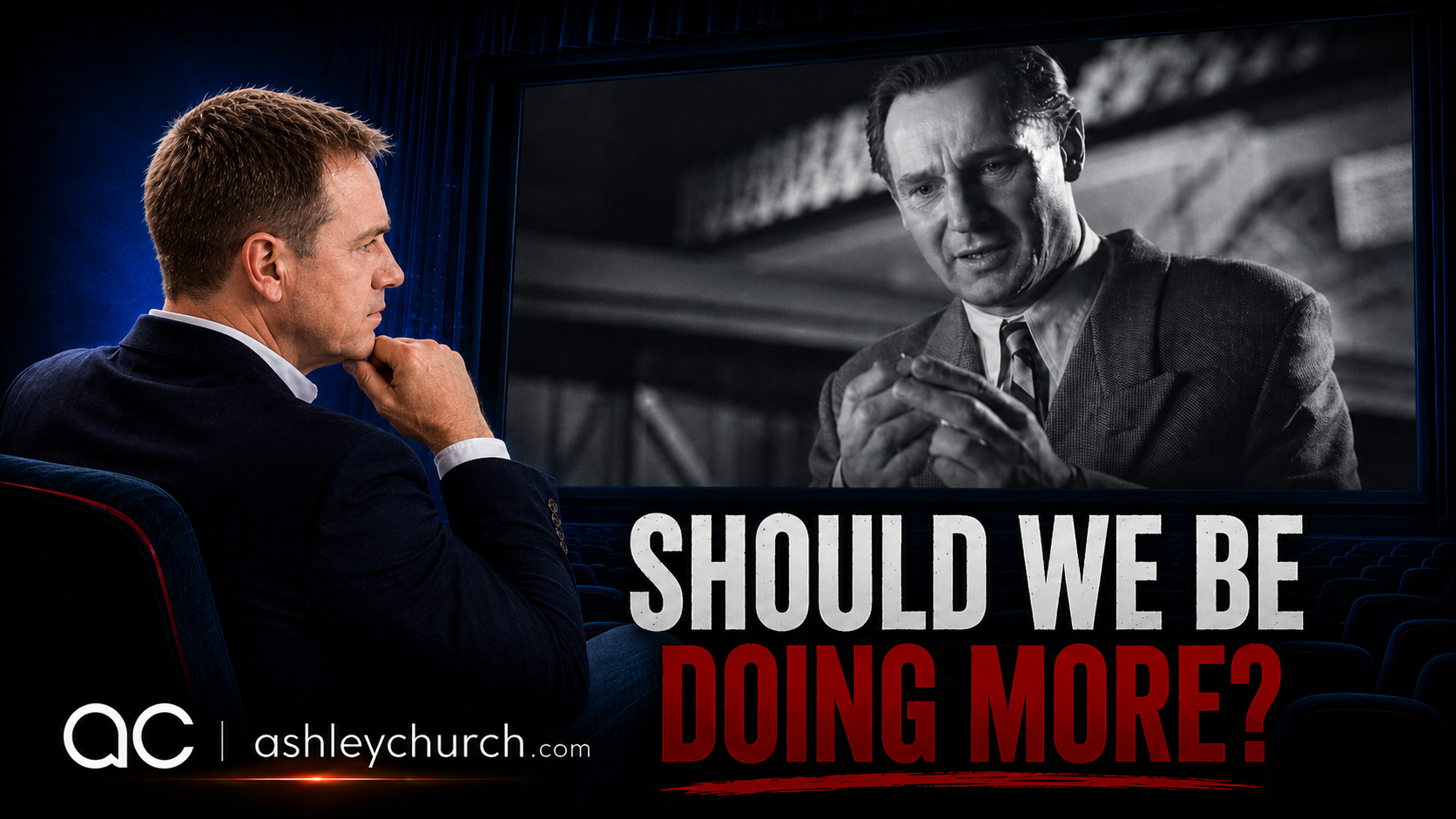
Should we be doing more?
Are you doing everything that you're called to do?
Most of those reading this will probably have seen the 1993 movie Schindler’s List, starring Liam Neeson and based on the actions of Oskar Schindler, the German industrialist who saved more than a thousand Polish Jews from the Nazi death camps during the Second World War.
The real-life Schindler was a complex and flawed character whose initial motivations were probably more economic than moral. But as the war raged on and he witnessed, first-hand, the atrocities being committed against the Jews of Poland, there’s no doubt that his focus changed and became increasingly about saving as many Jewish lives as possible.
This is perfectly encapsulated in what is, for me, the most powerful scene in the movie. It takes place near the end, after Germany has been defeated and Schindler is preparing to leave one of his factories, surrounded by hundreds of the Jewish people he has saved.
As he looks around, a terrible realisation seems to come over him. He looks at his car and thinks about how many more people it might have bought. He looks at the gold pin on his lapel and wonders whether it might have saved another life. Despite everything he has done, he is overwhelmed by the thought that he might still have done more.
Captured in that one moment is the remorse and regret of all those who tried to help the Jews during the Second World War, coupled with the question that must have haunted many of them for the rest of their lives: could I have done more?
For most of my life, that seemed like a question from another age. The Holocaust stood as a warning from history, a reminder of what happened when hatred was allowed to grow unchecked and when too many people looked away. But we told ourselves that that was in the past. That antisemitism had been driven to the margins. That the conditions which made such evil possible could never return.
Then came October 2023 and, in its wake, the most rapid onset of evil in modern history.
Antisemitism has returned with a speed, confidence and legitimacy that should alarm every decent person. Once again, Jewish people are being vilified, intimidated and isolated. Israel is not simply being criticised – it’s very right to exist is being questioned, while those who openly seek its destruction are excused, defended or celebrated.
Old hatreds are being repackaged in the language of human rights and social justice, then carried into universities, workplaces, churches, media organisations, political movements and public streets. People who normally pride themselves on opposing racism and bigotry become remarkably selective when the targets are Jews.
This was not a passing moment – it is still happening now. The hostility is real, the misinformation is still spreading, and Jewish people are still being expected to justify their existence and defend themselves against accusations that would never be applied to others.
As such, we are now living through a period in which the question posed by Schindler’s story has become urgent again.
Should I be doing more?
That is a particularly confronting question for me. As a Christian, I’ve understood for a long time that standing with the Jewish people is not optional. My faith is rooted in their history, their Scriptures and their Messiah, and I’ve always known that Christians owe an incalculable debt to the people through whom God chose to reveal Himself to the world.
But for much of my life, I failed to make that responsibility a genuine priority. I had time, opportunities, platforms, relationships and resources that could have been used more deliberately, but too often I spent them on things that mattered more to me at the time. I was busy building careers, organisations, businesses and a public profile, and I allowed ambition, recognition and the spotlight to crowd out things that were far more important.
The result? At 62, I look back, with horror, on so many missed opportunities and so many chances that I had to impact on the lives of others as my God reaches down and whispers in my ear, “You could have done more”.
For me, that admonishment resonates most loudly in respect of my defence of Israel and the Jewish people – something that God has increasingly pressed on me since around 2017. But even then, the change was neither complete nor especially clean. I was involved, but often on the fringes, and the commitment sat alongside the same ego, distractions and competing ambitions that had shaped so much of my life.
There were times when I spoke and acted, but many more when I could have done more. There were opportunities to learn more, say more, correct misinformation and use my influence more deliberately, but I still allowed fear, self-interest and other priorities to determine the intensity of my involvement.
It has really only been since October 2023 that I’ve really begun to understand the full weight of what is happening to the Jewish people and to Israel, and to respond with anything approaching the urgency and passion that the moment requires.
That is not a claim to virtue or a neat story of transformation. It is an admission that I understood the responsibility long before I was willing to give it the place in my life that it deserved – and I doubt that that failure is unique to me.
There will be many people reading this who have also understood, at least in principle, that standing with the Jewish people matters, yet have never allowed that belief to become a serious priority.
We may have agreed privately, shared the occasional article or expressed support when the subject came up, but still kept the issue at arm’s length because other things seemed more urgent, more comfortable or more personally useful.
Some of us have been too busy. Some have been afraid of conflict. Some have worried about professional consequences or what friends and family might think. Others have simply assumed that somebody else, with a bigger platform or greater knowledge, would do the work.
Those excuses are understandable. They are also inadequate.
Once we understand what is happening, the question becomes unavoidable.
Are we doing enough? Are we using our talents, resources, relationships and opportunities? Are we speaking when we should speak, correcting misinformation when we encounter it and supporting Jewish people when they increasingly feel abandoned?
Or are we still finding respectable reasons to leave the work to somebody else?
There is no point in crying over spilt milk. The opportunities we wasted are gone and the years we failed to use properly are not coming back. Regret has value only if it changes what we do next.
The real question is what we do from today. Schindler had factories, money and access to powerful people. Most of us do not, but that misses the point. The issue is not whether we have what he had. It is whether we are using whatever has been placed in our own hands.
We all have conversations, friendships, families, churches, workplaces and professional networks. We have opportunities to correct a false claim, share reliable information, support a Jewish friend or refuse to remain silent when antisemitism is disguised as political virtue.
We can speak when others are silent. We can challenge churches and organisations when they cross the line from legitimate criticism into hostility toward Israel and the Jewish people. We can support those who take a stand and let Jewish friends know that they are not alone.
These may seem like small things, but small things matter when enough people do them.
There are already courageous people doing exactly that, often at considerable personal cost. They lose friendships, opportunities and standing because they have chosen to speak. They deserve our respect, but there need to be many more of them.
Schindler did not begin as a hero. He began as a man looking after his own interests, but as the enormity of what was happening became clear, he understood that he no longer had the luxury of standing by.
That is the moment in which many of us now find ourselves. We may not have understood the full significance of what was happening at first, but by now there is enough evidence for anyone willing to look.
The Jewish people are once again looking around the world and asking who will stand with them. We may not be able to change everything, but we can all change something, and the cumulative effect of thousands of people speaking, correcting, supporting and refusing to remain silent could move the dial far more than we imagine.
One day, we will all stand before our Creator and He will ask us what we did with the opportunities that were available to us.
When that day comes, none of us should want to be left with the same terrible question:
Could I have done more?
Interact with this article on Facebook by clicking here
Discover more from ashleychurch.com
Subscribe to get the latest posts sent to your email.
