
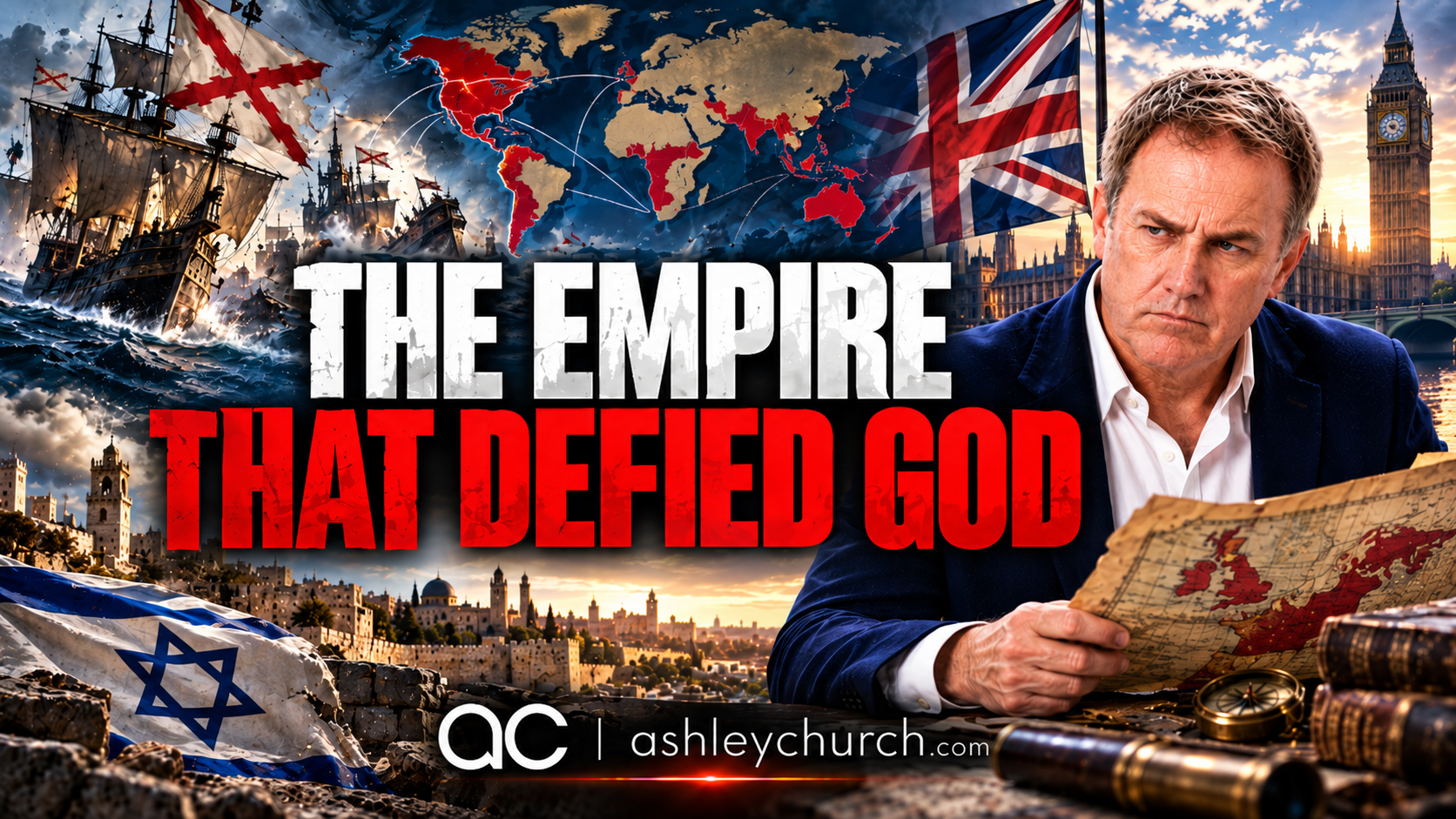
The Empire that defied God
How a centuries old blessing can disappear within a generation
As we take stock of the world in 2026 there is something deeply disturbing about the places in which hostility towards Israel and the Jewish people has most strongly taken root.
It’s not in the Middle East. Yes, Iran and its proxies are still dedicated to the destruction of the Jewish state, but over the past few years most of the nations of the Arab world have actually built practical relationships with Israel. The United Arab Emirates maintain diplomatic and commercial cooperation, Egypt’s peace treaty has survived for decades, and Jordan and Saudi Arabia have both recognized their common security interests with the Israeli state.
But in the west the situation is very different. Governments beat their chests in faux angst about the ‘plight of the Palestinians’ while vehement campaigns of hate play out amongst civilians and intimidation and violence surge against the Jewish people. Across Europe, North America and Australasia, Jewish communities face threats that would once have seemed unthinkable in countries that pride themselves on tolerance.
But this isn’t happening in a vacuum. History teaches us that hostility towards the Jewish people has consequences – and to understand how serious those consequences can be, let’s consider the fate of the greatest empire that has ever existed.
There have been many claimants to that title in history. Some might point to Babylon, Greece – whose influence outlived its conquests by thousands of years – or Rome, the glorious empire that spread from the British Isles to Africa. Others might even point to the modern United States.
All would be wrong.
If greatness is measured by territorial reach, and the enduring influence of language, culture and institutions, one empire towers over the field.
At its height, the British Empire dwarfed them all. It covered roughly 35 million square kilometres – a quarter of the worlds land surface – making it almost half as large again as its nearest rival, the Mongol Empire. No other empire in recorded history has come close to matching that reach. As darkness fell over one of its territories, morning was breaking over another. The saying that the sun never set on the British Empire was a description of its astonishing geography.
But just as significant as its size is the story of how Britain came to be the centre of an empire without historical equal – because the powerful British Empire started with an event which, by any rational measure, should have destroyed it.
In 1588, another superpower had England in its sights: Spain. It commanded an immense overseas empire and formidable military resources. In power and prestige, Spain was the United States of its day and was also the leading armed champion of Catholic Europe. Now it was assembling a fleet of around 130 ships to help invade Elizabeth I’s kingdom, remove its Protestant queen and restore Catholic rule.
England had broken with Rome 54 years earlier in 1534 under Henry VIII – and Henrys son, Edward VI, had continued those reforms. These were then briefly reversed by Mary, before becoming firmly established under Elizabeth. But now, in 1588, what had taken decades of struggle to secure could now be overturned by invasion. For Protestant England, this was a battle for the soul of the world. The survival of a nation increasingly committed to the authority of Scripture was being challenged by a power determined to return it to obedience to the errors and tradition of Rome. The future spread of the Protestant gospel hung upon a kingdom whose survival was suddenly in question.
And then, as the Spanish Armada attacked, God intervened.
To be fair, the English fought with courage and skill. Fireships scattered the Armada from its anchorage at Calais, and English guns battered it at Gravelines. Unable to return through the Channel, the Spanish fleet was forced north and up around Scotland and Ireland. There, the real damage was done. Atlantic storms drove ships onto unforgiving coasts. Ireland alone accounted for the loss of some 26 vessels. At Streedagh, three ships were wrecked with the loss of more than 1,100 lives.
The fleet sent to impose Philip’s will returned to Spain battered, its invasion abandoned. The might of Spain had been unable to overcome the winds.
The people who lived through it immediately recognised Gods deliverance. A Dutch commemorative medal struck that very year placed the name of Jehovah in Hebrew above the fleets and declared, “He blew and they were scattered.” Centuries later, Britain’s national Armada memorial at Plymouth would carry the same understanding: “He blew with His winds and they were scattered.”
God had preserved Protestant England.
Spain remained dangerous for a few more years – but further armadas in 1596 and 1597 were also scattered by storms – and eventually Spain accepted that it had failed to extinguish Elizabeth’s kingdom at a moment when the consequences could have changed the religious history of the world. England’s Protestant future survived, and with it the possibility of the immense work that lay ahead.
Over the next few centuries Britain was enormously blessed, far beyond anything that its people could have imagined in the 16th century. It became the world’s first industrial nation. Steam engines drove its factories, railways transformed its landscapes, and its ships carried manufactured goods into distant markets. Wealth and invention reinforced each other, while a dominant navy connected possessions separated by entire oceans.
Other European powers pursued greatness, but none built an empire of comparable territorial vastness. From a small collection of islands off Europe’s western coast emerged a power whose decisions shaped lives on the other side of the planet. Christ’s command to “go into all the world and make disciples of all men” underpinned British foreign policy for hundreds of years as the English carried British values and a Protestant understanding of the gospel into every corner of the globe with “trade in one hand and a bible in the other”.
Early British missionaries travelled into unfamiliar lands, learned languages and translated Scripture. They opened schools and taught people to read. They also trained local converts to become teachers and evangelists themselves – carrying the message of the Gospel into communities that foreign missionaries could never have reached alone.
The effect was literally lifechanging. In Fiji, Christian conversion helped communities abandon cannibalism and the strangling of widows. In India, the campaign against sati confronted the burning of widows on their husbands’ funeral pyres. Indian reformers, including Ram Mohan Roy, helped also persuaded British authorities to prohibit the practice in Bengal in 1829.
But these are just samples of a much longer list and it’s important that we remember these reforms because, even as I write, the impact of so called ‘colonialism’ is portrayed as the forced imposition of British values on benign and noble peoples whose greatness was interrupted by rampaging British greed and arrogance. But tell that to the millions of women who were spared from the flames, avoided strangulation, or literally avoided being eaten as the result of Christian reform. Tell it to the almost one million people who were freed when Britain turned its power against the slave trade, finally abolishing slavery throughout the empire in 1807 – and thereafter using British warships to pursue those who continued trafficking human beings.
And there’s another group that also benefitted from British might: the Jews. Medieval England had persecuted Jews -and in 1290, Edward I had even expelled them – but the country that emerged from the Reformation had gradually began taking a different path. In 1656, under Oliver Cromwell, Jews were permitted to re-establish an openly practising community in England. They could meet for prayer and establish burial grounds. Families whose histories included flight from the Spanish and Portuguese Inquisitions could begin building a future in a Protestant country.
Yes, the advance towards equality was uneven, and prejudice remained – but the direction mattered. In 1846, legislation extended Jewish rights in education, property and charitable administration. In 1858, Lionel de Rothschild finally took his seat in Parliament as a practising Jew.
Then came a responsibility that should have been the crowning expression of that earlier work: helping the Jewish people return to their homeland. Following the defeat of the Ottomans in WW1, the British took control of the Holy Land and, in November 1917, the Balfour Declaration announced British support for a national home for the Jewish people in the region known as Palestine, while protecting the civil and religious rights of existing non-Jewish communities. So the empire that had carried the Jewish Messiah’s gospel across the oceans now held authority in the land from which that gospel had come and – after centuries of scattering and persecution – the Jewish people finally had before them the prospect of national restoration.
Then everything changed. The protection of imperial interests increasingly took precedence and regional pressure and strategic calculations caused the British to backtrack on their promises to the Jews – culminating in a 1939 White Paper which limited Jewish immigration to the Holy Land to just 75,000 over five years. The Paper also stipulated that preference would be given to Arab immigration thereafter. In other words – just as Nazi persecution intensified, Britain restricted a route of escape to the Jewish homeland.
Then came the Shoah. Six million Jews were murdered. Families were transported to death camps, shot into mass graves, or died through starvation and forced labour. Entire communities were erased in the worst catastrophe in the Jewish people’s long history – the tail end of a 1,260 year period that the New Testament refers to as The Great Tribulation.
Then, when the killing finally stopped and the survivors emerged into a Europe filled with graves and the ruins of their former lives, Britain continued to restrict their entry into the land that had been promised to them as a national home. A power that had once offered refuge and protection, and had even encouraged Jewish return, was now using its authority to obstruct that return at the moment of greatest need.
Between August 1946 and May 1948, British authorities intercepted more than 50,000 Holocaust survivors attempting to reach the Holy Land and interned them in Cyprus. Survivors who had endured the destruction of European Jewry once again found themselves held behind barbed wire.
In 1947, the British intercepted the Exodus, carrying more than 4,500 Jewish refugees, including Holocaust survivors. Its passengers were eventually transported back to Germany and interned in the British occupation zone. Try to comprehend that journey. Having survived the catastrophe that had consumed their families and communities, people seeking a future in the Jewish homeland were forcibly returned to Germany.
The grotesqueness of that policy is difficult to absorb. Britain had helped defeat Nazi Germany, yet its government chose to obstruct the survivors’ passage to the land it had once undertaken to help restore as their national home.
The empire that had received extraordinary blessings was now it was using its authority against a people whose return God had promised. The Protestant power that had once resisted Rome’s claims was increasingly reproducing the abuse it had condemned – placing its own interests above the word of God.
But God is not mocked. Genesis 12:3 declares God’s blessing upon those who bless Abraham and His curse upon the one who curses him. Ezekiel 36 and 37 promise regathering and restoration. Jeremiah 31 affirms Israel’s enduring place before God. Joel 3 describes nations being called to account for their treatment of His people and His land.
Britain had placed itself in opposition to those purposes, and the consequences, which would unfold over the following decades, were inevitable.
In my recently published book Prophecy Shock, I explain how Daniel’s visions trace the succession of powers controlling Jerusalem and how Daniel 7’s little horn describes Britain in the closing years before Jewish national restoration. The chapter describes the removal of the opposing dominion and the kingdom being given to the holy people.
Daniel 11:40–45 goes into even more detail and carries the account through Ottoman defeat, British control and its eventual end. Read together with the wider prophetic chronology, the geography and historical events are identified in extraordinary detail leaving no doubt as to who Daniel was writing about.
Readers familiar with other interpretations may find that identification surprising but it Is all there in black and white for those with the ability to comprehend it. (“Those who are wise will understand”)
The rest is history. British rule of the Holy Land ended in 1948, and the loss of its empire was already underway with India and Pakistan becoming independent the previous year. Across the decades that followed, that trend gathered devastating momentum. The wealth that had once sustained imperial ambition had been drained by war. Debt narrowed Britain’s freedom. Independence movements challenged its authority, while the United States and Soviet Union displaced it at the summit of world power.
American pressure against imperial trade preferences and support for self-determination further weakened the old order. These pressures formed part of the consequences through which Britain’s position unravelled.
Decolonisation continued through Africa, Asia and the Caribbean and, within a generation, an empire assembled over centuries had surrendered most of its possessions.
Historians can describe each independence movement and each political decision to explain how these events unfolded. But only Scripture explains why it happened. The British Empire brought judgment upon itself by disobeying God over the Jewish people. Its retreat was the working out, through human history, of consequences that no accumulation of past achievements could prevent.
Centuries of blessing had given Britain enormous opportunity – but that couldn’t withstand the consequences of defying the One who had blessed it.
That warning continues to have relevance to us in 2026. As we look at economic insecurity, deepening political division and the fraying of social trust we need to understand why these things are happening to the West. The lesson of the Britain Empire demands that we examine the choices our nations are making before God.
When societies that inherited so much from Christianity become places where Jews are intimidated, synagogues need protection and hostility towards Israel becomes a badge of political virtue, we should be asking what follows.
Britain’s experience shows how consequences can unfold through events that appear, individually, to have entirely practical explanations. A nation can be losing the future it once took for granted while remaining convinced that each setback is merely another problem to manage.
The blessings of previous generations provide no permanent protection against the consequences of present decisions. God has never promised that prosperity will survive a nation’s determination to defy Him.
If the greatest empire in history could destroy its own future by defying God over Israel, what makes us imagine that we are exempt?
Comment on this article on Facebook
Comment on the article on LinkedIn
Discover more from ashleychurch.com
Subscribe to get the latest posts sent to your email.
