
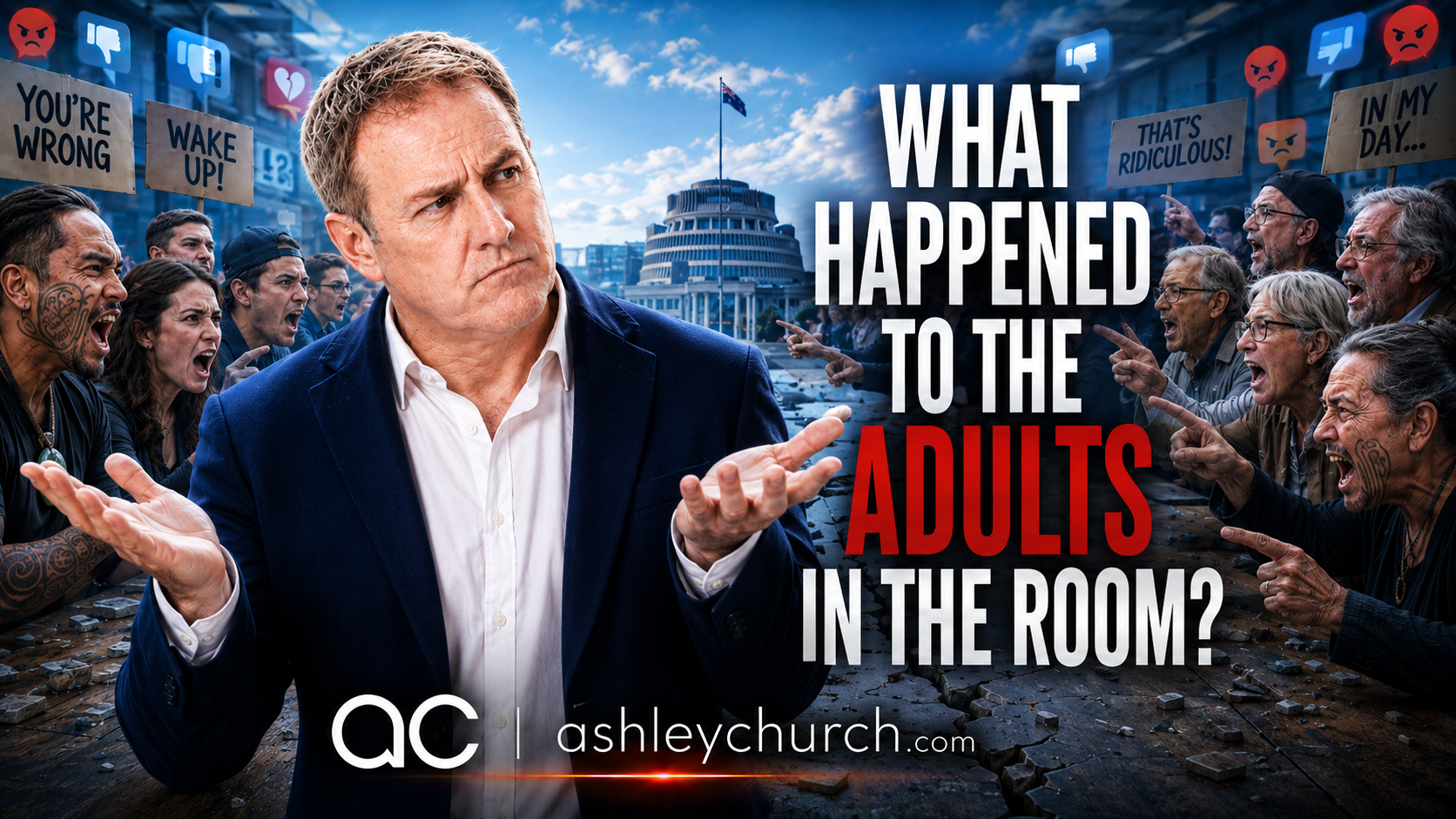
What happened to the adults in the room?
Winning the battle but losing the war
Back in the mid 70’s I used to regularly watch a British science-fiction tv series called The Tomorrow People (the original – not the remake).
The premise was irresistible to a kid of my age. The Tomorrow People were young people who had begun to “break out” into a new stage of human evolution. They could communicate telepathically, move objects with their minds and teleport from one place to another. Equally importantly, they were smarter, more capable and they represented the future – a generation that would rise above the limitations and failures of those who had gone before them.
And, sitting there watching it in 1974, that meant my generation. We were going to inherit the world and make it better.
And we certainly tried. We challenged things. We protested. We pushed for change. We questioned institutions and assumptions that our parents had largely taken for granted, and we helped reshape society in ways that we genuinely believed represented progress.
Some of those changes unquestionably made the world better. Others may look rather different with fifty years of hindsight. But the point is that we believed in what we were doing.
Which is why, at 62, I shouldn’t be too dismissive of young people who look at the world we’ve handed them and decide that they can do better, too.
I understand the impatience. I understand the certainty. I understand looking at an established way of doing something and wondering how the people in charge could possibly have failed to see a better alternative which seems so obvious.
I understand it because I remember it.
But there is also something different. While there was plenty of disagreement when I was young – protests, political arguments enormous social changes and parents who didn’t agree with everything my generation believed – I don’t remember the same degree of hostility.
Undoubtedly part of that was practical. My parents didn’t have Facebook, X or an endless stream of videos arriving on a phone in their pocket telling them what some 22-year-old thought about the world. They weren’t given the opportunity, dozens of times a day, to become angry about it and immediately tell everyone why.
But I also wonder whether there was a little more wisdom involved. While my parents’ generation probably rolled their eyes and thought some of our ideas were ridiculous – I think many of them understood that being young involves an amount of certainty about things you haven’t yet had enough life experience to test and that, ultimately, life would do some of the arguing for them.
Time has a way of sanding the sharp edges off certainty.
Work changes you. Responsibility changes you. Raising a family changes you. Paying bills changes you. Watching apparently perfect ideas collide with imperfect human beings changes you.
And I wonder whether my generation (including me) has forgotten that most young people eventually work those things out on their own.
Instead of providing distance and perspective, we’ve climbed into arguments that our parents stayed out of. We defend our ground, answer every challenge and push back against people forty years younger than us as though every disagreement has to be settled immediately.
And perhaps that is part of why everything now feels so much more angry?
Which brings me back to The Tomorrow People. There was an episode of the show that has stayed with me for more than five decades. It was called The Blue and the Green. In it, ordinary people became divided into two groups and started turning against one another. Blues hated Greens. Greens hated Blues. People who previously had no reason to dislike each other became angry and eventually violent simply because they belonged to opposing sides.
And what fascinated me when I went back and looked at the story again, was how little substance there was to the division itself. The colour – the badge – was enough.
Once someone became a Blue or a Green, the people wearing the other colour stopped being friends or family members with a different point of view. They became the enemy.
And the idea wasn’t new. In sixth-century Constantinople, supporters of rival chariot-racing factions known as the Blues and Greens developed loyalties which spilled far beyond sport into politics, identity and eventually terrible violence.
Human beings, it seems, have always been remarkably good at finding reasons to divide themselves.
To be fair, not all of the divisions we see today are generational. Political ideology has become just as toxic as age. Here in New Zealand we’re heading toward another election and already we’re reducing people to what they believe and who they vote for.
The same thing happens around economics, gender, race, religion, Israel and Gaza, and a dozen other issues. But it wasn’t always that way.
Here in Hawkes Bay there’s a man I see regularly, at my local café, who is as strongly pro-Palestinian as I am pro-Israel. We both know where the other stands and we both know that neither of us is likely to change the other’s mind, so we simply leave that topic alone and talk about other things. We laugh. We enjoy each other’s company, and there’s genuine warmth between us.
Twenty years ago there would have been nothing remotely remarkable about that. Today it’s the exception.
Increasingly, one disagreement is enough to contaminate an entire relationship. We stop seeing someone as a person who happens to hold a view we strongly disagree with and start seeing that view as the defining fact about them.
Before long, people become categories: Boomers are greedy. Young people are entitled. Conservatives are heartless. Progressives are dangerous. Supporters of Israel are monsters. Supporters of Palestinians are extremists.
Blues and Greens.
Now, none of this means that I’m about to surrender everything I believe in the interests of getting along. I have deeply entrenched views about politics, economics, Israel, faith and a range of social issues, and I hold those views because I believe the evidence supports them, because they fit with my faith and because I believe that they lead to better outcomes for society.
So I’m still going to argue for them. But holding a strong opinion about an idea doesn’t require me to hate the person who holds the opposing one.
Most of us are trying, however imperfectly, to protect something we value. Our family. Our children. Our freedom. Our security. Our understanding of justice. Our hopes for the future.
Why shouldn’t the same also be true of those who hold opposing views?
That doesn’t mean that everybody is well motivated or that every dispute is simply the result of a misunderstanding. There is evil in the world. There are people whose intentions are genuinely destructive and there are circumstances where the appropriate response requires considerably more than politely agreeing to disagree.
But I don’t believe those people represent the majority.
And there’s an even bigger consideration – particularly if you’re a Christian – what, exactly, are we trying to achieve?
Our role, as Christians, is to take Christ into the world. Not simply His message, but something of His character reflected through us.
Yet I increasingly see the same anger, contempt and tribal hatred among Christians that I see everywhere else.
Yes, sometimes that reflects strong views on issues that we know to be important – but what have we won if we’re not actually reaching the people we debate with?
If someone abuses me and I abuse them back, what exactly have I demonstrated? If someone despises what I believe and I respond by despising them too, what have I shown them that is different?
Jesus gave us a much harder standard: Love your neighbour. Love your enemy. Pray for those who persecute you. Turn the other cheek.
None of that requires us to abandon truth, excuse evil or stop standing up for the things that matter.
But it does require us to understand that the way we fight matters too.
And perhaps that is what happened to the adults in the room.
Maybe they didn’t disappear. Maybe my generation, the generation that once believed it was going to make the world better, simply became so busy defending what it had built that it forgot what it was like to be young, certain and convinced that another way was possible.
And perhaps, instead of joining every fight, our job now is to bring something different to the room.
Perspective, restraint, grace, wisdom and – for those of us who claim to follow Christ – the willingness to turn the other cheek when every instinct tells us to hit back….remise was irresistible to a kid of my age. The Tomorrow People were young people who had begun to “break out” into a new stage of human evolution. They could communicate telepathically, move objects with their minds and teleport from one place to another. Equally importantly, they were smarter, more capable and they represented the future – a generation that would rise above the limitations and failures of those who had gone before them.
And, sitting there watching it in 1974, that meant my generation. We were going to inherit the world and make it better.
And we certainly tried. We challenged things. We protested. We pushed for change. We questioned institutions and assumptions that our parents had largely taken for granted, and we helped reshape society in ways that we genuinely believed represented progress.
Some of those changes unquestionably made the world better. Others may look rather different with fifty years of hindsight. But the point is that we believed in what we were doing.
Which is why, at 62, I shouldn’t be too dismissive of young people who look at the world we’ve handed them and decide that they can do better, too.
I understand the impatience. I understand the certainty. I understand looking at an established way of doing something and wondering how the people in charge could possibly have failed to see a better alternative which seems so obvious.
I understand it because I remember it.
But there is also something different. While there was plenty of disagreement when I was young – protests, political arguments enormous social changes and parents who didn’t agree with everything my generation believed – I don’t remember the same degree of hostility.
Undoubtedly part of that was practical. My parents didn’t have Facebook, X or an endless stream of videos arriving on a phone in their pocket telling them what some 22-year-old thought about the world. They weren’t given the opportunity, dozens of times a day, to become angry about it and immediately tell everyone why.
But I also wonder whether there was a little more wisdom involved. While my parents’ generation probably rolled their eyes and thought some of our ideas were ridiculous – I think many of them understood that being young involves an amount of certainty about things you haven’t yet had enough life experience to test and that, ultimately, life would do some of the arguing for them.
Time has a way of sanding the sharp edges off certainty.
Work changes you. Responsibility changes you. Raising a family changes you. Paying bills changes you. Watching apparently perfect ideas collide with imperfect human beings changes you.
And I wonder whether my generation (including me) has forgotten that most young people eventually work those things out on their own.
Instead of providing distance and perspective, we’ve climbed into arguments that our parents stayed out of. We defend our ground, answer every challenge and push back against people forty years younger than us as though every disagreement has to be settled immediately.
And perhaps that is part of why everything now feels so much more angry?
Which brings me back to The Tomorrow People. There was an episode of the show that has stayed with me for more than five decades. It was called The Blue and the Green. In it, ordinary people became divided into two groups and started turning against one another. Blues hated Greens. Greens hated Blues. People who previously had no reason to dislike each other became angry and eventually violent simply because they belonged to opposing sides.
And what fascinated me when I went back and looked at the story again, was how little substance there was to the division itself. The colour – the badge – was enough.
Once someone became a Blue or a Green, the people wearing the other colour stopped being friends or family members with a different point of view. They became the enemy.
And the idea wasn’t entirely new. In sixth-century Constantinople, supporters of rival chariot-racing factions known as the Blues and Greens developed loyalties which spilled far beyond sport into politics, identity and eventually terrible violence.
Human beings, it seems, have always been remarkably good at finding reasons to divide themselves.
To be fair, not all of the divisions we see today are generational. Political ideology has become just as toxic as age. Here in New Zealand we’re heading toward another election and already we’re reducing people to what they believe and who they vote for.
The same thing happens around economics, gender, race, religion, Israel and Gaza, and a dozen other issues. But it wasn’t always that way.
Here in Hawkes Bay there’s a man I see regularly, at my local café, who is as strongly pro-Palestinian as I am pro-Israel. We both know where the other stands and we both know that neither of us is likely to change the other’s mind, so we simply leave that topic alone and talk about other things. We laugh. We enjoy each other’s company, and there’s genuine warmth between us.
Twenty years ago there would have been nothing remotely remarkable about that. Today it’s the exception.
Increasingly, one disagreement is enough to contaminate an entire relationship. We stop seeing someone as a person who happens to hold a view we strongly disagree with and start seeing that view as the defining fact about them.
Before long, people become categories: Boomers are greedy. Young people are entitled. Conservatives are heartless. Progressives are dangerous. Supporters of Israel are monsters. Supporters of Palestinians are extremists.
Blues and Greens.
Now, none of this means that I’m about to surrender everything I believe in the interests of getting along. I have deeply entrenched views about politics, economics, Israel, faith and a range of social issues, and I hold those views because I believe the evidence supports them, because they fit with my faith and because I believe that they lead to better outcomes for society.
As such, I’m still going to argue for them. But I’m starting to ask myself a different question: what am I trying to achieve in the way that I do that?
Because holding a strong opinion about an idea doesn’t require me to hate the person who holds the opposing one.
Most of us are trying, however imperfectly, to protect something we value. Our family. Our children. Our freedom. Our security. Our understanding of justice. Our hopes for the future.
Why shouldn’t the same also be true of those who hold opposing views?
That doesn’t mean that everybody is well motivated or that every dispute is simply the result of a misunderstanding. There is evil in the world. There are people whose intentions are genuinely destructive and there are circumstances where the appropriate response requires considerably more than politely agreeing to disagree.
But I don’t believe those people represent the majority.
And there’s an even bigger consideration – particularly if you’re a Christian – what, exactly, are we trying to achieve?
Our role, as Christians, is to take Christ into the world. Not simply His message, but something of His character reflected through us.
Yet I increasingly see the same anger, contempt and tribal hatred among Christians that I see everywhere else.
Yes, sometimes that reflects strong views on issues that we know to be important – but what have we won if we’re not actually reaching the people we debate with?
If someone abuses me and I abuse them back, what exactly have I demonstrated? If someone despises what I believe and I respond by despising them too, what have I shown them that is different?
Jesus gave us a much harder standard: Love your neighbour. Love your enemy. Pray for those who persecute you. Turn the other cheek.
None of that requires us to abandon truth, excuse evil or stop standing up for the things that matter.
But it does require us to understand that the way we fight matters too.
And perhaps that is what happened to the adults in the room.
Maybe they didn’t disappear. Maybe my generation, the generation that once believed it was going to make the world better, simply became so busy defending what it had built that it forgot what it was like to be young, certain and convinced that another way was possible.
And perhaps, instead of joining every fight, our job now is to bring something different to the room.
Perspective. Restraint. Grace. Wisdom.
And – for those of us who claim to follow Christ – the willingness to turn the other cheek when every instinct tells us to hit back….
Comment on this article on Facebook
Discover more from ashleychurch.com
Subscribe to get the latest posts sent to your email.
