
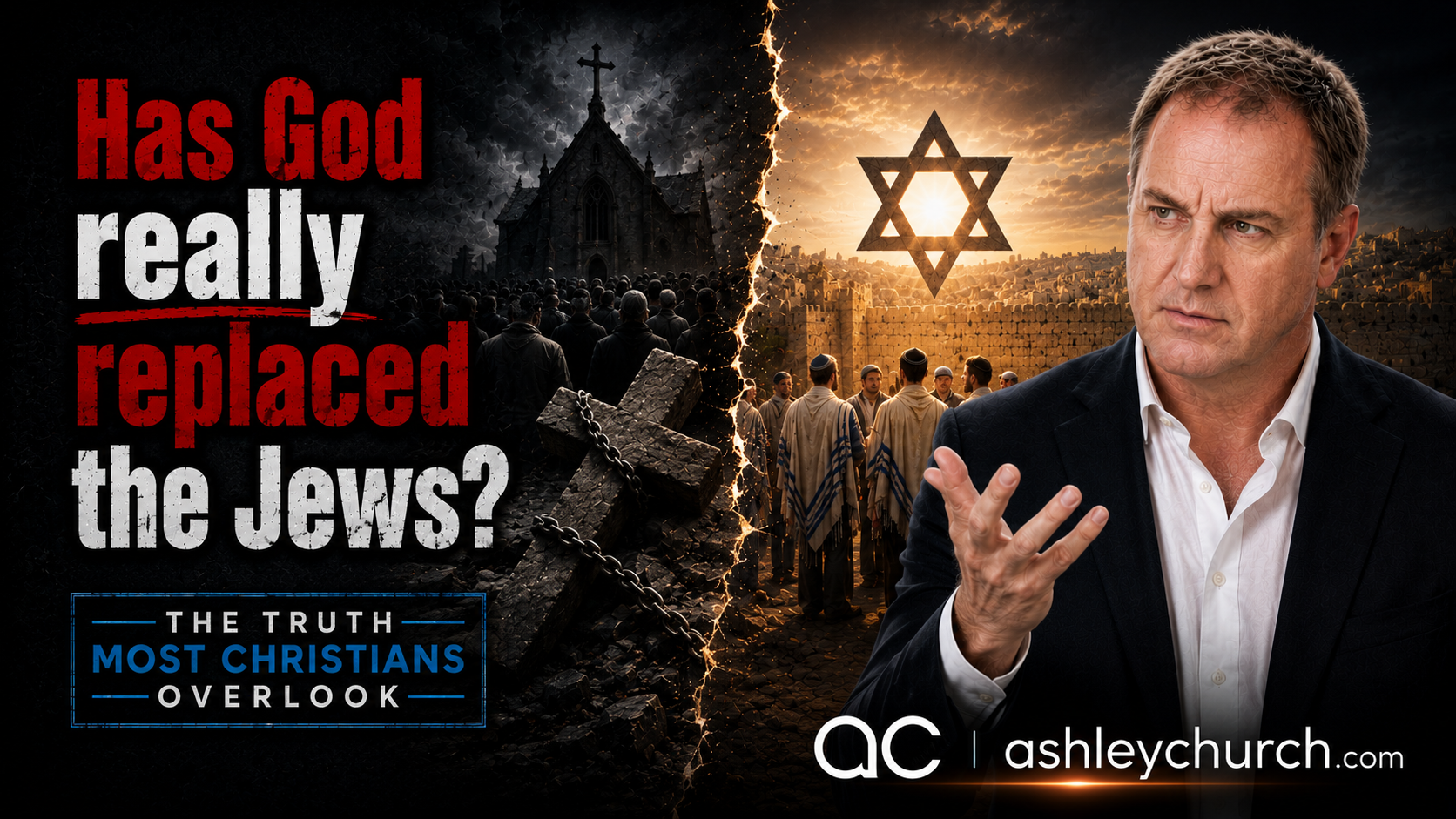
Has God really replaced the Jews?
The truth most Christians overlook
Every Saturday morning, for at least the past twelve months, Hawkes Bay Pastor Nigel Woodley and a group of supporters from his Hastings church have gathered at the Marine Parade roundabout in Napier.
They don’t make speeches or block traffic. They simply stand quietly, holding Israeli flags in solidarity with Israel and the Jewish people. This simple and powerful witness takes place week after week, in good weather and bad.
And that scene isn’t unique to Napier.
Since the weeks following the October 7 attacks, similar expressions of Christian support have appeared across New Zealand and throughout the Western world. Some are public rallies. Some are prayer meetings. Some are small groups of people standing quietly on street corners with Israeli flags. None of them make the nightly news, but all of them matter much more than many Christians realise.
Indeed, in an age in which Israel is routinely misrepresented by media, universities, activists, politicians and international institutions, Christian support has become one of the few consistent sources of moral clarity in a very noisy world.
Jewish communities notice it. Israel notices it. And those of us who have Jewish friends around the world know that it is deeply appreciated.
Sadly, however, that support is not uniformly shared across the Christian community. To the shame of the Church, some Christian voices have moved into a form of activism that is openly hostile to Israel and, at times, disturbingly indifferent to Jewish fear. When Christian leaders and church groups adopt the language, symbols and accusations of the wider anti-Israel protest movement without seriously confronting the antisemitism that so often travels with it, they become difficult to distinguish from the mobs they should be prophetically correcting. That’s not courage. It’s spiritual cowardice and moral confusion dressed up as compassion.
But how did this happen?
How did Christianity become so divided on a question that ought to be much clearer to anyone who takes Scripture seriously?
The answer predates current events by nearly two thousand years.
In the early centuries of the Christian faith, as the Church gradually separated itself from its Jewish roots, many Christians came to believe that Israel had served its purpose. The Jewish people had been the vessel through which God delivered the Scriptures, the prophets and ultimately the Messiah, but once the Church was established, Israel was increasingly pushed to the margins of the story.
Over time this developed into what became known as ‘replacement theology’, or ‘supersessionism’ – the belief that the Church had replaced Israel as God’s people and inherited the promises, blessings and responsibilities that had once belonged to the Jewish nation.
The consequences of this were profound. Once the Jewish people were no longer seen as central to God’s ongoing purposes, they became easier to marginalise, blame and persecute. Across the centuries Jews were expelled from countries, confined to ghettos, restricted in employment, accused of crimes they never committed and subjected to recurring waves of persecution. While many Christians opposed such treatment, no honest reading of history can avoid the conclusion that anti-Jewish theology often helped create an environment in which antisemitism could flourish.
The Reformation corrected many errors, but it did not fully correct this one. Martin Luther’s later writings about the Jews remain among the most disturbing examples of anti-Jewish literature produced by a major Christian figure. By the time the modern era arrived, much of Christianity had become accustomed to viewing Israel as a people of the past rather than a people with a future.
Then came an important correction.
In the nineteenth century, John Nelson Darby and the movement that became known as dispensationalism challenged many of these inherited assumptions. Darby argued that God had not finished with Israel, that the promises made to the Jewish people still mattered, and that the Jewish nation continued to occupy an important place within God’s purposes.
The impact of this view was profound. It encouraged millions of Christians to rediscover the Jewish roots of their faith and laid much of the theological foundation for the extraordinary support that Israel receives from evangelical Christians today. For that alone, it deserves to be treated with honour.
However, in correcting one error it created another.
While many Christians came to recognise that the Jewish people still mattered, dispensationalism also encouraged them to read much of Scripture – and particularly prophecy – through a predominantly Christian lens. Israel was restored to the story, but the Church remained the assumed centre of that story.
That distinction may seem subtle, but its consequences have been enormous. Christians who rejected replacement theology began supporting Israel, praying for Israel and defending Israel while continuing to assume that the great prophetic books of Daniel and Revelation were primarily about Christians, forecasting events whose principal subject was the Church.
The result has been the creation of an entire prophetic framework in which Christians are taught to expect a future world ruler who will persecute them, a coming seven-year tribulation centred on the Church, a global mark that will determine whether Christians can buy or sell, a final world government, a last-days deception aimed primarily at Christian believers, and a sequence of end-time events in which the Church becomes the main target, main witness and main interpretive key.
These ideas were not invented out of thin air. They were built from real passages of Scripture – but they were lifted out of their Jewish setting and reapplied to a Christian audience for whom they were never primarily intended.
As such, none of these things are going to happen – at least not to Christians in the way supposed.
These prophecies, given through Jewish prophets, using Jewish symbols, are about Jerusalem, Israel, the Temple, exile, persecution and the fate of the Jewish people. Because of this, all of the Book of Daniel – and a significant part of the Book of Revelation – are about the Jews and Israel, not a Christian end-times drama that remains perpetually just over the horizon.
The corrected interpretation of those prophecies reveals dramatic fulfilment in two events which occurred less than 80 years ago – the consequences of which are still playing out before our eyes. Christians can certainly draw lessons from these but we are not free to make ourselves the subject of prophecies that Scripture itself locates elsewhere.
So the central question is no longer whether Israel matters. Millions of Christians have already answered that correctly.
The deeper question is whether we have fully accepted the implications of that answer.
If Israel remains central to God’s purposes, then Israel is also central to God’s prophecies. If Jerusalem remains important in Scripture, then Jerusalem must remain important in interpretation. If the Jewish people continue to occupy a unique place in God’s unfolding purposes, then we should expect the major time-defined prophecies of Daniel and Revelation to be primarily about their story rather than ours.
This is not a small interpretive mistake. It changes the entire direction of prophecy, and it is one of the central arguments I make in Prophecy Shock.
The Christians standing on roundabouts with Israeli flags have already grasped something many churches lost a long time ago. They understand that the Jewish people still matter.
The next step is to recognise just how much they matter.
That may be the last and most persistent form of replacement theology still left to overcome….
You can interact with this article on Facebook by clicking here
Find out more about my book Prophecy Shock by clicking here
Discover more from ashleychurch.com
Subscribe to get the latest posts sent to your email.
