
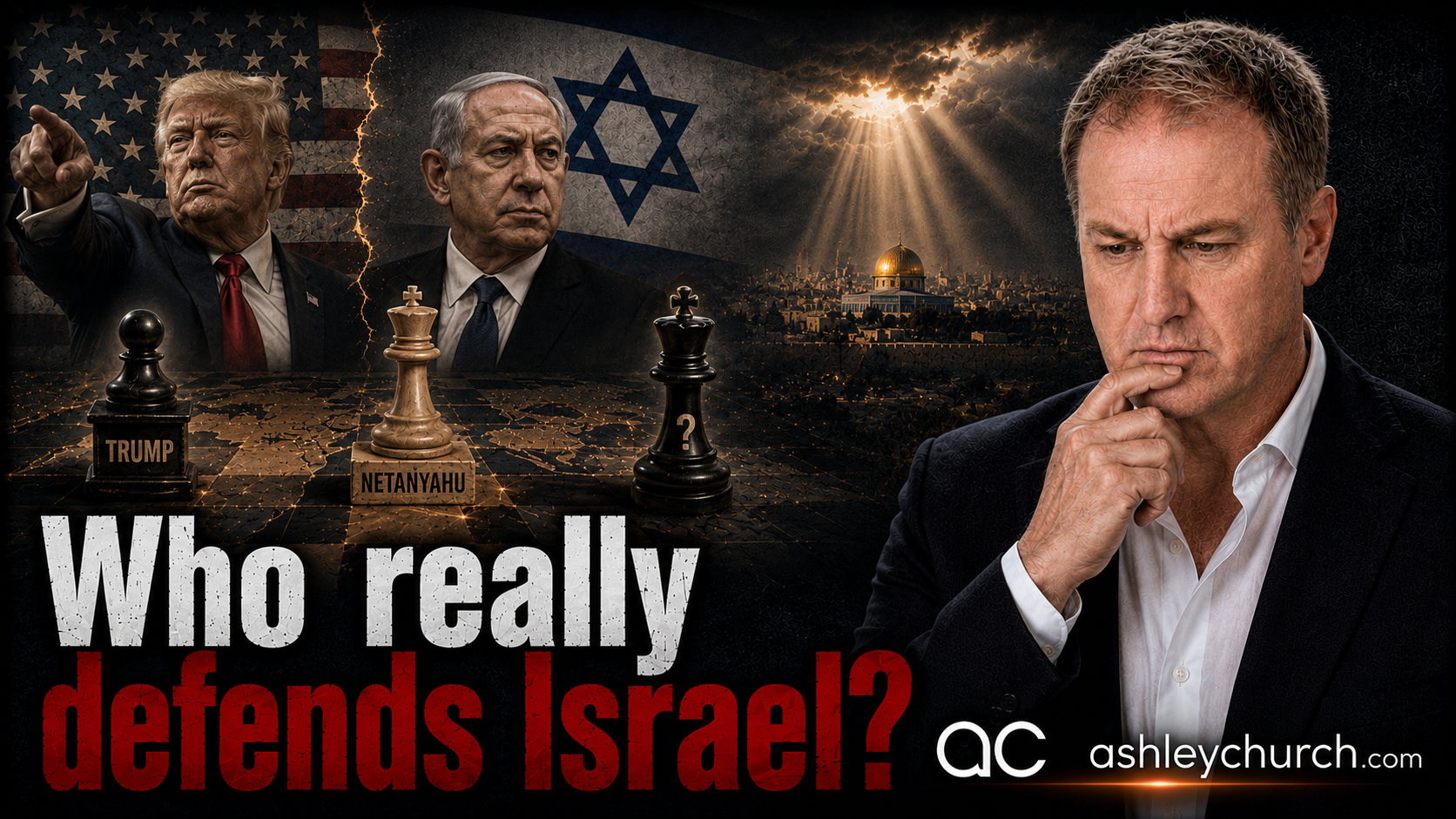
Who really defends Israel?
Analysing Trump's claim to be 'calling the shots'
Those of us of a certain age will remember Mohammed Saeed al-Sahhaf, even if we don’t remember him by that name. During the 2003 Iraq War, al-Sahhaf was Saddam Hussein’s Information Minister and became a familiar media figure – frequently appearing on TV to insist that Iraq was winning the war and that the invaders were being crushed, even as American forces closed in on Baghdad.
Because of this, Western media dubbed him “Comical Ali” and “Baghdad Bob” because the gap between what he was saying and what everyone could see had become absurd.
There is a clear parallel between those events and what is unfolding between the United States, Iran and Israel in the Middle East.
Let’s remind ourselves of the objectives of this conflict when it first began.
The first was that Iran was not going to be allowed to obtain nuclear weapons. Iran appeared to be edging ever closer to a nuclear capability, and there was broad agreement that this represented an unacceptable threat not only to Israel but to regional and global stability.
The second objective related to the regime itself. After decades of oppression, economic hardship, political repression and religious authoritarianism, millions of Iranians were living under a government they neither trusted nor supported.
At that stage, American interests and Israeli interests appeared to be aligned in their view that it was not enough to contain Iran – that the regime itself had to be eliminated.
To his credit, Tump acted where previous Presidents had just talked. He committed American military resources, authorised direct action against Iranian targets, and repeatedly stated that Iran could not be allowed to obtain nuclear weapons. The message was unambiguous. The nuclear threat would be removed, the regime would be brought to heel, and the strategic landscape of the Middle East would be fundamentally changed.
But action is not the same as success. Courage at the start of a campaign does not remove the need to judge the result – and several months on, the picture is far less convincing. The Islamic Republic remains in place and the same governing structure remains intact, albeit with different names on some of the desks.
Nor has Iran folded in the way many in Washington seemed to expect. By most accounts, it is rebuilding military capability, reconstituting networks and preparing for the next stage. The nuclear issue has not disappeared. The regime has not surrendered. The grand objectives that were stated so confidently at the beginning now look much harder to reconcile with the reality on the ground.
But instead of acknowledging this, the language out of the White House has simply shifted. ‘Regime change’ is now redefined to mean the elimination of the IRGC leaders who were in command when the war started and is ticked off as ‘achieved’ when clearly it has not been. Ending Iran’s nuclear programme is redefined as achievable within ‘a deal’ which will no doubt kick the can down the road for another few years rather than dealing with the existential threat that is in front of us right now.
To be clear, I believe that Trump entered this conflict with good intentions. But the reality on the ground has pushed him back into his default mode – the desire to ‘do a deal’ and to somehow salvage some sort of victory from the jaws of defeat.
As a result, the early alignment between America and Israel is rapidly eroding. American interests are now about avoiding wider escalation, protecting shipping routes, stabilising oil markets and producing a politically saleable outcome – while Israel’s concern remains what it has always been: existential survival and the determination to ensure that those who openly seek its destruction cannot acquire the means to do so.
That divergence has now become impossible to miss. When an Iranian missile brought down an American helicopter near the Strait of Hormuz, the United States responded with military strikes and described them as self-defence. But when Iran fired missiles at Israel, Trump instructed Netanyahu not to respond, because action might compromise the possibility of a deal.
That tells us that Israel’s security is no longer treated as a shared objective. It has become a variable to be managed inside a wider American strategy.
And look at what that strategy appears to entail: Vice President J.D. Vance been clear. He has conceded that Israel may not be happy with the emerging agreement with Iran, while making clear that America will pursue what it regards as being in its own best interests. Meanwhile, Trump has been reported as saying that Netanyahu will have “no choice” but to accept whatever arrangement America reaches with Iran, adding that he “calls the shots.”
But does he?
On one level, yes. America is powerful. It provides weapons, diplomatic cover and strategic support. Israel would be foolish to treat that lightly.
But Israel’s survival has never ultimately rested in Washington. It did not rest there in 1948, when the reborn Jewish state was attacked almost immediately and survived against overwhelming odds. It did not rest there in 1967, when Israel faced the prospect of annihilation and emerged from the Six-Day War with a result so extraordinary that even secular observers still struggle to explain its speed and scale. And it did not rest there in 1973, when Israel was caught by surprise on Yom Kippur yet still endured.
Again and again, Israel has made decisions that outsiders criticised, misunderstood or opposed, only for history to show that its instincts about its own survival were often far sounder than the advice and demands of others. That does not mean Israel is perfect or that every Israeli government decision is automatically correct. But it does mean that the Jewish state has learned something many Western leaders still seem unable to grasp: in that part of the world, weakness is punished, restraint is often misread, and hesitation can be fatal.
But more importantly than that – Scripture makes clear that Israel’s future is not ultimately in the hands of any earthly power. In Genesis, God promises blessing to those who bless Abraham’s Israeli descendants and consequences for those who oppose them. In Jeremiah 31, He ties Israel’s continued existence as a nation to the fixed order of the sun, moon and stars. In Zechariah 12, He warns that Jerusalem will become a burdensome stone for the nations. Psalm 121 says that He who keeps Israel neither slumbers nor sleeps.
That is not a small claim. It means Israel is not merely another country on the diplomatic chessboard. The re-establishment of the Jewish state in 1948, the recovery of Jerusalem in 1967, and Israel’s repeated survival through wars that many believed it could not win are not random events sitting disconnected from one another. They form part of a pattern that was described long before any modern American president, long before the United Nations, and long before the current conflict with Iran.
The existential threat to Israel, today, is no different to the one that faced it during any of those crises – but, despite this, the ultimate outcome is not in doubt. The same God who has already fulfilled promises that once appeared impossible has made very clear that He intends to finish what He started.
The story of Israel did not begin with Donald Trump, and it will not end with Donald Trump. Long after today’s negotiations have been forgotten, long after today’s politicians have passed from the stage, the question will not be what Washington promised, what Tehran threatened, or what agreement was eventually signed.
The question will be whether the God who defends Israel will keep His word.
On the evidence of the last century, and indeed the last three thousand years, there is every reason to have confidence that He will….
You can interact with this article on Facebook by clicking here
Find out more about my book Prophecy Shock by clicking here
Discover more from ashleychurch.com
Subscribe to get the latest posts sent to your email.
