
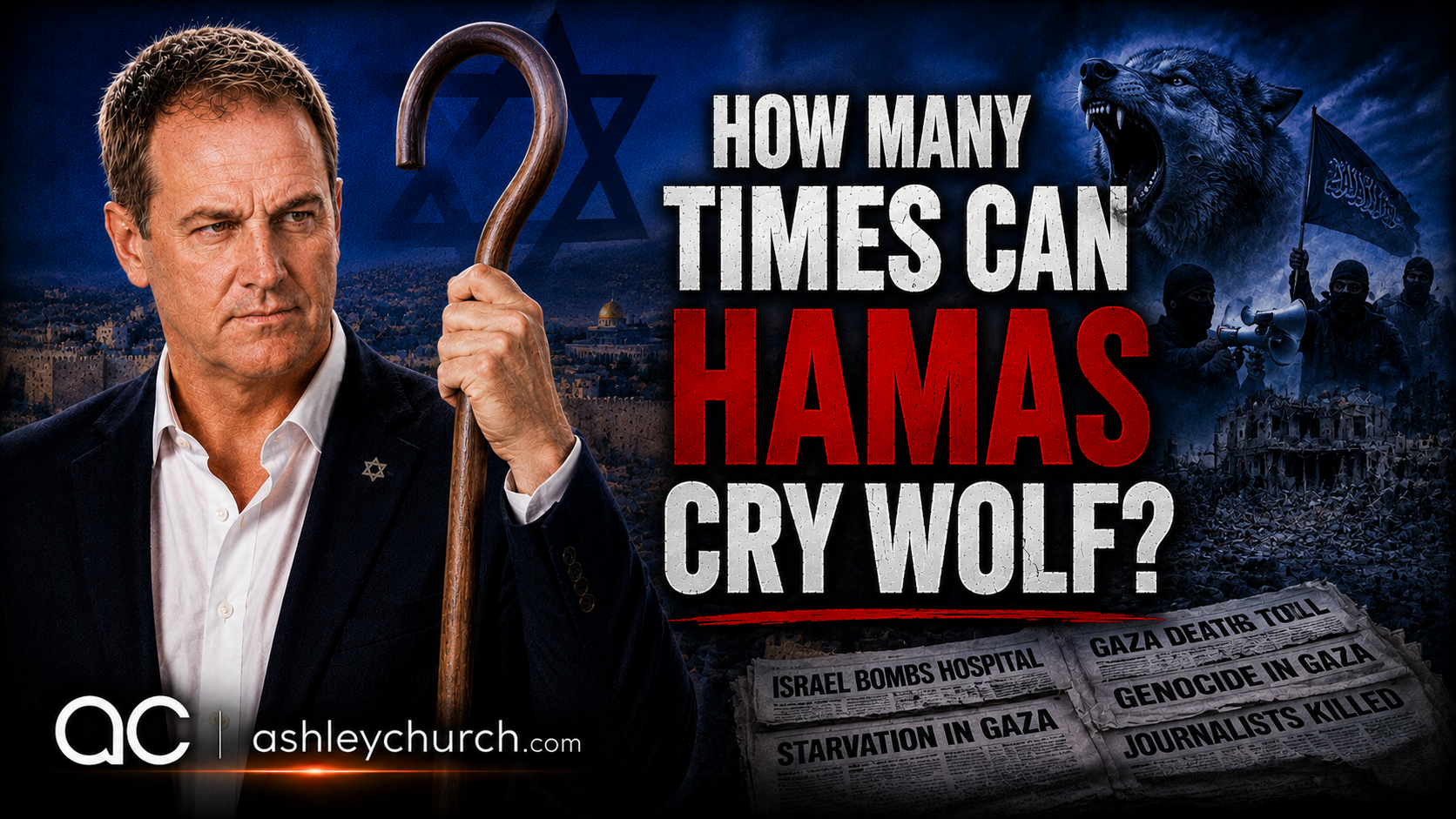
How many times can Hamas cry ‘wolf’?
...before the world recognises the pattern
Most of us grew up hearing the story of The Boy Who Cried Wolf about a young shepherd repeatedly raising false alarms and delighting in the panic he causes. But when a wolf really did appear, nobody believed him. The lesson was simple: if you lie often enough, people eventually stop listening.
But over the past couple of years we’ve witnessed almost the reverse of that story.
Instead of learning to distrust those who repeatedly cry wolf, much of the international media has continued to treat every fresh accusation against Israel as though it were established fact. Time after time, allegations have been broadcast around the world before the evidence has been properly examined. Time after time, those allegations have later unravelled under closer scrutiny. And time after time, the corrections have attracted only a fraction of the attention given to the original claims.
You would think that, by now, this pattern would have made journalists, governments and international organisations more cautious. Instead, they continue to fall for the same trick. It works like this:
A serious allegation (usually originating from Hamas) is made against Israel. Before there’s been any meaningful investigation, the claim becomes a headline around the world. Governments react. International organisations react. Commentators react. Social media explodes. Israel is condemned.
Israel protests. Those of us who support Israel point to inconsistencies, missing evidence or obvious questions that haven’t been asked. Independent researchers begin digging. Sometimes former military experts, intelligence analysts and specialist organisations produce detailed investigations that directly challenge the original narrative. These are ignored.
Then, weeks or months later, a very different picture begins to emerge. More evidence emerges that Hamas has lied. Israel is finally exonerated. The narrative is corrected. But here’s the thing – none of this makes its way into the media and the original slur is left in the minds of the public.
That has happened again and again during this war.
- In the early days of the conflict, Hamas claimed Israel had bombed the Al-Ahli hospital and killed hundreds of people. Much of the world accepted the claim almost instantly. Israel denied responsibility. Later evidence showed the cause to be a failed Palestinian rocket. But the original accusation had already done its damage.
- Then came the casualty figures. Hamas-run authorities repeatedly presented death totals in a way that encouraged the world to see the dead almost entirely as innocent civilians, especially women and children. Later revisions and further analysis showed that this early picture was grossly misleading, and that Israel’s claim that a significant proportion of those killed were Hamas combatants was correct.
- Then came the starvation narrative. Israel was accused of deliberately starving Gaza and blocking food from reaching civilians. Yet the fuller picture showed enormous quantities of aid waiting at crossings or entering Gaza, while distribution inside Gaza was repeatedly disrupted by looting, chaos, armed gangs, Hamas interference and failures by the international aid system. The simple claim that Israel was just preventing food from reaching Gazans did not match the reality on the ground.
- Then came the claims about hospitals and civilian infrastructure. Israel was accused of inventing excuses to attack hospitals, schools and residential areas. But evidence repeatedly emerged that Hamas had embedded itself in precisely those places, using tunnels, command facilities, weapons stores and fighters among civilians. Again, Hamas had lied and Israel’s central claim was true.
- Then came the genocide accusation. This may be the most obscene example of all. Israel was accused of attempting to destroy the Palestinian people, even as it warned civilians to evacuate, allowed humanitarian aid into Gaza, fought an enemy embedded among civilians, and targeted Hamas rather than Palestinians as a people. The accusation has continued because it is politically useful, not because the facts sustain it in any credible way.
- Then there was the denial, minimisation or deflection around Hamas sexual violence on October 7. For months, people who demanded impossible standards of proof for Jewish victims were happy to accept almost any allegation against Israel. Yet detailed investigations later documented rape, sexual assault and sexual mutilation as part of the October 7 atrocities. Once again, the early attempt to blunt or bury the truth gave way to evidence that could no longer be ignored.
This list is by no means exhaustive – it is a pattern.
Allegations against Israel are accepted with extraordinary speed if they fit the anti-Israel narrative. Evidence pointing in the other direction is treated with scepticism, delayed, minimised or ignored. And when the original claim finally collapses, the correction rarely receives anything like the attention given to the accusation.
Which brings me to the latest example.
One of the most repeated accusations throughout this conflict has been that Israel has killed unprecedented numbers of journalists. That claim, strongly promoted by the International Committee to Protect Journalists (CPJ), has been quoted by governments, campaigners, international organisations and media outlets across the world. Indeed, it has become part of the accepted story of the war.
However, from early on that narrative was challenged.
Researchers from the Meir Amit Intelligence and Terrorism Information Center published detailed work examining those listed as journalists. Commentators including Jonathan Conricus raised repeated concerns. Publications including The Times of Israel, The Jerusalem Post, The Algemeiner and others highlighted evidence suggesting that some of those being counted as journalists were also members of Hamas or Palestinian Islamic Jihad.
The criticism wasn’t based simply on opinion. It was supported by analysis of Arabic-language social media, organisational statements, Telegram channels, obituary notices and other material.
Yet the CPJ stood by its database and the claim of Gaza Journalists being killed by Israel stood – until recently.
So what finally forced the media to change its narrative?
It wasn’t months of criticism. It wasn’t repeated objections from Israel. It wasn’t even the growing body of independent research.
It was Hamas itself.
In June, Hamas and Palestinian Islamic Jihad produced a list of names honouring a number of their dead combatants from the Gaza War – naming them as martyrs. Among these were the names of those who the CPJ had repeatedly claimed to be ‘Journalists’ killed by Israel – a line parroted by most international media. Ironically, it was Hamas itself that finally forced the Committee to Protect Journalists to revisit its own figures. The CPJ has since removed eight names after concluding they were Hamas or Palestinian Islamic Jihad operatives and has launched a wider review of the entire database.
This is remarkable.
For months, critics have been arguing that these names deserved much closer scrutiny – but those protests went nowhere. Only when Hamas itself effectively confirmed key parts of that criticism, did the database suddenly change.
But as shocking as this is, this story isn’t really about terrorists masquerading as journalists. It’s about how quickly the world is prepared to believe the worst about Israel. It’s about how reluctant many institutions are to revisit those judgments when contrary evidence emerges. And it’s about how useful these false or distorted claims are to Hamas and to the wider anti-Israel movement.
Hamas understands this perfectly. So do the antisemitic activists and ideological campaigners who amplify its claims. They know that in the modern media environment, the accusation matters more than the correction. The headline matters more than the evidence. The first emotional image matters more than the later investigation.
Israel is then left fighting two wars. One is the military war against Hamas. The other is the propaganda war against people who are perfectly willing to lie, distort, omit and manipulate in order to blacken the name of the Jewish state.
And no, Israel does not simply do the same thing in reverse. That is one of the reasons this conflict is so lopsided in the information space. Hamas lies because lies are useful. Israel, for all its imperfections, generally argues from evidence because it has to. That distinction matters.
So when the next sensational allegation appears, perhaps the wisest response is not immediate outrage but scepticism.
Ask where the claim came from.
Ask who benefits from it.
Ask whether Hamas-linked sources are being treated as neutral witnesses.
Ask whether Israel’s denial is being dismissed before the evidence is even examined.
And remember the pattern.
The hospital. The casualty figures. The starvation claims. The hospitals and human shields. The genocide slur. The sexual violence denial. And now the journalist casualty list.
Again and again, the accusation came first.
Again and again, Israel was condemned.
And again and again, when the evidence finally emerged, the truth looked far closer to what Israel had been saying all along.
Interact with this article on Facebook by clicking here and check out my new book www.prophecyshock.com to learn how all of this was predicted over 2,000 years ago
Discover more from ashleychurch.com
Subscribe to get the latest posts sent to your email.
