
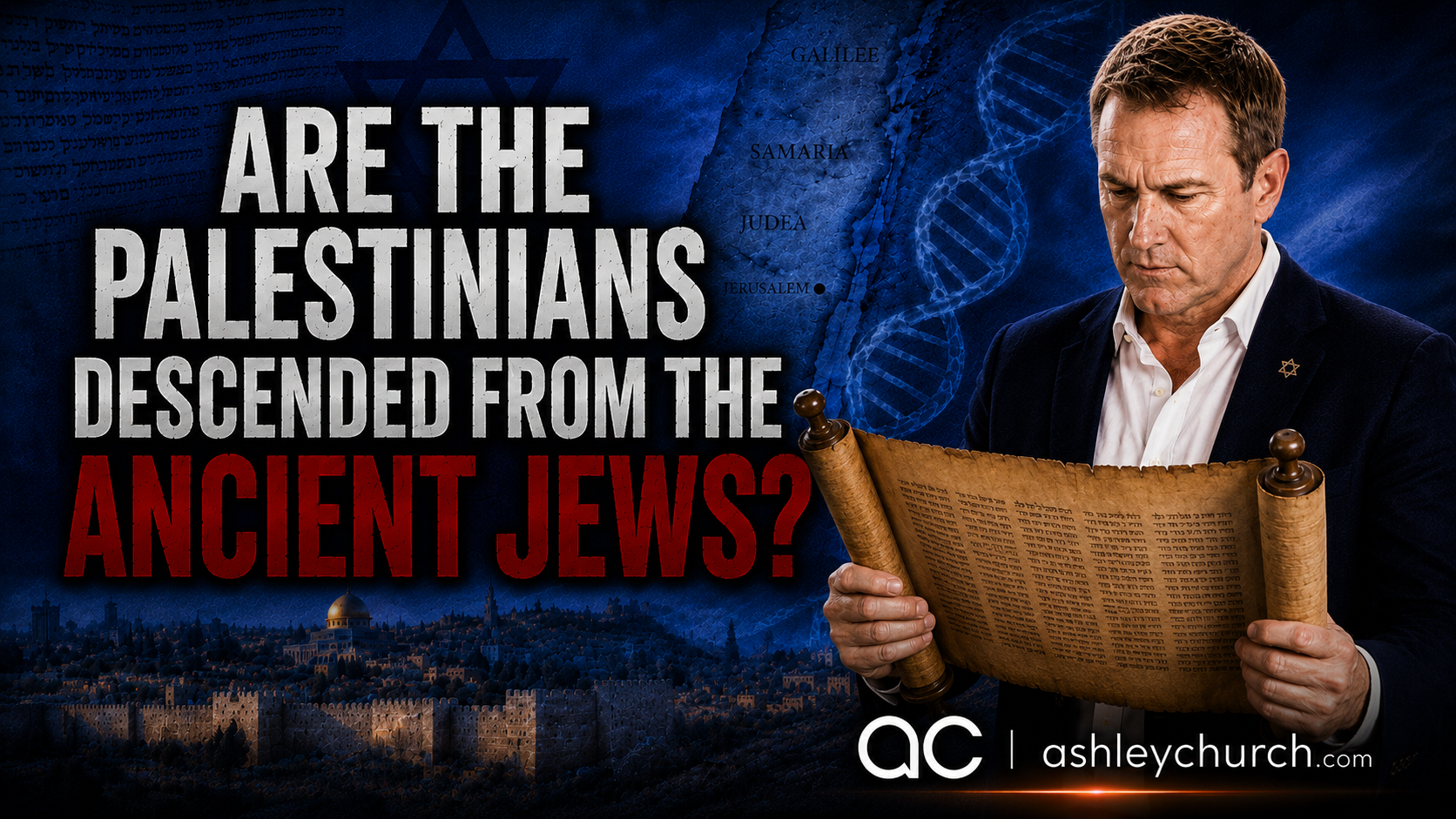
Are the Palestinians the ‘real Jews’?
What defines an ancient identity?
Back in June I wrote an article pointing out the inconvenient fact that there has never, at any time in history, been a sovereign Palestinian state and that reference to one is an invented modern fiction.
Antisemitic commentators responded immediately.
Unable to challenge the core of my argument (because history is history) they changed tack and latched on to an old conspiracy theory: that the Palestinians and the Jews are genetically related and that, therefore, the Palestinians are the ‘real Jews’ while the people we now call Jews are outsiders.
It’s a bizarre claim born of desperation: if you can’t prove a link through your own history, attempt to appropriate someone elses history instead. But like many of these nutty theories it is eagerly picked up by people who ‘want’ it to be true.
It’s also built around a small kernel of truth: many modern ‘Palestinians’ DO carry ancestry linked to ancient populations that lived in the land once broadly known as Canaan.
But Palestinians aren’t unique in that respect. Genetic studies indicate varying degrees of shared ancestry among many peoples of the region, including Palestinians, Lebanese, Druze, Samaritans, Jordanians and Jewish populations. After thousands of years of migration, conquest, conversion, intermarriage and population movement, that is hardly surprising.
But that does not translate to ‘Jewish identity’.
By way of comparison, most people of European descent could probably trace different branches of their ancestry across several modern countries. An Englishman may discover French, German, Scandinavian, Roman or Celtic ancestry. A Frenchman may carry ancestry linked to populations that once lived in Italy, Spain, Germany or Britain. The same will be true of Italians, Greeks, Spaniards and almost every other European people.
But an Englishman who discovers some ancient Italian ancestry does not thereby become Italian or inherit Italy’s national history. A Frenchman with distant links to populations that once lived in Britain does not become English, and a Spaniard with Greek ancestry does not become the modern continuation of ancient Greece.
That conclusion would be absurd because shared ancestry is not shared identity, shared nationhood, shared culture or shared historical continuity.
DNA can reveal that populations are related – but it doesn’t make one nation the continuation of another or transfer one people’s history to somebody else.
This is where the Palestinian genetic argument falls apart. It takes a limited truth, that different peoples in the Middle East share some ancient ancestry, and tries to use that truth to appropriate the national, cultural and historical identity of the Jews.
But the decisive question is not simply who carries ancient Middle Eastern DNA. The decisive question is which modern people can demonstrate historical continuity with ancient Israel and Judah.
That answer is not difficult.
The Jewish people emerged in that land and established kingdoms there. Their scriptures were written around its history, while their laws, festivals, language and worship were centred on it. Jerusalem was their capital and the spiritual centre of their civilisation.
When the Jews were scattered, they did not forget who they were or where they had come from. For almost two thousand years, Jewish communities maintained their identity across Europe, North Africa, the Middle East and elsewhere. They prayed towards Jerusalem, celebrated festivals rooted in the land of Israel, mourned the destruction of Jerusalem and ended Passover with the hope, “Next year in Jerusalem.”
Jewish communities also continued to live in the land throughout much of that history, even when their numbers were small and their position precarious.
The modern return of the Jewish people to Israel was therefore not the creation of a new people with a vague ancestral memory. It was the return of an existing people to the historical, geographical and spiritual centre of its civilisation.
DNA supports that story by confirming the Jewish people’s ancestral roots in the region, but it does not define Jewish identity. What makes the Jewish people Jewish is their continuous existence as a people through their shared history, scriptures, faith, language, laws, customs, festivals, collective memory and enduring connection to Israel and Jerusalem. Sharing some ancient Middle Eastern ancestry does not, by itself, make another people Jewish or give them ownership of Jewish national and historical identity.
The claim that the Palestinians are the real Jews would therefore require us to disregard the people who preserved the name Israel, the Hebrew scriptures, Jewish worship and the memory of Jerusalem, and to transfer that identity to another population that did not historically understand itself to be Jewish.
That claim is absurd.
In the end, the argument intended to undermine the Jewish connection to Israel actually reinforces it. The genetic evidence confirms that Jews are not foreign Europeans with no ancestral connection to the Middle East (another conspiracy theory for another day). Instead, it points to the extraordinary continuity of an identifiable people whose national story, language, faith, memory and hope have remained tied to the same land for more than three thousand years.
Palestinians and Jews may share some ancient ancestry, but being related to the Jews does not make Palestinians the Jews, and it certainly does not give anyone the right to claim the history of the Jewish people as their own…
Comment on this article on Facebook
Discover more from ashleychurch.com
Subscribe to get the latest posts sent to your email.
