
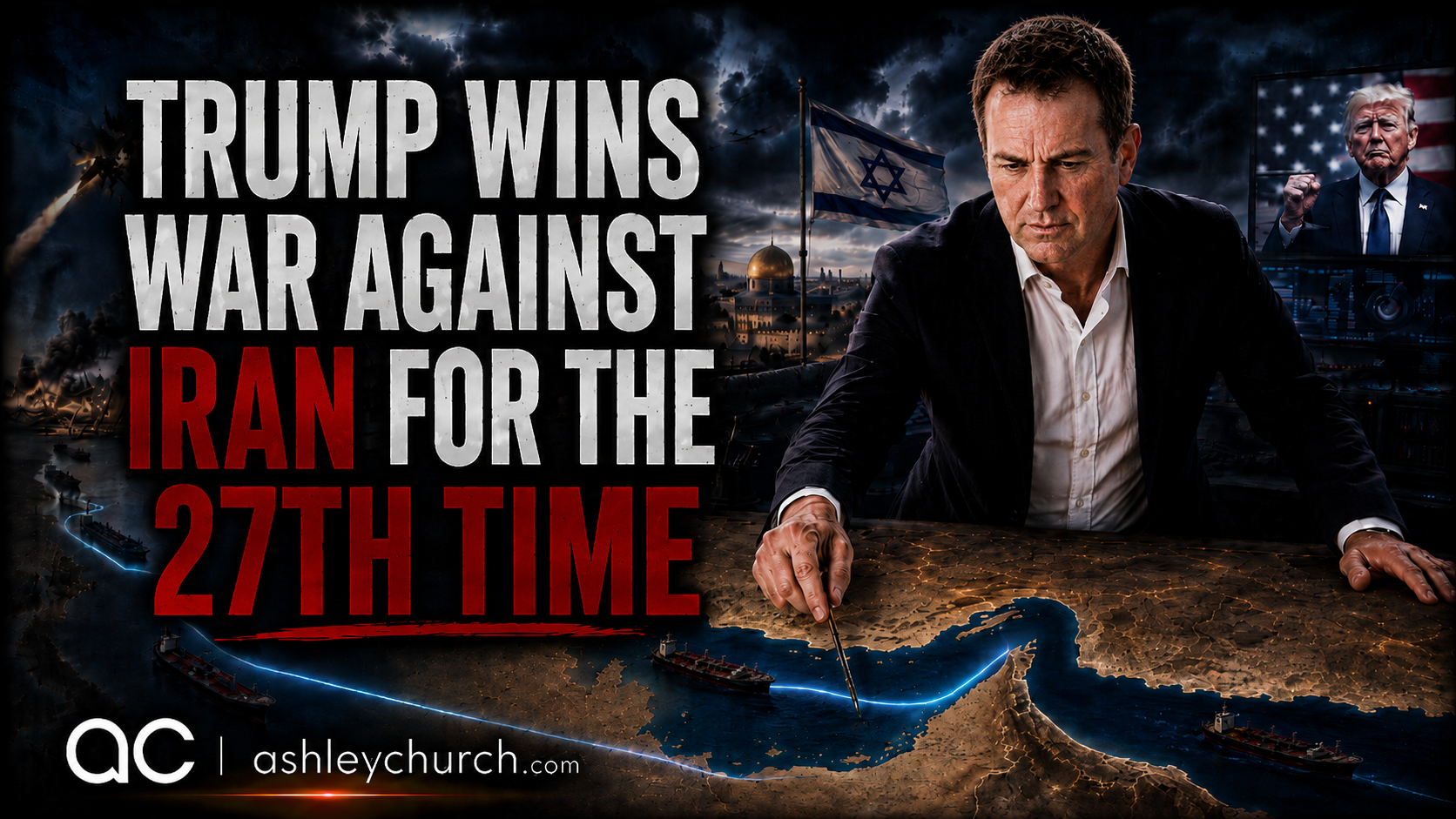
Trump wins war against Iran for the 27th time
Can he make it 28?
A recent satirical headline claimed that Trump had broken the world record by winning his war against Iran 27 times – a claim that is funny because it comes uncomfortably close to the truth.
Overnight, Donald Trump has announced that the United States would halt its latest planned attack against Iran because the parameters of yet another agreement have emerged. The proposed deal would reportedly reopen the Strait of Hormuz, end regional hostilities and address Iran’s nuclear threat, although negotiations remain incomplete and Iran has yet to make any binding public commitment.
But does anyone still believe that this will actually stick?
Trump has repeatedly announced victories, breakthroughs and imminent agreements that have dissolved almost as quickly as they appeared. Conversely, he has also described Iran, at various times, as “totally defeated”, its military capability “destroyed”, its navy “annihilated”, its missiles “obliterated” and its capacity to threaten anyone supposedly eliminated.
Only days ago, he was again promising imminent overwhelming action. Now, apparently, we’re talking again.
For the benefit of those who believe that supporting Trump requires defending everything that he does, let me remind you that unquestioning adulation is unhealthy.
I supported the original campaign against Iran because it was morally right and because its objectives appeared clear and necessary. The Islamic regime in Tehran is brutal, expansionist and dangerous. It represses its own people, sponsors terrorism throughout the region, seeks Israel’s destruction and has spent years moving closer to the capacity to build a nuclear weapon.
Removing that regime and permanently ending its nuclear ambitions were worthy objectives.
But maturity also requires the ability to recognise both a leader’s strengths and his failures – and in respect to Iran, Trump has failed spectacularly.
I don’t doubt that he entered the conflict believing he could achieve its original goals. Unfortunately, those objectives began disappearing almost immediately. Removing the regime became weakening it. Ending the nuclear threat became damaging parts of the programme. Decisive victory became another temporary agreement.
There’s nothing wrong with pursuing a negotiated peace rather than another round of bombing. But there’s something deeply wrong with repeatedly describing an unresolved conflict as an historic victory while the enemy continues doing the things the war was supposed to prevent.
And the consequences aren’t remotely funny.
The Iranian people have suffered the effects of war and intensified repression. Israelis have endured continued attacks. American forces, Gulf nations and commercial shipping have been drawn into the conflict.
Iran’s nuclear ambition also remains. The campaign may have damaged facilities and disrupted parts of the programme, but it hasn’t removed the purpose behind it. Iran has never treated nuclear weapons as a purely defensive safeguard. Its regime has repeatedly threatened Israel’s destruction and built its military strategy around extending Iranian power across the region.
A nuclear weapon would allow Tehran to pursue those ambitions under the protection of nuclear blackmail. Any agreement claiming to remove that threat will therefore require verifiable restrictions, intrusive inspections and consequences Iran knows will actually be enforced.
But another issue has quickly become the focus of much of the world: the Strait of Hormuz.
The Persian Gulf is effectively a vast maritime cul-de-sac with only one principal sea exit. Tankers carrying oil and gas from Saudi Arabia, Iraq, Kuwait, Qatar, Bahrain, the United Arab Emirates and Iran must pass through the Strait of Hormuz before entering the wider world.
Before the present crisis, nearly 20 million barrels of oil and petroleum products passed through it each day, close to one-fifth of global consumption. A major share of internationally traded liquefied natural gas also used the Strait.
Iran doesn’t need to own Hormuz or formally announce its closure to cause enormous economic damage. It merely needs to make passage dangerous enough that shipping companies, crews and insurers decide the risk is unacceptable.
There are alternative pipelines, but they can carry only a fraction of the normal traffic. Nor can the oil simply be shifted onto trucks or trains. A single large crude carrier can move around two million barrels in one voyage. There is no immediate substitute.
That matters because oil powers transport, agriculture, aviation, construction and industry, and is used in thousands of manufactured products. When oil becomes more expensive, the cost spreads through almost everything, producing the unpleasant combination of rising inflation and weaker economic growth.
That’s why most of the world is desperate for the conflict to end. For many nations, the crisis has become primarily about oil prices, shipping routes and economic stability.
Sadly, this is the legacy of Trumps war.
Trump deserves credit for acting when others wouldn’t – but the measure of success isn’t another announcement. It’s whether Iran’s nuclear threat has been removed, whether the regimes ability to terrorise its own people and its neighbours has been neutralised, and whether the Strait of Hormuz is secure.
Right now, the answer to all three questions is ‘no’.
But even those questions don’t identify the country with the most to gain or lose: Israel.
Israel has lived under constant attack from Iranian proxies for decades. Hezbollah, Hamas, Palestinian Islamic Jihad and the Houthis have all formed part of Tehran’s effort to weaken and ultimately destroy the Jewish state.
The Hamas atrocities of 7 October 2023 may not have been directly organised by Iran, but they couldn’t have occurred without years of Iranian funding, training, weapons and encouragement.
Iran’s leaders have never hidden their objective. Israel is their immediate target, followed by the wider Western world. Its nuclear programme must be understood within that stated ambition.
For all the attention given to American strategy, Trump’s declarations and the price of oil, this conflict was never fundamentally about the United States. It was about Iran and Israel.
Israel has shown remarkable restraint while America’s objectives shifted and its declarations multiplied. It has deferred to Washington and allowed the United States room to act.
That restraint can’t continue indefinitely.
If the latest agreement leaves the Iranian regime in power, allows its nuclear programme to survive and permits its proxy network to rebuild, Israel will eventually have to do what it has repeatedly done when its survival is threatened and deal with the problem itself.
Frankly, that moment can’t come soon enough.
Perhaps this latest agreement will work. We should all hope it does.
But Donald Trump hasn’t won the war because he says he has.
The war will have been won only when Iran can no longer carry out the destruction it has spent decades promising against Israel…
You can comment on this article on Facebook
Discover more from ashleychurch.com
Subscribe to get the latest posts sent to your email.
