
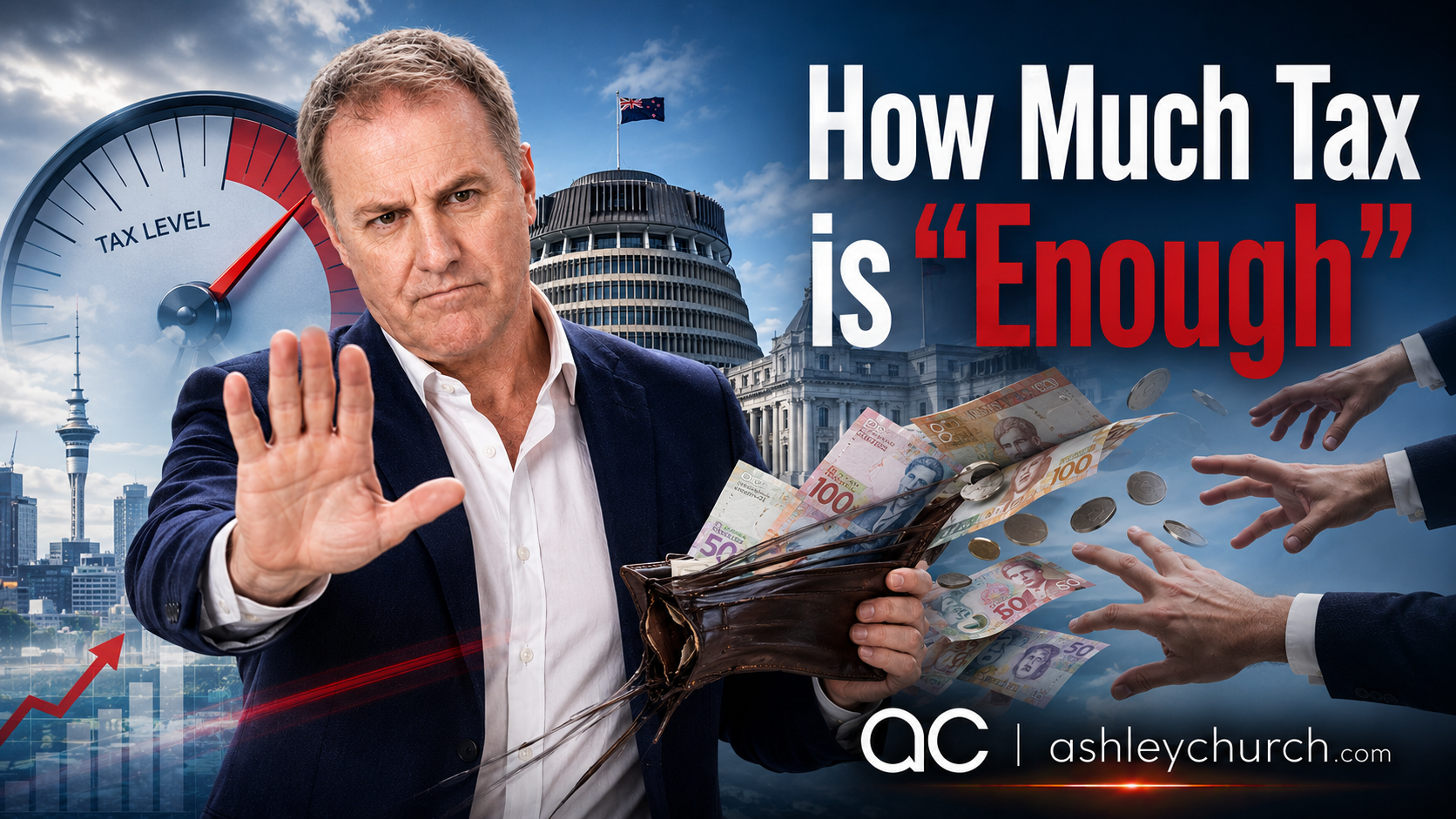
How much tax is “enough”?
The question that no one wants to answer
There’s a famous moment in the New Testament when the Pharisees try to trap Jesus with a question about tax by asking Him whether it’s lawful to pay taxes to Caesar.
If he says no, he can be accused of rebellion against Rome. If he says yes, he risks alienating those who bitterly resent Roman occupation.
Instead, Jesus asks to see the coin used to pay the tax and asks whose image is on it. When they reply that it’s Caesar’s, Jesus gives the answer that has echoed down through history: “Render therefore unto Caesar the things which are Caesar’s; and unto God the things that are God’s.”
It’s an extraordinarily clever answer because it establishes a principle that has remained relevant for the 2,000 years since. We live in civil society. Civil society has laws, institutions and obligations and we are bound by those obligations.
And that includes tax – in fact, taxation is one of the basic mechanisms by which civil society pays for the things it has decided government should provide. Roads, hospitals, schools, policing, defence, courts and the countless other things that allow an orderly society to function all have to be paid for somehow.
That’s relevant to NZ, right now, because we’re heading into an election in which parties on the left are proposing an extraordinary collection of new or higher taxes to pay for these things. Capital gains taxes. Wealth taxes. Inheritance taxes. Land taxes. Higher income taxes on higher earners. Higher company taxes. Additional taxes or levies on banks.
But if we just keep loading taxes on – how do we determine the point at which somebody has paid a “fair” amount of tax? What calculation are we using? What moral principle tells us that the amount they’re paying today is unfair, but that some higher amount proposed tomorrow will somehow cross an invisible line and become fair? And when we get there, how will we know?
That’s the question that seems to be missing from almost the entire tax debate: How much tax is “enough”?
It’s a deceptively simple question because it comes back to the heart of the issue – “fairness” – and when it comes to tax, almost the entire argument turns on what we believe that word actually means.
There are, broadly speaking, two very different principles upon which a tax system could be built. The first is essentially transactional. Under that model, people would pay for the services they receive from the state. Use the roads, contribute to the roads. Use public hospitals, contribute to public health. Send your children to state schools, contribute to education.
In theory, that has a certain purity to it because contribution is linked directly to consumption – but no modern Western country operates on that basis because government services, such as defence, policing, courts and border protection, can’t sensibly be divided into individual invoices.
Instead, New Zealand, like virtually every Western democracy, operates a redistributive system. That means that taxation doesn’t just fund services, it also deliberately transfers resources from those with greater incomes and wealth to those with less, through welfare, tax credits, subsidised services, public health, education and a range of other supports.
That decision was made decades ago, and there’s strong evidence that it has been an important factor of the enormous improvement in Western living standards over the past century, including better health, longer lives and protection against forms of extreme deprivation that were once commonplace.
So the question isn’t whether New Zealand should redistribute income and resources – we already do. The question is around who we can extract “more” from – and on this question the parties of the left are remarkably united. They all agree that “the wealthy” aren’t paying their “fair share”.
Perhaps you believe that too? That “the wealthy” should pay more. Perhaps you’ve bought into the idea that there is a group of wealthy New Zealanders who have somehow escaped contributing adequately and should finally be required to pay up.
The problem is that the figures tell a very different story. Across the ten tax years from 2015 to 2024, the top 10 percent of earners paid around 46 percent of all income tax collected – so roughly one person in every ten was, collectively, providing almost half of the individual income tax recorded in those tables.
These aren’t figures invented by a centre-right think tank or political party – they come from Inland Revenue – and they still only tell us one side of the story. Because Treasury research also looked at the other side of the equation and found that households in the bottom five income deciles – half of all households – received more on average through government services and support than they paid in tax.
That isn’t a criticism of those people. It simply tells us what the system actually does.
At one end, a relatively small group contributes a remarkably large share of the tax collected. At the other, a much larger part of the population receives more back through services and support than it contributes through the taxes captured.
So the question isn’t around whether the better off should pay “more” – they already do. The question is around why that “more” still isn’t “enough”.
Claiming that “they can afford it” doesn’t cut it. Ability to pay more isn’t the same thing as establishing that paying more is fair – in fact, these are two completely different propositions. The former was espoused by Karl Marx in his Critique of the Gotha Programme where he said: “From each according to his ability, to each according to his needs” – so the idea has its roots in Communism which also promotes a heavily progressive income tax and abolition of inheritance rights.
That doesn’t mean everybody who believes in redistribution is a Marxist – particularly when New Zealand and virtually every other Western democracy already incorporate substantial redistribution into their systems – but Marx’s formulation is useful because it exposes the underlying principle with unusual clarity. Ability, itself, becomes the justification for taking: if you have “more”, it should be taxed.
And once that becomes the test, an interesting problem emerges.
Suppose somebody has $100 million and somebody else has almost nothing. We decide the difference is unfair, so we take some of the first person’s wealth and redistribute it leaving them with $90 million.
But what if the inequality still exists? If the existence of that inequality justified the first intervention, why doesn’t it justify the second? And if it justifies the second, why not a third?
At what point does the principle itself tell us to stop? How far do you take it and what principle determines the limit.
On the extremes, some will argue that there is no limit – that society always needs “more”, that there are hospitals that need improving, infrastructure that needs building, people who need greater assistance, schools that could do with more resources and social problems that governments might help to address.
But how far should a society go? Many of those things may be entirely worthwhile, but the existence of a worthwhile thing doesn’t answer the question of whether government should take additional money from somebody else to pay for it.
And there are other questions. Before we start taxing people “more”, are we sure that the money the government already has is being spent well? Are existing programmes producing the outcomes that they were supposed to produce? Could priorities be changed? Could things be done more efficiently? Are there programmes that should stop so that more important things can be funded?
Only after those questions have been answered do we get to the question of whether government genuinely requires more revenue.
Imagine a friend comes to you because his car has broken down and he needs help. You’re in a position to assist, so you give him the money. A couple of weeks later he comes back again, this time because he wants some new clothes. You help again. Then he returns a third time, and a fourth, and before long the requests have shifted from genuine need to concert tickets, electronic gadgets and things he’s spotted online that he simply likes the look of. The problem isn’t that every request is outrageous in isolation. The problem is that, once he discovers there’s no real limit and no requirement to justify how the money is being used, asking you for more becomes easier than making choices with what he already has. Governments aren’t friends borrowing from your wallet, obviously, but the principle is similar: if the answer to every new idea or new need is simply to take more from taxpayers, the discipline to prioritise, economise and justify existing spending disappears.
We’ve had a fairly dramatic recent demonstration of that in very recent times. The previous government borrowed around $60 billion, ostensibly to fund its response to COVID – yet Treasury figures demonstrate that around half of this was spend on projects which had no relationship to COVID. What happened to the other $30 billion? Was it used in ways that improved the lives of kiwis? What enduring value did New Zealanders receive from that additional borrowing. Where are the transformed public services, the dramatic improvements in infrastructure, health, education or productivity that would justify spending on that scale?
You would be hard pressed to identify it and that observation, alone, challenges the assumption that simply giving government more money automatically produces a better country. That’s why the question shouldn’t simply be, “How much more money could government spend?” It should be, “What is government already doing with the money it has?”
New Zealand doesn’t have to look very far back to find governments of very different political colours that understood this principle. During the Clark-Cullen years, the Crown recorded substantial operating surpluses and significantly reduced government debt. By 2008, gross sovereign-issued debt had fallen markedly from where it had stood in 1999.
The Key-English Government inherited the Global Financial Crisis, subsequently dealt with the Canterbury earthquakes, ran deficits through that period and then returned the books to operating surplus in 2014/15. Treasury’s retrospective analysis describes that process as one of fiscal consolidation, including tighter control over future spending allowances.
Those were governments from opposite sides of politics, with very different philosophies and priorities, but there was a common recognition that government ultimately had to make choices within financial constraints.
That isn’t an argument for never spending more, and it isn’t an argument for never raising a tax. Circumstances change and sometimes governments genuinely do need more revenue.
It’s simply an argument for remembering that fiscal discipline isn’t left-wing or right-wing. It’s good government.
Governments aren’t households. They can tax, borrow and manage an economy in ways a household obviously can’t. But there’s one useful discipline that applies to both: limited resources force choices.
If every new need can simply be answered by another tax, that discipline starts to disappear. The easier it becomes to reach into someone else’s pocket, the less pressure there is to ask whether the money already available is being used as wisely as it should be.
By the way, there’s a legitimate discussion to be had about “tax reform”. We could reasonably ask whether New Zealand collects tax from too narrow a range of sources or whether our reliance on income tax creates distortions and whether the tax burden should be spread differently across income, consumption, property or other forms of economic activity.
Those are reasonable debates for any society to have from time to time. But that isn’t what’s being argued by those parties calling for more tax in the forthcoming election. None of them are calling for a reduction in one tax and an increase in another to ‘recalibrate’ the tax system in a more equitable way. They’re all just calling for “more’.
And there’s also a practical problem with the reassuring idea that all of this can simply be paid for by “the super-wealthy”: there simply aren’t enough of them. The current narrative conjures up images of a mysterious class of people living on yachts, drinking champagne in Monaco and shifting billions between secret bank accounts while ordinary New Zealanders struggle to pay the grocery bill. It’s a caricature designed to make the wealthy appear sinister and anonymous – a “them” to our collective “us” – because it’s much easier to demand more money from “them” than it is to think about who these people actually are.
But most “wealthy” New Zealanders aren’t the tiny number of uber rich who can move capital, restructure investments or simply leave if the tax environment becomes punitive enough. They’re just ordinary people who run businesses, take risks, employ people and accumulate assets over time.
That’s why cheering when government says it’s going after “them” can be dangerously short-sighted. Once those with the greatest ability to move their money have gone, the tax burden doesn’t disappear. It simply moves down the line until it reaches you and me.
So when you stand in the voting booth in November, faced with promises to make things ‘better’ by taking still more in tax, there’s one word worth remembering.
Enough.
Discover more from ashleychurch.com
Subscribe to get the latest posts sent to your email.
