
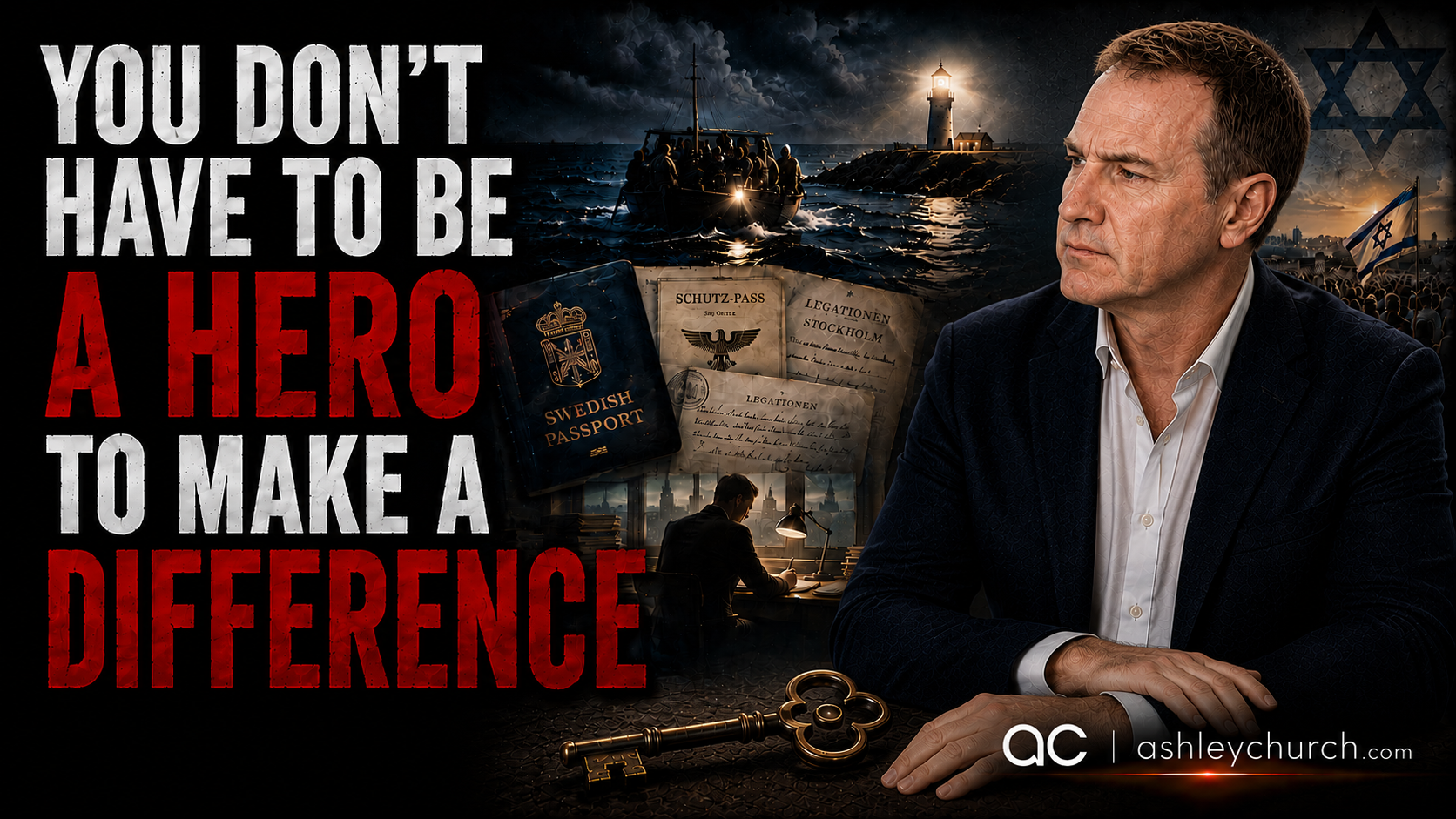
You don’t have to be a hero to make a difference
Changing the world with what you have
A few weeks ago I wrote an article about Oskar Schindler, the German industrialist whose extraordinary story was made famous by the movie Schindler’s List. By the end of the Second World War, Schindler had saved the lives of more than 1,000 Jews by employing them in his factories and increasingly putting his own life and fortune at risk to protect them from the Nazis.
I could equally have written about Tuvia Bielski, the Jewish resistance leader who, with his brothers, established an armed partisan group in the forests of what is now Belarus. The Bielskis fought the Germans and their collaborators, helped Jews escape from ghettos and protected a community in which more than 1,200 Jews survived the war.
These are extraordinary stories, and they deserve to be remembered. But I’ve become conscious that stories like these can sometimes have an unintended effect.
For those of us who look at what’s happening to Jews around the world today and wonder what we can do about it, the sheer scale of what these people achieved can make our own efforts seem almost insignificant by comparison.
After all, most of us aren’t Oskar Schindler. We don’t own factories that can be used to protect people. Nor are we armed resistance leaders commanding people prepared to fight the Nazis in the forests of eastern Europe.
We admire what these people did, but perhaps we also quietly conclude that we’re not made of the same stuff. We’re not heroes, so what difference could we possibly make?
Which brings me to another remarkable story from the Second World War, and to a man you’ve probably never heard of.
His name was Gösta Engzell, and he was a Swedish civil servant working in the Foreign Ministry. Engzell wasn’t a famous industrialist, a military commander or a resistance leader. He was a career bureaucrat who eventually headed the Foreign Ministry’s Legal Division. A humble man in a humble role – yet historians estimate that the actions he initiated ultimately contributed to the rescue or relief of somewhere between 30,000 and 40,000 Jews.
To understand how extraordinary that was, you first need to understand Sweden’s unusual position during the war. Sweden was neutral and was never invaded or occupied by Nazi Germany – but that didn’t mean it was safely removed from the conflict. When Germany invaded Denmark and Norway in April 1940, Sweden found itself in an extraordinarily vulnerable position. Hitler’s armies dominated much of Europe, Germany was economically important to Sweden, and the Swedish government knew perfectly well what might happen if it pushed Berlin too far.
So Sweden made concessions. It continued trading with Germany and, during parts of the war, allowed German troops and supplies to transit Swedish territory.
Nor was its early record on Jewish refugees particularly heroic. Like several other democracies, Sweden had been reluctant to accept large numbers of Jews fleeing Nazi persecution. In fact, Engzell himself had been part of that system. In 1938 he’d represented Sweden at the Evian Conference, the infamous international gathering at which governments expressed concern about the growing Jewish refugee crisis while overwhelmingly declining to open their doors to those trying to escape it.
But then something changed. By 1942, increasingly detailed reports of what the Nazis were doing to Europe’s Jews were reaching Sweden – including information confirming that Europe’s Jews weren’t just being persecuted or driven from their homes. They were being systematically murdered.
Engzell decided to take action using what he had.
He didn’t have Schindler’s factories or Bielski’s guns. Instead, Gösta Engzell had bureaucracy and paperwork. And he used them brilliantly.
He and his colleagues began using Swedish passports, visas, protective documents and diplomatic representations to place vulnerable Jews in other parts of Europe under Swedish protection wherever they could. Swedish connections were exploited, German authorities were challenged through diplomatic channels, and Sweden increasingly offered itself as a place of refuge.
The Nazis had turned bureaucracy into an instrument for identifying, isolating and murdering Jews. Engzell helped turn another bureaucracy against them. Sweden used this strategy in Norway, Denmark and elsewhere in occupied Europe, and later helped the Hungarians to develop it on an even larger scale.
Perhaps its most dramatic expression came in Denmark in 1943, when word leaked that the Germans were preparing to round up the country’s Jewish population. Sweden announced that it would accept them, giving Denmark’s Jews somewhere to escape to. Over the following weeks, Danish resistance members, fishermen and ordinary citizens hid Jewish families and moved them towards the coast. Fishing boats and other small craft carried them across the narrow Øresund Strait to Sweden, often at night and at considerable personal risk.
As a result, almost the entire Danish Jewish community – more than 7,000 people – survived the Holocaust.
It’s an extraordinary story, but the reason I’m telling it isn’t simply because another forgotten figure deserves to be remembered. It’s because Engzell’s story speaks directly to the situation we find ourselves in today.
The circumstances aren’t identical to the 1930s and 1940s, of course. Jews today have something that the Jews of Europe didn’t have. They have Israel. – and that fact alone has fundamentally changed their vulnerability.
In fact, it’s the only reason that we aren’t watching a repeat of the 1930s and 1940s play out right now. Humanity hasn’t somehow cured itself of the evil of antisemitism. Indeed, since October 7, the speed with which antisemitism has returned to public life should terrify anyone who knows their history. Jews have again been treated as collectively responsible for events in the Middle East. Jewish businesses and institutions have again been targeted. Jewish students once again have faced intimidation. Ancient accusations have been recycled in modern language, and hostility toward Jews has once again found respectable political and cultural cover.
The parallels with the 1930s aren’t subtle. They’re staring us in the face and, had Israel never been created, I have absolutely no doubt that we would already be much further down the same road that Europe travelled before the Second World War.
So the hatred hasn’t disappeared. What has changed is that the Jewish people now possess the means to defend themselves and somewhere to which Jews elsewhere can escape.
That should give us comfort, but it shouldn’t give the rest of us an excuse to stand back – because the moral question remains exactly where it has always been: how do we respond in the face of evil?
Which brings me back to Gösta Engzell. Most of us will never be Oskar Schindler or Tuvia Bielski – but we could absolutely be Engzell.
Engzell had paperwork. What do you have?
Perhaps you’ve got a social media account. Perhaps you own a business or lead a church. Perhaps you’ve got money you can give to organisations supporting Israel or Jewish communities. Perhaps you’ve got political contacts, a professional network or simply a group of friends who listen when you speak.
Maybe you’ve got a platform from which you can challenge the lies being told about Israel and the Jewish people.
Or perhaps you’ve got none of those things. Maybe all you’ve got is a Jewish friend who needs to know that somebody stands beside them. Maybe it’s a conversation around a dinner table where somebody repeats something you know isn’t true. Maybe it’s simply the willingness to speak when staying silent would be easier.
The point isn’t that any of us knows where those actions will lead. Engzell couldn’t have known at the beginning that decisions made behind his desk would eventually contribute to the rescue or relief of tens of thousands of Jewish people. He simply recognised that something evil was happening and decided to use whatever was in his hands to push back against it.
And you can do the same.
By the way – if you found Engzell’s story inspiring, it’s been dramatized as a movie called The Swedish Connection that you can watch, right now, on Netflix. It’s been dubbed into English from Swedish and it’s a bit shaky at the start – but once you get into it it’s a brilliant retelling of one of the most important initiatives of the war.
Yes, it simplifies parts of the history, but Engzell was real, the Swedish rescue effort was real, the passports and protective documents were real, the Danish Jews crossing the Øresund were real – and the tens of thousands of Jewish lives touched by Sweden’s change in policy were very very real.
So don’t make the mistake of thinking that we need to be heroes before we can make a difference.
We don’t.
We simply need to look at what we have and decide whether we’re prepared to use it.
Comment on this article on Facebook
Discover more from ashleychurch.com
Subscribe to get the latest posts sent to your email.
