
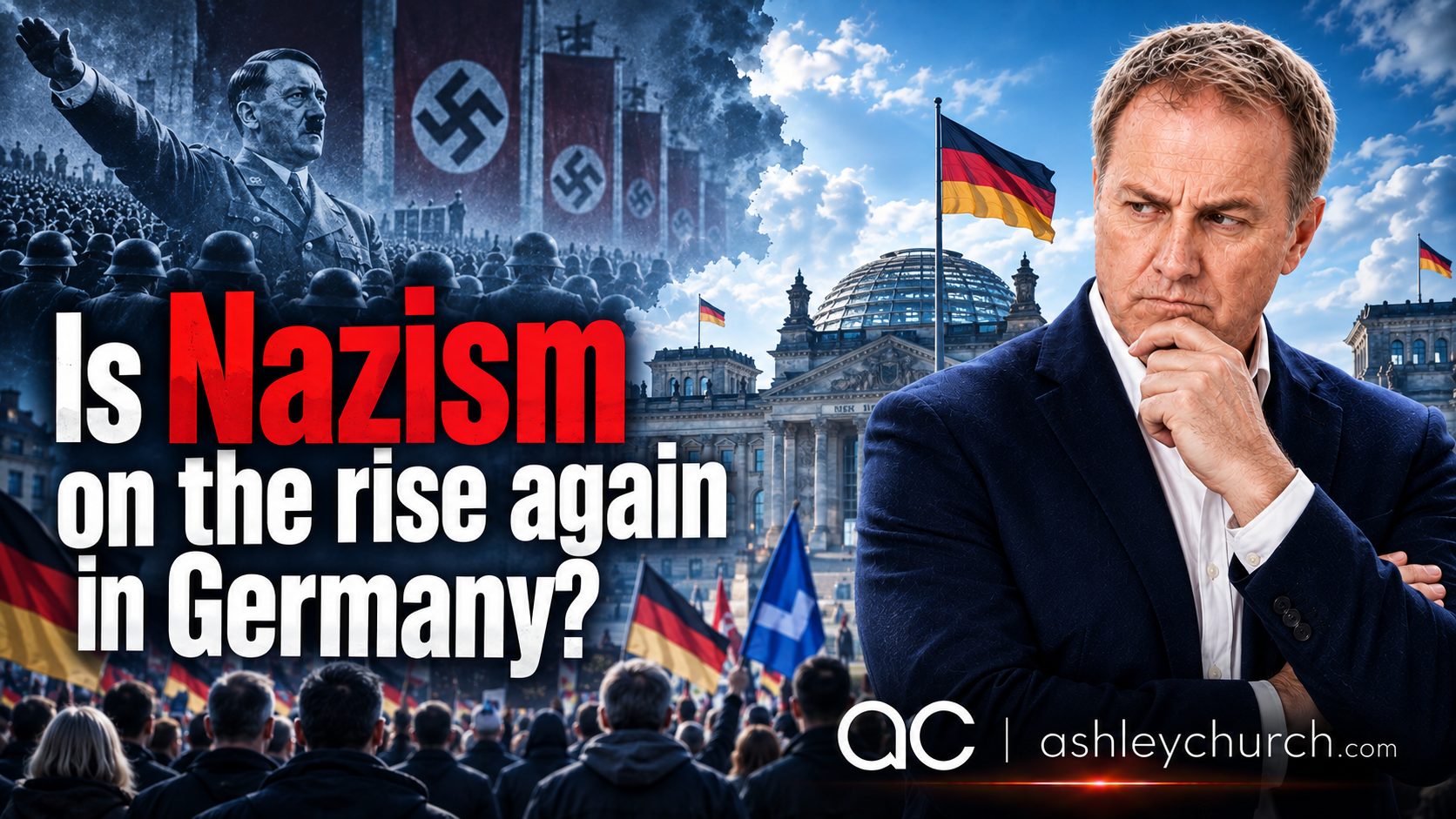
Is Nazism on the rise again in Germany?
Shockwaves in State elections
Over the past couple of days, media outlets here in New Zealand have reported that the “far-right Alternative for Germany” (AfD) has swept to a stunning victory in the eastern German state of Saxony-Anhalt, winning almost 44 percent of the vote and more than doubling its support from the previous election.
That result is extraordinary. The AfD, has gone from being a minor insurgent political force to one of the most powerful parties in Germany, and the scale of its victory has understandably set alarm bells ringing well beyond the country’s borders.
1News noted that the Saxony-Anhalt branch of the AfD has been classified by Germany’s Office for the Protection of the Constitution as a proven right-wing extremist organisation, and much of the international media now simply shorten this description to “far right”.
Given Germany’s history, that’s no small thing. In the 1930s, Adolf Hitler and the Nazi Party dismantled German democracy, imposed a dictatorship, plunged Europe into war and, in the greatest stain on that murderous regime, systematically murdered six million Jews in the Holocaust.
Following the war, Germany spent the next 80 years proving that it had rejected that nightmare. West Germany embraced democracy and created one of the world’s great economies – and was reunified with East Germany in 1990, creating a nation which became one of the anchors of the new Europe.
So the idea that a new far-right movement might once again be surging toward power in Germany is understandably unsettling.
But is it true? Is the description of the AfD as “far right” really accurate in the sense that any reasonable person would understand that term?
There’s a fairly simple way to test it: just look at what the AfD actually says it wants to do.
First, let’s acknowledge that the AfD is unquestionably a party of the political right. It wants much tighter controls on immigration and asylum, stronger borders and the removal of people who have no lawful right to remain in Germany. It also wants migrants who settle in Germany to integrate into German society rather than establish permanent parallel cultures. It’s strongly opposed to political Islam, supports traditional families, wants less regulation and lower taxation, favours tougher law and order, is deeply sceptical of major parts of Europe’s climate and energy programme and wants Germany to recover powers that have progressively migrated to the European Union.
In Saxony-Anhalt itself it went further – advocating policies during the election which included a “deportation offensive”, removing incentives for illegal migrants, allowing homeschooling, requiring schools to fly the German national flag, ending financial support for Ukraine and seeking an end to sanctions against Russia.
Sure, some of those policies might be controversial – but are they really far right?
Secure borders aren’t. That policy was once an entirely conventional position of mainstream conservative parties. So was removing people who had no lawful right to remain in a country. Similarly, supporting traditional families wasn’t considered extremist. Nor was flying a national flag at a national school, allowing parents greater control over the education of their children, or believing that migrants should integrate into the culture of the country they’d chosen to make their home.
In fact, what’s striking about many of these policies is how historically ordinary they are.
Go back 30 or 40 years and much of this would have sat comfortably within the programme of a mainstream centre-right party almost anywhere in the Western world.
But wait. What about the policy which ultimately defined the nazis: Antisemitism? Germany, under Hitler, stripped the Jews of their rights, identified them as racial enemies of the German nation and ultimately transported them to ghettos, killing fields and eventually death camps. Does the AfD harbour similar views?
Far from it – in fact the AfD position is almost exactly the opposite. It condemns antisemitism, defends Jewish life in Germany and is strongly supportive of Israel.
So where does the claim of extremism come from?
Certainly there are genuinely radical figures and strands within the AfD, particularly in some of its eastern branches. The Saxony-Anhalt organisation, itself, has attracted concern over rhetoric surrounding ethnicity, migration and the question of what constitutes German identity, and Germany’s Office for the Protection of the Constitution has classified it as a proven right-wing extremist organisation.
But the Office for the Protection of the Constitution isn’t a court. It sits within the state’s Interior Ministry, which forms part of an executive government led by the Christian Democratic Union (the CDU), the very political party whose electoral position is now being devastated by the rise of the AfD.
That doesn’t mean the office is corrupt or that its findings should be dismissed. But it does create an obvious conflict. An organ of government is making judgments about a party that is simultaneously threatening the governing party’s hold on power. At the very least, that should make us look twice at its pronouncements rather than treating them as politically neutral judgments delivered from on high.
And Germany’s courts have themselves demonstrated why that distinction matters. In February this year, the Cologne Administrative Court stopped the federal Office for the Protection of the Constitution from continuing to classify the entire national AfD as a confirmed extremist organisation while the substantive case proceeds, finding that there wasn’t sufficient evidence to generalise those views to the party as a whole.
That’s a useful distinction. Recognising extremist elements within a party is one thing – but If every political party were disqualified based on the views of its most radical members, there’d be very few parties left anywhere in the Western world.
So the evidence to support the claim that the AfD is “far right” looks thin. Instead, what we see is a collection of policies around borders, immigration, family, national identity, law and order, energy, sovereignty and cultural cohesion which, until remarkably recently, would have been recognised across much of the West as conventional centre-right politics.
So perhaps what we’re watching in Germany is part of a much broader political correction taking place across the Western world?
For the past three decades, Western politics has moved steadily left on many of these issues, with those who disagree with them being labelled “hard right”, “extreme right” or “far right”. We saw this in the elections of Giorgia Meloni in Italy and Javier Milei in Argentina. Both were the subject of apocalyptic headlines presenting them as dangerous far-right firebrands despite the fact that both have proved to be capable and effective leaders who have restored stability to their nations.
The same story is being mirrored across the Western world as large numbers of voters are rejecting the so-called “progressive” political agenda of the past generation and seeking a return to traditional values. Calling these people “far right” is not only disingenuous – but the casual use of that term destroys its meaning altogether.
Things are further complicated by the fact that many of these movements are a response, not just to the left, but to the leftward drift of parties traditionally associated with the centre right.
Germany’s Christian Democratic Union (CDU) is a striking example. Under Angela Merkel, the party moved significantly toward the political left, accepting positions on immigration, energy, family and social policy that would have been unthinkable for a conservative party a decade earlier. That strategy helped Merkel dominate German politics for years, but it also came at a cost. Traditional conservative voters increasingly found that the party they’d relied on to represent them was accepting more and more of the assumptions and policies of its opponents.
The CDU has now begun trying to recover some of that lost ground under Friedrich Merz, particularly on immigration, economic policy and questions of national culture – but the party still remains considerably more socially liberal than it once was – and the voters don’t like it.
And that pattern isn’t unique to Germany. Across the Western world, traditional parties of the centre-right have moved progressively left on social and cultural questions, sometimes so gradually that they barely seem to have noticed it themselves. Policies and values that once formed part of their political identity have been softened, abandoned or quietly absorbed into a new progressive consensus.
So what we’re seeing in Germany and elsewhere isn’t a population lurching dramatically to the right. It’s voters looking for someone prepared to re-establish positions that sat comfortably within mainstream conservatism for decades.
And, in Germany, that void is being filled by the AfD. The German people haven’t become radicals. They’ve simply had enough of being told that the values they regarded as normal for most of their lives are now treated as outdated, oppressive or embarrassing remnants of another age. Societies can only travel so far from their foundations before people begin to notice what’s been lost.
The far right is real. Fascism is real. Authoritarianism is real. Nazism was horribly real. But if we use the same vocabulary to describe someone who wants controlled immigration, traditional families and a German flag outside a German school, what language will we have left when the real thing actually appears?
The values being espoused by the AfD aren’t radical and new – and they didn’t begin in Berlin, Brussels or Strasbourg. They began in Jerusalem and established the very principles on which Europe was founded: human dignity, moral responsibility, justice, mercy and the value of individual life – all concepts which are inseparable from the God of Israel.
Not everything labelled conservative is Christian, of course. Not every AfD policy is wise. And there are people within that party whose ideas deserve serious scrutiny.
But a renewed belief in family, responsibility, national community, ordered freedom and the preservation of the civilisation inherited from previous generations isn’t evidence of an emerging far right simply because today’s political spectrum has shifted so far to the extremes on the left. Rather, it is a longing for the restoration of the things that made western civilisation great.
And if that eventually leads Europe back toward an appreciation of its Judeo-Christian inheritance, of the Jewish people who sit at the centre of that story, and ultimately of the God from whom that inheritance came, history may judge the real danger to have been the 30+ year experiment with the extreme ideas of the left rather than a return to the values on which our societies were founded…
Comment on this article on Facebook
Discover more from ashleychurch.com
Subscribe to get the latest posts sent to your email.
