
The new definition of ‘genocide’
Who's next after Israel?
Imagine a farmer who is charged with attempting to burn down his neighbour’s house.
The farmer makes no secret of the fact that he lit a fire. His intention was to remove an unwanted hedge on his property, which he successfully did. There is some peripheral damage to his neighbour’s house but this was clearly not the focus of his efforts.
Nevertheless, the prosecution alleges that the farmer’s real intention was to destroy the house.
Under established legal precedent, the prosecution faces a considerable obstacle. The farmer has a perfectly reasonable explanation for his actions, supported by the evidence.
But while the case is awaiting trial, a third party intervenes in an entirely separate court case and argues for a broader interpretation of the law. It argues that the farmer’s intention to destroy the hedge does not exclude the possibility that he also intended to destroy the house.
The court adopts this broader interpretation, despite strong objections from several of its own judges. Nothing about the farmer’s actions has changed. No new evidence has emerged. Yet the prosecution now has a potentially more favourable legal precedent.
Would you have confidence in that judicial process?
Because something remarkably similar has just happened at the International Court of Justice (ICJ).
Unless you’ve been living under a rock for the past three years, you’ll be familiar with the accusation that Israel has been committing genocide in Gaza. It’s an accusation that has been repeated relentlessly by politicians, protesters, academics, journalists and even entire governments and is accepted as a fact by millions of people.
Except, there’s just one problem. It isn’t true.
Under the ICJ’s own established interpretation of genocide – the evidence of Israel’s military campaign simply does not establish genocide. The legal definition of genocide is set out in the 1948 Genocide Convention which, ironically, was adopted in the aftermath of the Holocaust. Importantly, genocide is not simply another word for war, widespread destruction or even the unlawful killing of civilians. It requires something very specific: an intention to destroy, in whole or in part, a national, ethnic, racial or religious group.
It is that ‘intention’ which distinguishes genocide from other international crimes. In two landmark judgments, in 2007 and again in 2015, the ICJ established that Serbia had committed genocide against both Bosnia and Croatia based on a particularly demanding benchmark for determining whether an intention existed. The Court ruled that, where genocidal intent was to be inferred from a pattern of conduct, it had to be the only reasonable inference that could be drawn from the evidence.
This means that the ICJ could not simply establish that genocidal intent is a conceivable explanation for a nation’s actions. It must establish that the evidence cannot reasonably be explained without it.
And that’s where this story gets interesting. In December 2023, South Africa initiated proceedings against Israel in the International Court of Justice, alleging genocide against the Palestinian population of Gaza. But the problem for South Africa was that Israel went to war following the Hamas atrocities of 7 October 2023 with three clearly stated objectives: to dismantle Hamas’s military capabilities, recover the hostages and prevent a repetition of those attacks.
Israel’s military objectives, its warnings to civilians, its evacuation instructions and its measures to facilitate humanitarian assistance all provide evidence of intentions other than the destruction of the Palestinian people.
The terrible loss of civilian life in Gaza does not, by itself, establish genocidal intent. Nor does the destruction of buildings in an urban environment in which an armed terrorist organisation operates.
So what happens when an allegation of genocide encounters a legal benchmark that the evidence doesn’t satisfy? Apparently, one response is to seek to change the benchmark.
On 19 November, the International Court of Justice handed down its judgment in a completely different genocide case, brought against Myanmar by The Gambia in 2019. The case concerned the persecution of the Rohingya, a predominantly Muslim ethnic minority, and particularly the military operations conducted against them in 2017.
There is substantial evidence of appalling atrocities committed against the Rohingya but the question before the Court was whether those atrocities satisfied the specific legal requirements necessary to establish genocide.
By a majority of nine judges to six, the Court ruled that they did.
So what does this mean? Did the ICJ find that an intention to destroy, in whole or in part, a national, ethnic, racial or religious group existed?
Nope. Instead, the ICJ simply changed its definition – expanding it to accept that genocidal intent could coexist with other intentions, including military objectives – even where a state failed to exploit the opportunities available to it to destroy a population. In other words – a nation doesn’t need to commit genocide to be guilty of genocide.
But here’s the thing. Of the 15 Judges on the ICJ Panel – six of them emphatically disagreed. Their objections were not simply about whether sufficient evidence had been presented against Myanmar. They went to the very heart of the Court’s legal reasoning and its adherence to established international law.
In their joint dissenting opinion, the six judges accused the majority of effectively broadening the concept of destruction “through the backdoor”. They warned that the majority’s approach weakened the established distinction between the destruction of a population and its forcible removal, blurring the boundary between genocide and other international crimes.
They also raised serious concerns about the way alternative explanations had been assessed and the evidential burden placed on Myanmar, maintaining that genocidal intent had not been established to the standard required under the Court’s own previous judgments.
Think about that language for a moment. Six members of the world’s highest international court are accusing their colleagues of effectively expanding a fundamental legal concept through subterfuge.
So why did the majority of the Panel change the definition? That’s where things get interesting – particularly in the light of what happened in the two years leading up to the Myanmar judgment and, in particular, the role played by Ireland.
It’s no secret that the governments of both Ireland and South Africa want Israel’s conduct in Gaza to be declared genocide. But having Israel condemned for genocide in your perfect little antisemitic political fantasy world, as the ultimate expression of your hostility towards the Jewish state, and actually establishing genocide under the ICJ’s traditional legal standard are two entirely different things – and Ireland knew this.
So, in March 2024, just three months after South Africa initiated its genocide proceedings against Israel, the Irish government announced its intention to intervene in the case. Then, eight months later, the Irish government issued a remarkably revealing public statement. Ireland’s then Foreign Minister, Micheál Martin, announced that Ireland would be asking the ICJ to broaden its interpretation of “what constitutes the commission of genocide by a State.”
Make no mistake about what this meant. Ireland knew that Israel hadn’t committed genocide – so it wanted the definition of that term expanded to find that it had.
In the very same announcement, the Irish government confirmed that it had also approved intervention in the genocide proceedings against Myanmar and expressly linked these two interventions. Indeed, Michael Martin told reporters at the time that the government believed a broader interpretation would encompass what had occurred in Gaza.
Just consider the significance of that sequence of events for a moment. A government seeking to have Israel’s conduct brought within the scope of the Genocide Convention publicly announced that it wanted the existing legal interpretation broadened – then intervened in a separate case, under the same Convention, in order to gerrymander the established definition of genocide.
Ireland wasn’t simply seeking to present evidence that would establish that Israel had breached an existing legal standard. It was openly advocating a broader interpretation of that standard itself. And now, less than two years later, aspects of that reasoning have found their way into a landmark ICJ judgment. In fact, Paragraph 441 of the Myanmar judgment specifically discusses Ireland’s arguments concerning the coexistence of counter-terrorism objectives and genocidal intent. Two paragraphs later, the Court sets out its reasoning accepting that genocidal intent may coexist with other intentions.
The retrospective relevance to Israel could hardly be more obvious.
To be fair – I’m not the first to notice this. In December 2024, Israeli Foreign Minister Gideon Sa’ar and Israel’s ambassador to Ireland, Dana Erlich, both publicly raised concerns that Ireland was seeking to reshape the legal interpretation of genocide in connection with the case against Israel.
And again, on 30 June this year, almost five months before the Myanmar judgment, international law professor Gregory Rose published an article for the Hague Initiative for International Cooperation examining the links between the two proceedings and warning that governments were seeking to use them to reshape the meaning of ‘genocide’.
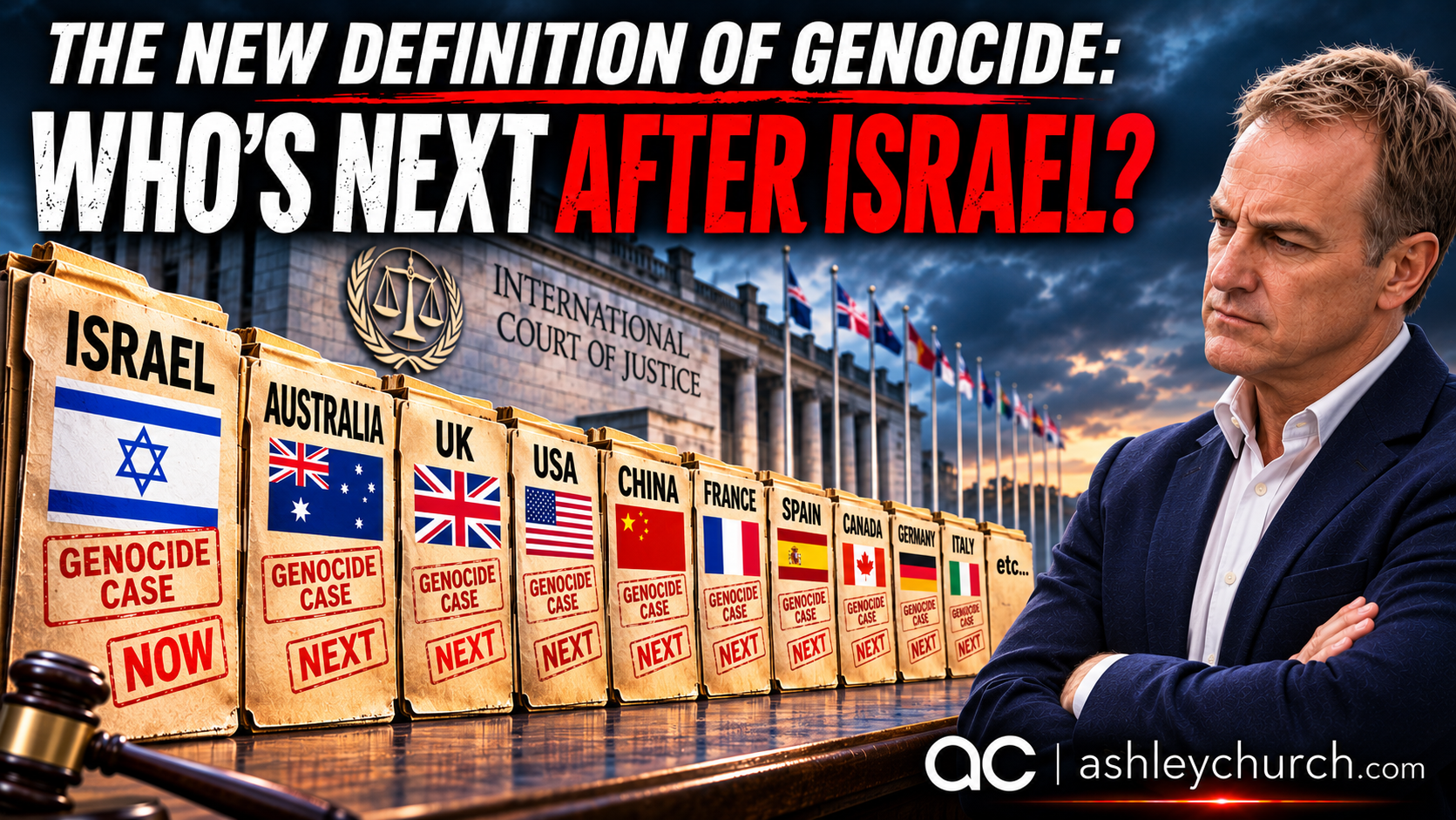
But the significance of the Myanmar ruling goes well beyond Israel. If this broader approach is to become the benchmark against which military conduct is assessed, Britain, France, Australia, the United States and countless other nations have all committed ‘genocide’ and would be fair game for class actions by aggrieved parties. That might be an uncomfortable reality – but it’s the logical conclusion of this new definition?
That is not simply a theoretical concern. Legal analysis published this week by the Lieber Institute at the United States Military Academy at West Point has already identified significant implications for the military operations of NATO countries arising from the Myanmar judgment.
International law cannot have one evidential standard for nations whose actions are politically unpopular and another for everybody else. Nor should its most serious criminal concepts be expanded or contracted according to the prevailing political climate.
Which brings us to the real motivation behind these actions.
Hatred of Jews has historically manifested itself in many forms. Sometimes it has been religious, sometimes racial, sometimes political. And one of its most enduring characteristics has been the willingness of societies to hold Jews to standards that they would never contemplate applying to themselves.
The relentless campaign to portray the Jewish state as uniquely criminal, and the willingness of some governments to seek changes to international jurisprudence in pursuit of that campaign, bears all the hallmarks of that same double standard.
Ireland’s coordinated interventions, the timing of its proposals, the warnings issued before the Myanmar judgment and the subsequent objections of six ICJ judges deserve considerably greater scrutiny than they have received. Taken together, they demonstrate that the effort to reshape the interpretation of genocide was driven by the desire to secure a finding against Israel.
And I now fear that it will be successful and that the ICJ will use this convenient new definition to find Israel responsible for genocide. Not because Israel has committed genocide – it hasn’t – but because the evidential benchmark has fundamentally changed and the interpretation of genocide has been broadened in precisely the direction sought by those campaigning for that outcome.
If that is what ultimately transpires, it will represent a monumental failure of international justice and a dangerous precedent for the rest of the world.
Justice is supposed to determine an outcome by applying the law to the evidence. Not reshape the law to accommodate a desired outcome.
So what do we do about it?
If you’re a Christian, I would encourage you to pray. It’s the one thing that all of us can do, regardless of where we live or what influence we have.
Pray fervently against an unjust ruling of genocide against Israel. Pray that the judges will resist political pressure and uphold the integrity of international law. And pray that the deliberate efforts to reshape that law will not succeed in delivering an antisemitic outcome.
We all know that the dark clouds are gathering – but perhaps we can hold them back for a little longer…
