
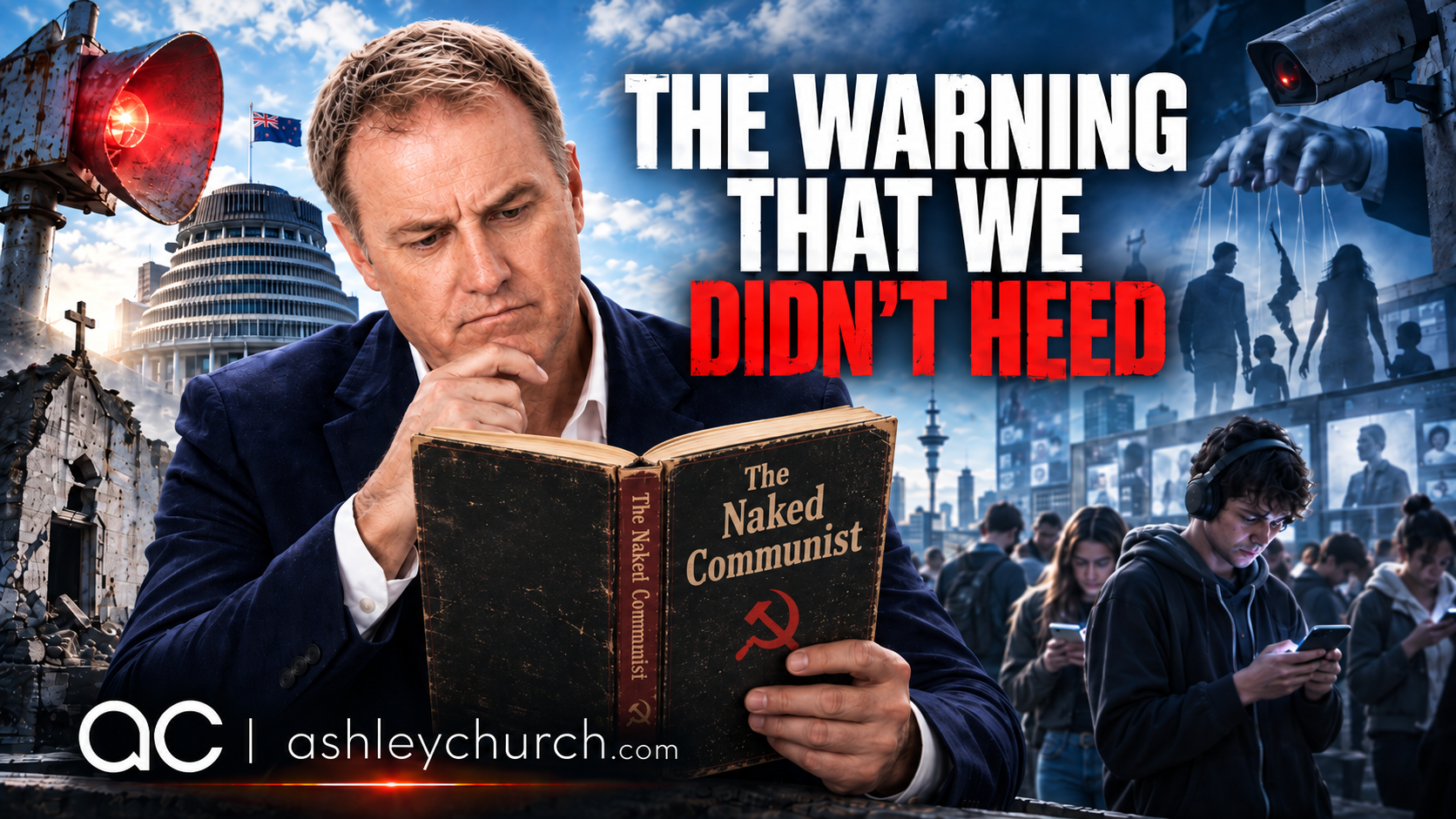
The warning that we didn’t heed
Who, or what, is really pulling the strings?
Most of us like to think that what we believe is the result of our own independent thought. That we look at the world, assess what we see, make our own judgements and arrive at conclusions which seem sensible to us. But none of us really develops our worldview in a vacuum. From the moment we’re born we’re being influenced by our parents, our schools, our universities, our churches, television, movies, music, politicians, journalists, social media and the people around us – and over time those influences help shape the things we come to regard as normal.
That’s not necessarily sinister – it’s simply how society works – but it does raise an interesting question around what is regarded as ‘normal’. Ideas which might once have been regarded as radical and subversive to one generation can – over time – become more accepted, then mainstream, until eventually a whole generation grows up with no idea that those ideas were ever regarded as radical at all. They simply become part of the cultural wallpaper.
I found myself thinking about this over the weekend while attending the Family First conference in Auckland. It was an excellent conference with a wide range of speakers and I’ll probably write about several things that came out of it over the next few days.
But one thing in particular caught my attention during Bob McCoskrie’s opening address. Bob referred to a book called The Naked Communist, written by an American named W. Cleon Skousen and first published in 1958.
Skousen wasn’t writing as a communist, but rather as someone who had spent years studying communist writings, congressional testimony, political developments and the ideological currents of his time – and the book was his attempt to draw those things together into a coherent picture of where he believed they were heading. In a later edition he included a list of 45 things he called the “Current Communist Goals”, and in January 1963 those goals were placed into the United States Congressional Record.
So there was no secret document containing his 45 points and there doesn’t appear to have been a single communist organisation working its way methodically through his list. Skousen was essentially joining the dots and saying, “This is what I believe is happening, these are the areas being targeted, and this is where I think it will lead.”
The extraordinary thing is that we can now test Skousen’s warning against the intervening 60+ years of history – and when you read what he wrote, today, the sense of recognition is eerie.
Among the many objectives Skousen identified were the gaining of influence over schools and teachers’ associations, the use of education to transmit ideological ideas, the gaining of influence over newspapers, radio, television and the motion picture industry and the systemic breakdown of traditional standards of morality. He also identified the infiltration of churches and the replacement of traditional religion with a form of social religion which discredited the Bible, the removal of prayer and religious expression from schools, the discrediting of the family as an institution and the creation of the idea that children needed to be liberated from the negative influence of their parents.
This isn’t a comprehensive summary of Skousen’s 45 warnings – but the ones I’ve mentioned caught my attention because they relate directly to the society in which we now live. Education, the media, sexuality, Christianity, the family, parental authority and the relationship between children and their parents have all changed dramatically over the past six decades. You may regard some of these changes as good – but no one can seriously argue that they haven’t happened.
And that’s where this starts to become much more than an interesting historical curiosity because this isn’t so much about Skousen’s remarkably foresight – but about ‘how’ these things happened in the intervening years.
For the record – I don’t believe that there is a giant committee sitting in a dark room somewhere ticking off Skousen’s list one item at a time. But nor do I believe that what happened was accidental.
And that’s where the question changes from ‘how’ to ‘why’.
Skousen’s warning was about Communism – but even that word conjures up images which are different to those intended by its creators. Marx and Engels weren’t really focused on economic systems and who owned the factories. They were proposing something much more fundamental – a “radical rupture of traditional ideas” which challenged the traditional family, dismissed religion and morality as products of an existing social order and envisaged an entirely different basis on which society would be organised.
This explains why family, faith, morality, education and the values passed from one generation had to be destroyed. These are the things which give a civilisation continuity and purpose and place limits on State power. A strong family creates loyalties which don’t belong to the state. Parents possess an authority which doesn’t originate with government. Christianity says that there is a power higher than government and a moral law which politicians don’t get to rewrite. Objective morality means that right and wrong aren’t simply whatever the prevailing culture decides they are.
Change these beliefs and, over time, you change the civilisation itself. Eventually order and morality is replaced with anarchy and dystopia.
And that’s exactly what has happened.
The Western society of 2026 is profoundly different from the Western society into which The Naked Communist was published in 1958. We’ve moved an extraordinary distance in many of the precise areas Skousen identified, to the point where ideas which would have been regarded as radical then are now accepted by millions of people as obvious and unremarkable.
But remember – we’re not yet at the end of that process. History teaches us that Communist regimes have differed enormously in culture and circumstance but have shared some disturbing characteristics. Power becomes increasingly concentrated, independent institutions are weakened, religion is abolished or recreated in the image of the State, dissent becomes harder, and the individual becomes increasingly subordinate to the political collective.
Which brings us back to the question of why. Who ultimately benefits?
As a Christian, I have an answer to that question.
The Bible describes human history as containing a struggle which goes much deeper than politics. It speaks of truth and deception, good and evil, and a spiritual enemy whose objective has always been to separate humanity from God and to corrupt the things God established for our good.
You don’t have to share my faith to recognise the historical transformation I’ve described, and I’m not suggesting that everybody involved in that transformation is consciously serving some evil purpose. That’s not how deception works. People can act with the very best of motives and still advance ideas whose ultimate consequences they neither intended nor understood.
And perhaps that’s why Skousen’s warning is worth revisiting 60 years later. Now that so many of the changes he predicted have actually happened, perhaps we should ask ourselves a question which is much bigger than Skousen, communism or politics: if family, faith, parental authority and traditional morality have been subjected to such sustained challenge for more than half a century, what was it about those things that made them such important targets in the first place?
Maybe, before simply assuming that every change represented progress, we should take another look at what we’ve left behind.
We might discover that some of the things we were encouraged to discard were protecting us from something much much darker….
Comment on this article on Facebook
Discover more from ashleychurch.com
Subscribe to get the latest posts sent to your email.
