
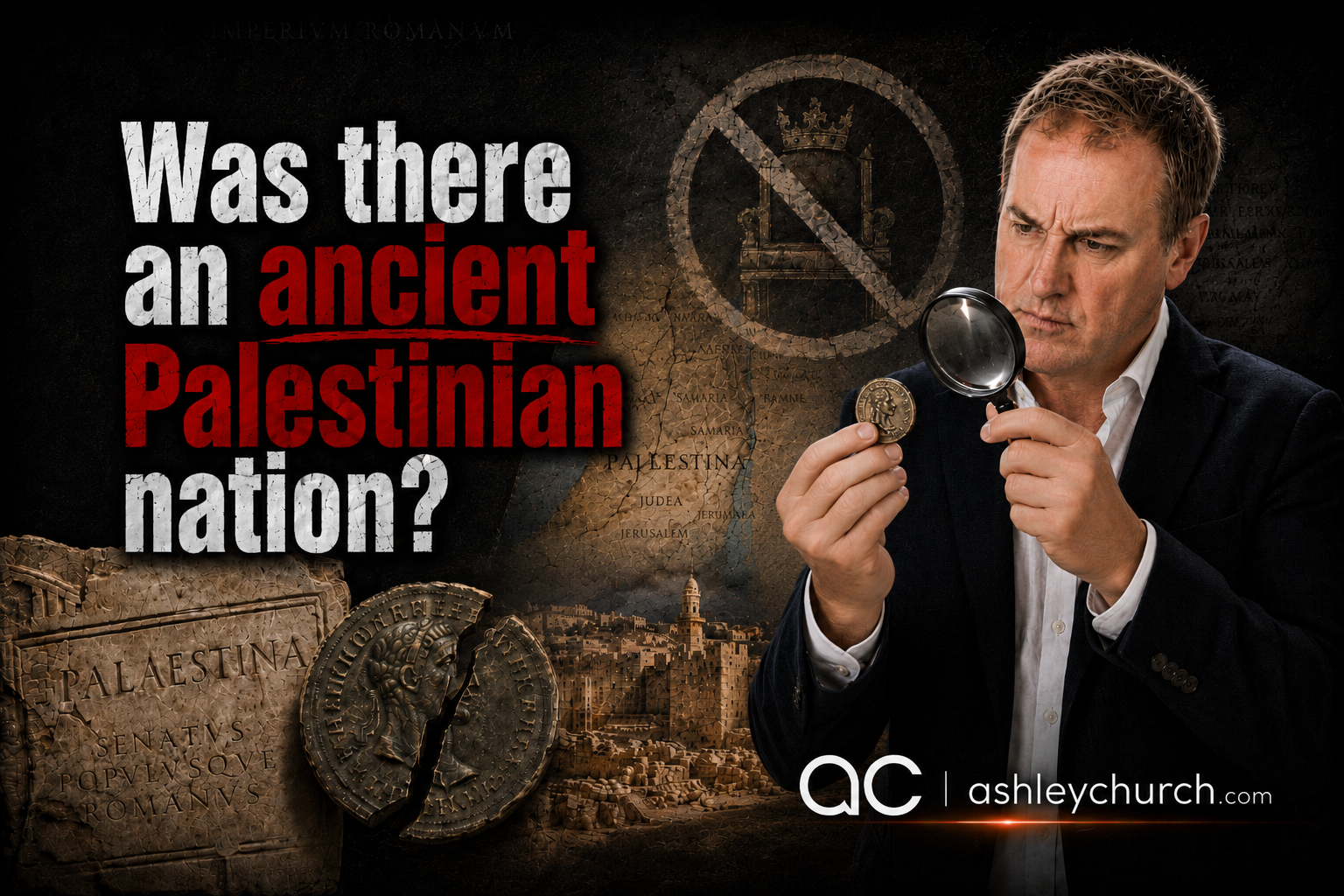
Was there an ancient Palestinian nation?
Separating fact from fiction
Ask any pro-‘Palestinian’ protestor what they’re marching for (or against) and most of them wouldn’t have a clue other than that they want all Jews eliminated. But amongst the few that actually have a broader opinion they’ll tell you that they want the Palestinian homeland returned to its rightful owners (‘from the river to the sea’) based on a belief that the original Arab inhabitants come from a land that was displaced by Britain and then stolen by Israel.
That belief is powerful. But is it true?
Let’s review the origin of the ‘Palestinians; to see if we can shed light on this misunderstood term:
1. Where does the term ‘Palestinian’ come from?
The term “Palestine’ is not Arabic in origin. Its roots go back to the ancient Philistines – an Aegean (mostly Greek) seafaring people who settled along the southeastern coast of the Mediterranean around 3,200 years ago, in roughly the area later associated with Gaza, Ashkelon and Ashdod. The Philistines were not Arabs and they disappeared from history at the time of the Babylonian conquest in the 6th Century BC.
2. So the ancient Philistines were the ancestors of today’s Palestinians?
No. Their name survived as a geographic label – but by the time the Romans took control of Judea, the Philistines had been gone for 600 years.
3. So the Romans invented the name Palestine?
No – but they made it politically significant in a new way. After the Bar Kokhba (Jewish) revolt in the second century AD, the Romans renamed the province of Judaea, ‘Syria Palaestina’ in an attempt to weaken, obscure and insult the Jewish connection to their own land.
4. So what happened to the name between Rome and the modern period?
After Roman rule, and for the next almost 2,000 years, the land passed through different empires and administrative systems. Under the Byzantines, forms of the name Palaestina were used for provinces. After the Arab Muslim conquests, the land became part of wider Islamic empires. Later it was ruled by the Ottomans (from what is now known as Turkey) for centuries – but through all that time, “Palestine” never existed as an independent nation-state. Ever. Check your history – you will find no Palestine kings, queens, or Caliphs anywhere – because they have never existed. It was a regional or geographical term used as a place-name by outsiders, administrators, scholars, travellers, empires and later European powers. That doesn’t mean that no Arabs lived there – of course they did – but the claim that Israel displaced a pre-existing sovereign Arab state called Palestine is historically false.
5. So what did the term “Palestinian” mean in the early 20th century?
It meant someone connected with the territory called Palestine – regardless of race or ethnicity. The term applied to Jews, Arabs, Christians, Muslims and others who lived in, came from, or were citizens of the territory known as Palestine under the British Mandate. In that sense, it worked like words such as “American,” “Canadian,” or “New Zealander.” An American can be white, black, Hispanic, Jewish, Asian, Arab, Christian, Muslim, atheist, immigrant, native-born, or anything else because “American” is a national or territorial label, not a single ethnicity. In the early 20th Century the word ‘Palestinian’ was the same – it identified a person’s connection to the territory – not their bloodline.
6. So Jews were once called Palestinians?
Absolutely, yes. Under the British Mandate, the geographical term ‘Palestinian’ was still in use to describe inhabitants of that land – so yes, Jews living in the territory were described as Palestinians. The Mandate itself even referred to Palestinian citizenship and included provisions to allow Jews who took up permanent residence there to acquire it. This is why the old Jewish newspaper was called The Palestine Post before it became The Jerusalem Post and why the Palestine Symphony Orchestra, founded in Tel Aviv in 1936, was a Jewish institution. Its musicians were overwhelmingly Jewish refugees and émigrés from Europe, recruited by Bronisław Huberman before the Holocaust. After Israel’s re-establishment, it became the Israel Philharmonic Orchestra. A Jew living in British Mandate Palestine could be a Palestinian in the territorial sense, just as a Jew living in New Zealand can be a New Zealander.
7. When did “Palestinian” become mostly associated with Arabs?
The term ‘Palestinian’ didn’t really become exclusively associated with Arabs until after 1948 and 1967 when Jews begun to identify themselves as Israeli – leaving the term to increasingly describe the displaced Arab population. Then, after the 1967 war, the Palestine Liberation Organization (which had been founded three years earlier) began to use the term as a description of Arab nationalism. That was the big shift. An old territorial label became a modern national identity.
8. What about the claim that Yasser Arafat invented the Palestinians?
It’s a great story but it’s not true. Arab life and the term Palestinian both existed before him – but what he did was help turn the word into the central political identity of a national movement. The PLO’s own charter defined Palestinians as Arab nationals who had normally lived in Palestine until 1947, whether they remained or were expelled, along with their descendants. That definition is revealing. It does not define Palestinians as descendants of the ancient Philistines, nor does it define them as citizens of a previous sovereign state of Palestine. Instead, it defines them as Arabs connected to the territory of British Mandate Palestine before Israel’s creation. That is a modern political definition not an ancient connection.
9. Is it still accurate to describe ‘Palestine’ as an Arab homeland prior to Israel?
It depends on what you mean by “homeland.” There were certainly Arabs living in the land and in many areas they were the majority. But we need to pick our definitions carefully. Arabs absolutely lived there and had deep attachments to the land – but neither they, nor their ancestors, ever lived in a sovereign Arab state called Palestine. And they weren’t ‘invaded’ by the Jews – the Jews already lived there too – in fact the Jewish connection to the land is much much older than the Arab connection. That’s the part the slogans usually leave out.
10. Why does this all matter?
Because words shape the argument. If people are told that Israel stole an ancient sovereign Arab nation called Palestine from its native people, they will see Israel as a colonial thief. But when they learn that “Palestine” was historically a geographical term, that “Palestinian” once applied to Jews as well as Arabs, that no sovereign state of Palestine has ever existed, and that modern Palestinian identity developed largely in the mid-20th century, the moral picture changes.
The Jewish people – the majority of the inhabitants of modern Israel – have, by far, the oldest surviving national claim to the land.
That does not mean Arabs didn’t live there. They did. It doesn’t mean they had no attachment to the land. Many clearly did.
But it does mean the story now being shouted in Western streets is not history. There was no ancient sovereign state of Palestine. There was no displaced Palestinian kingdom. There was no Arab nation called Palestine stolen by Jews who had no connection to the place.
There was an ancient Jewish homeland, later ruled by empire after empire, given a Roman name, administered as a British territory, and eventually reborn as Israel.
So the word “Palestinian” is real.
The activist myth attached to it is not….
You can interact with this article on Facebook by clicking here
Find out more about my book Prophecy Shock by clicking here
Discover more from ashleychurch.com
Subscribe to get the latest posts sent to your email.
