
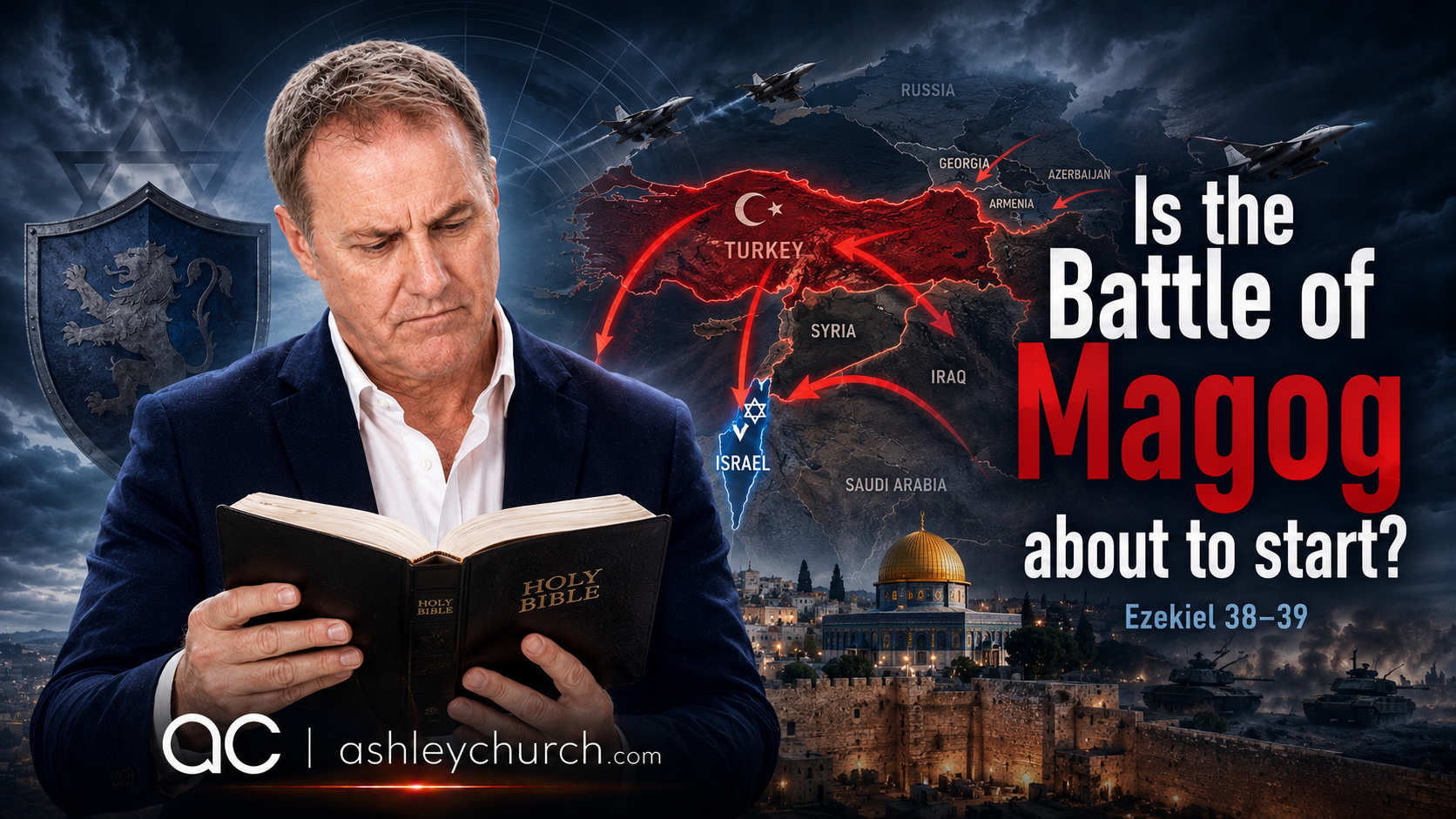
Is the Battle of Magog about to start?
A new defense pact with major implications
Over the past few weeks I’ve noticed a steady increase in the number of social media posts and YouTube videos talking about ‘last days’ bible prophecy.
That may simply be the algorithms feeding me more of the things they think I want to see or a reflection of a genuine increase in content related to these topics – but either way, there’s certainly no shortage of people trying to connect the latest political developments with the writings of Ezekiel, Daniel, Zechariah or John.
But – surprisingly – there’s been one fairly significant development that seems to have passed almost completely under the prophetic radar.
On 7 August, Turkey, Saudi Arabia and Pakistan signed what is being called the Mecca Joint Defence Agreement.
On the surface, it sounds like just another of the many agreements that periodically emerge from the Middle East. But this one is a little different. In this case, the three countries have agreed that an armed attack against any one of them will be regarded as an attack against all three.
If that sounds familiar, it should. It’s essentially the core principle behind NATO.
The North Atlantic Treaty Organisation (NATO) was established in 1949 in the aftermath of the Second World War as a collective defence organisation and its famous Article 5 says that an armed attack against one member will be considered an attack against them all.
It started with just 12 countries, but others joined progressively as the organisation developed and as countries decided that their security interests were better served by being inside the tent rather than outside it.
Importantly, NATO’s growth didn’t happen at a steady pace. There were long periods when very little changed, followed by bursts of expansion as the geopolitical environment shifted. The most obvious example came after the end of the Cold War and the collapse of the Soviet bloc, when a large number of former Eastern European states progressively joined the alliance over a relatively short period to protect themselves from being absorbed back into a resurgent Russia at some point in the future.
This was a perfect example of the alliance growing quickly when regional circumstances changed and, as a result, NATO membership now stands at 32 nations.
The new Middle Eastern agreement is obviously nowhere near that scale, but it’s worth noting that Turkey itself has already described the mutual defence provision as technically similar to NATO’s Article 5 and has made it clear that the new arrangement could eventually include other countries.
Egypt has already been discussed as a possible future member, while Bangladesh has reportedly begun considering whether it too might join.
So this could potentially be the beginning of something much larger – and that’s where things start to get interesting from a bible prophecy perspective.
Ezekiel chapters 38 and 39 describe a future coalition of nations which comes against Israel in what is usually referred to as the Battle of Gog and Magog.
For many years, parts of the Christian Church taught that Gog and Magog pointed toward Russia, but that interpretation hasn’t aged well. More recent scholarship has gone back to the ancient geographical evidence and determined that the ancient placenames in the prophecy are a much more logical match to places in modern day Turkey and the surrounding region. Joel Richardson and others have written extensively on this and the geographical case is now pretty much settled that Turkey can be identified as the geographical centre of the Gog and Magog prophecy.
That matters because Turkey isn’t merely one of the countries participating in this new agreement. It’s the architect.
Think about that for a moment: a major Muslim country which can credibly be associated with the leadership geography of Ezekiel 38 has just helped create a new collective defence organisation involving other Muslim nations – with more in discussion for possible membership.
And all of this is happening at a time when hostility toward Israel across much of the Islamic world is extremely high – so you can probably see where I’m going with this.
Has Turkey just begun assembling the coalition described by Ezekiel?
At first glance, it’s an enticing thought – but there are several problems.
The first is Saudi Arabia. While the Saudis are founding members of this new agreement they’re explicitly not part of the invading force in the Gog and Magog battle of Ezekiel 38. Instead, they’re identified in the prophecy as ‘Sheba and Dedan’ and portrayed as observers to the battle where they challenge what Gog is doing and ask him whether he has come ‘to take a spoil’.
Of course, Alliances change and this new organisation could be a very early precursor to a future coalition which doesn’t include the Saudis. Yesterday’s strategic partner can become tomorrow’s adversary.
But there’s an even bigger problem: Iran. Ezekiel specifically names Persia as one of the countries participating in Gog’s assault on Israel and there’s no real mystery about that identification. Ancient Persia is modern Iran.
Yet Iran isn’t part of this new alliance. In fact, one of the ironies of the present arrangement is that concern about Iran may be one of the things making this kind of collective security agreement attractive to Saudi Arabia in the first place.
The agreement itself doesn’t name either Iran or Israel as the enemy it’s designed to defend against, and its members don’t necessarily share the same threat assessment. While Saudi Arabia has obvious reasons to remain deeply concerned about Iran and Iranian-backed forces – Turkey has become increasingly hostile toward Israel.
And then there is Pakistan. Pakistan gives the new pact considerable strategic weight. It has a large military, a population of more than 250 million and nuclear weapons. It also has its own strategic priorities, particularly around India.
But there’s no obvious or convincing identification of Pakistan anywhere among the nations specifically named in Ezekiel 38 – and, at the same time, several of the nations which should be in the Ezekiel alliance are missing.
So if someone were to point to the Mecca agreement today and announce that the Battle of Gog and Magog is now assembling before our eyes, I’d suggest that they’re getting ahead of the evidence.
The pieces simply don’t fit. At least, not yet.
But that last qualification is important. NATO didn’t arrive fully formed either. It began with a relatively small group of countries united around common security concerns and then changed dramatically over the decades that followed.
And there’s no reason to assume that a Middle Eastern equivalent would necessarily take 70 years to do the same thing.
We don’t know.
And that’s really the point.
Bible prophecy isn’t a licence to grab every contemporary event and force it into a verse because some of the pieces look vaguely familiar.
If Ezekiel gives us details, then those details matter – and the new Mecca Pact doesn’t currently meet them.
If you’ve read Prophecy Shock, you’ll know that one of the central arguments of the book is that Scripture has been remarkably accurate in its accounting of history as it relates to Israel and Jerusalem.
Again and again, prophecy which has been treated as vague, symbolic or still future turns out to line up with identifiable historical events with remarkable precision.
But Scripture also has more to say about what happens next.
And when it comes to Gog and Magog, one characteristic is absolutely central: the coalition comes against Israel.
So what does lie ahead? That question will be examined in much greater detail in my upcoming book Prophecy Shock: What Happens Next, which I hope to publish toward the end of 2027.
Meantime, I’d be watching events as they unfold in the Middle East – with a particular eye on Turkey.
Comment on this article on Facebook
Discover more from ashleychurch.com
Subscribe to get the latest posts sent to your email.
