
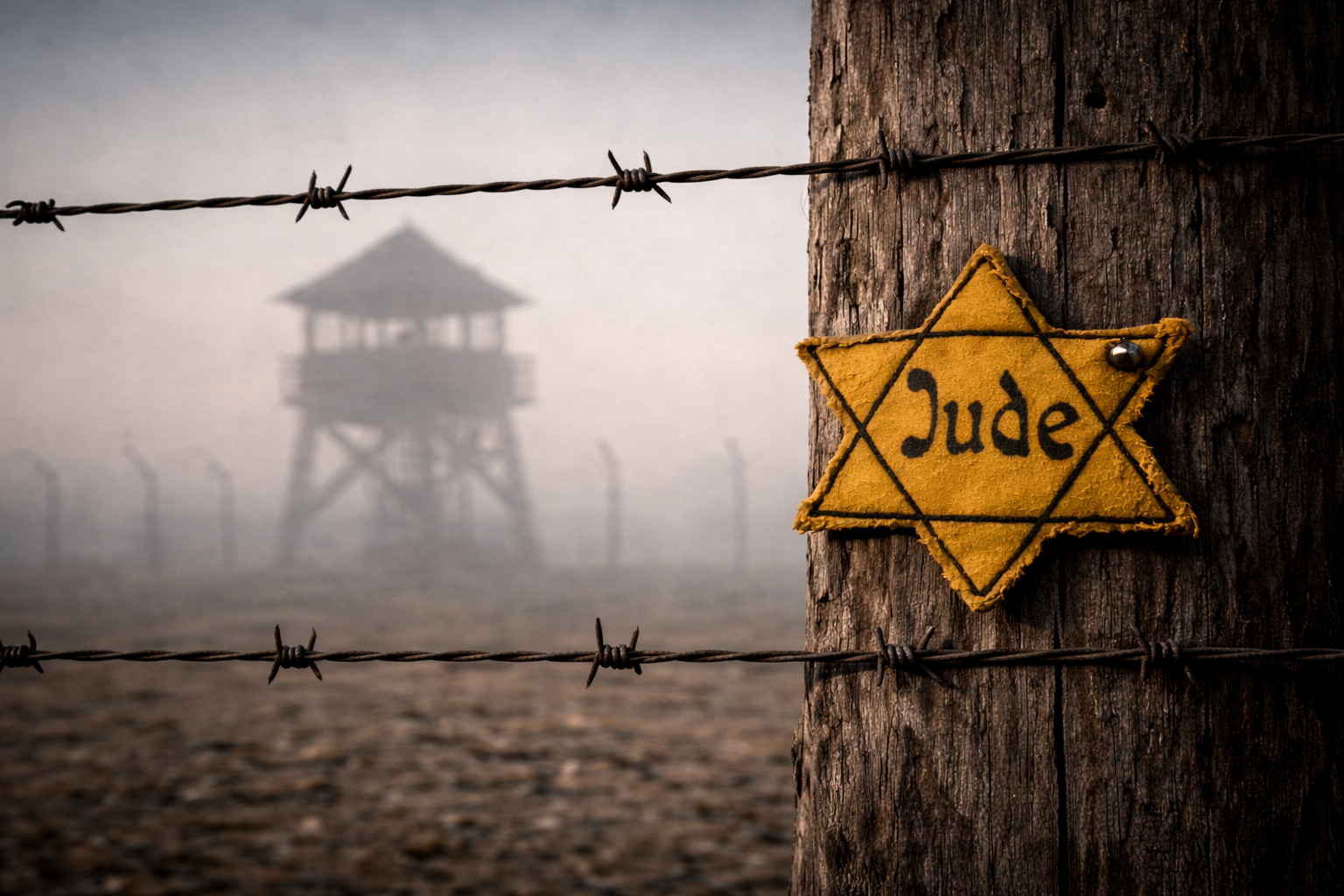
The hollow refrain of “Never Again”
Why Holocaust remembrance is more important than ever
The Holocaust did not begin with the gas chambers of Auschwitz or Treblinka. It began much earlier, with ideas, laws, exclusions, and the slow normalisation of cruelty. The part that history often forgets.
When Hitler became Chancellor of Germany in 1933, there was no plan to exterminate the Jews. What did exist was a heavily racist worldview: that Jews were alien, that they were a corrosive presence within society – and that the economic hardship, moral decay, and national humiliation that the Germans were facing was their fault.
So the early years were not about mass murder. They were about isolation.
- 1933–1935: In an eerie echo of the past couple of years, Jewish professionals were dismissed from public service. Jews were excluded from universities, media, law, and medicine. Boycotts of Jewish businesses were encouraged and enforced.
- 1935: The Nuremberg Laws stripped Jews of German citizenship and outlawed intermarriage. Jews were formally redefined as outsiders.
- 1938: ‘Kristallnacht’ marked a decisive escalation. Synagogues were burned, Jewish businesses destroyed, homes ransacked, and tens of thousands arrested-open violence, now state-sanctioned.
At every stage, the cruelty increased incrementally. Each step made the next possible. Each outrage became the new normal.
By the outbreak of war in 1939, Jews across German-controlled Europe were being forced into ghettos, subjected to starvation, disease, forced labour, and arbitrary killings. Deportations followed. Mass shootings by Einsatzgruppen began in Eastern Europe in 1941.
Still, even then, the machinery of total extermination had not yet been formally articulated.
That happened on 20 January 1942 when senior Nazi officials met at a villa in Wannsee, outside Berlin. The meeting didn’t debate whether Jews should be killed – that question had already been settled by ideology and practice. Instead, Wannsee was about coordination.
The “Final Solution to the Jewish Question” was formalised as a continent-wide, industrial process: the systematic deportation and murder of Europe’s Jews. Purpose-built extermination camps followed. Rail timetables were drawn up. Bureaucracy did what it does best – efficiently.
By the time the war ended, six million Jews were dead. Not because the world didn’t know – but because it looked away, rationalised, delayed, and normalised the unimaginable until it was too late.
But the Holocaust was not an aberration in Jewish history. It was just its most industrialised expression.
For more than two millennia, Jews have been expelled, ghettoised, scapegoated, and massacred across continents:
- Occupied by the Babylonians, the Persians and the Greeks
- Expelled from Roman Judea.
- Persecuted across medieval Europe.
- Accused of blood libels and well-poisoning.
- Expelled from England (1290), France (multiple times), Spain (1492).
- Confined to ghettos.
- Massacred in pogroms across Eastern Europe and Russia.
The pattern is unmistakable: Jews tolerated when useful, vilified when convenient, attacked when politically expedient. As such, Germany did not invent antisemitism – it simply systematised it.
So, when Zionism arose in the 19th century, it wasn’t through an imaginary desire for conquest or supremacy. It was through exhaustion.
Zionism recognised the unavoidable lesson. That no matter how integrated the Jews became, no matter how loyal or assimilated, they were never truly safe. Rights could be withdrawn overnight. Citizenship could be revoked. Neighbours could become executioners.
So Zionism proposed a simple proposition: a people without safety needed a homeland. And not just any homeland. Their own homeland – on land which they had possessed for thousands of years and from which they had been expelled in relatively recent history.
But at the time that the Zionist movement started in 1897 that land was a province of the Ottoman Empire and had been for almost 400 years. Prior to that it had been a territory of various Islamic powers – always ruled at a distance, never an independent nation.
So the Zionist movement encouraged Jews to do what reasonable people do. They didn’t build armies and form terrorist movements. They purchased land. They engaged in diplomacy, they negotiated. They sought legitimacy within the circumstances as they existed at the time.
But less than 20 years later – everything changed. The Ottomans were defeated during WW1 and the territory came under the administration of the British by international mandate. The Brits recognised that two different peoples lived there and that no ‘sovereignty’ existed – so they proposed to divide the land into two newly created nations (just as they did in other parts of the Middle East).
The Jewish leadership engaged with that process, accepted partition proposals, and even agreed to share their portion of the land with Arabs that were already living there, and live alongside them.
Some agreed. Many did not because – not satisfied to be offered their own nation – many Arabs wanted the Jewish land too.
This stalemate continued for years, with the British increasingly favouring their own economic and political interests over the established birthright of the Jews and, for a while, the establishment of a homeland seemed further away than ever.
And then the world changed again. The deathcamps of Europe tried to annihilate the Jewish people and finally the world understood what the Jews had been telling them: that the only way for the Jewish people to be safe was in an environment which they controlled their own destiny. In their own land.
So the State of Israel was declared in 1948. Not by military might – but by the agreement of the world community following a UN-backed partition plan. But the surrounding Arab states rejected coexistence and launched a war aimed at annihilation. Many Arab residents fled, expecting a swift victory and a return. That victory never came.
Israel survived. Barely.
And so the cycle continues. Eighty years after the Holocaust, Jews once again find themselves singled out.
- Once again, attacks on Jewish communities worldwide have surged.
- Antisemitic rhetoric is rebranded as political virtue.
- Israel – the only Jewish state – is judged by standards applied to no other nation. Its right to exist is debated openly. Its people are told that self-defence is aggression, survival is provocation, and that history should be forgotten.
Once again, the wheels of irrational hatred are turning again and we’re reminded of why we remember the Holocaust. Because “Never again” was never meant to be a slogan. It was meant to be a warning.
Any reasonable person can understand why Israel is uncompromising about its security. History has taught the Jews that promises fail, guarantees expire, and sympathy evaporates under pressure and changing leadership.
Holocaust Remembrance Day is not just about mourning the dead. It is about recognising the pattern that led to those deaths while there is still time to interrupt it.
Because the Holocaust did not begin with gas chambers. It began with the same things that we’re seeing, right now.
And history has a habit of repeating itself – first slowly, then all at once.
Discover more from ashleychurch.com
Subscribe to get the latest posts sent to your email.
