
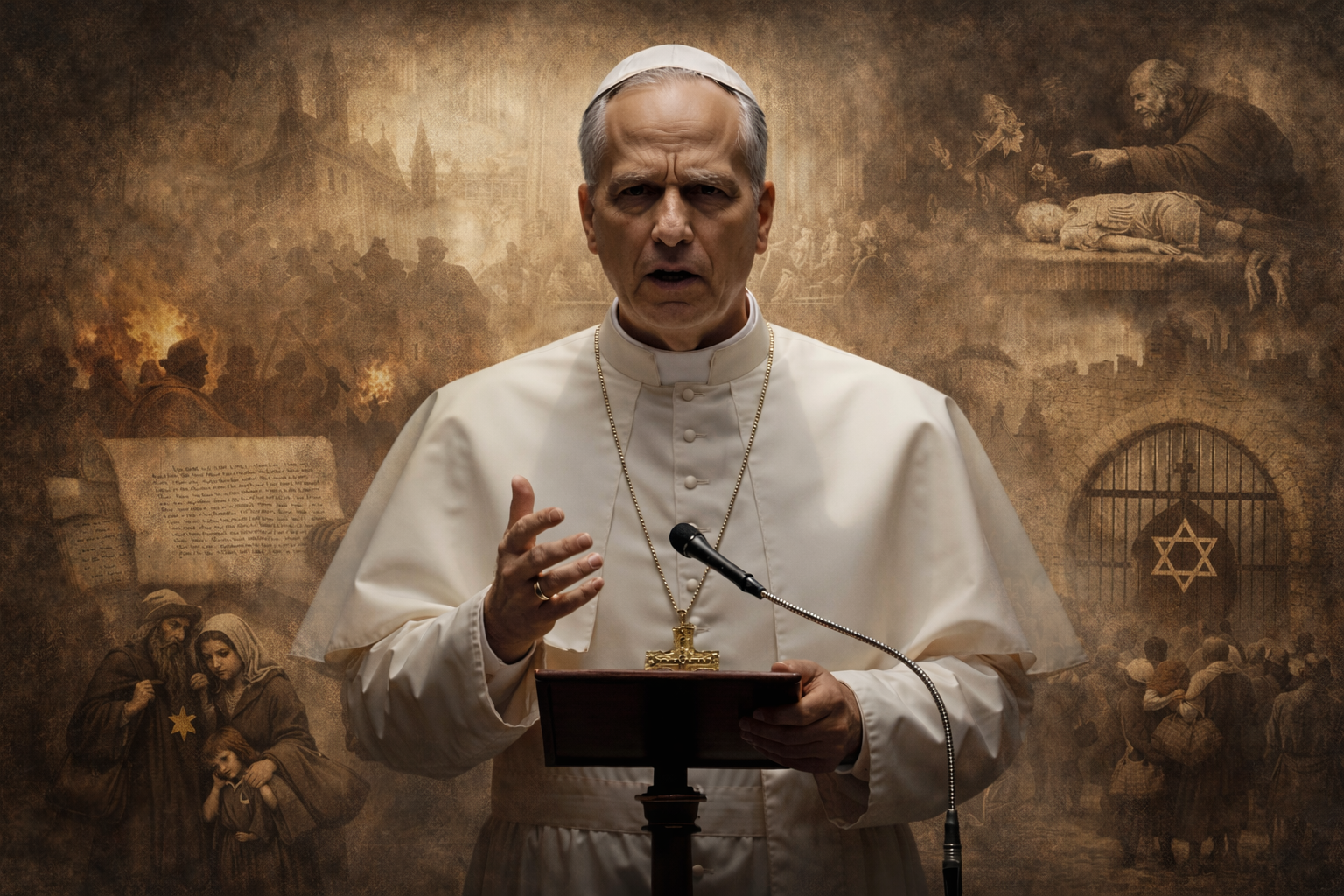
Why the Pope’s views on the Middle East should be treated with caution
An old hatred repackaged for the 21st century
Over the past few weeks, readers will have noticed a more assertive tone emerging from the Vatican. Pope Leo has stepped more deliberately into the geopolitical arena, offering commentary on events in the Middle East and positioning himself as a moral voice on international affairs.
In many quarters this has been welcomed. Surely the emergence of a respected spiritual leader into one of the world’s most complex conflicts should be a good thing? Surely a voice grounded in faith might bring clarity, balance, and even wisdom to a fractured and volatile region?
But that instinct rests on a very large assumption. It assumes that the Catholic Church is what it has spent the last century presenting itself as: a fundamentally moral institution, shaped by faith, operating above politics, and capable of offering neutral and principled guidance on global affairs.
But history tells a very different story. The Catholic Church is not a detached spiritual body – it is a political power – one of the most enduring in human history. And the history of that institution is not pretty and it certainly isn’t ‘Christian’.
For over a thousand years, the papacy ruled territory directly, raised armies, influenced monarchs, and shaped the political direction of Europe – and even today, it operates as a sovereign state. This is not a background detail. It is the defining context.
Once that is understood, its role in history becomes much easier to recognise and much harder to excuse because it is not a history of detached moral leadership. It’s a history marked by coercion, blood, and repeated persecution of Jews.
As early as the 4th century AD, when Catholicism was consolidating power in the Roman Empire, anti-Jewish theology was already hardening into anti-Jewish law designed to segregate Jews and curtail their freedoms.
In the 380s AD, John Chrysostom delivered his notorious sermons Against the Jews, helping entrench the idea of Jews as a dangerous and corrupting presence within Catholic society.
In 589 AD, the Third Council of Toledo marked the establishment of Catholicism as the state religion in Visigothic Spain. From there, Church and state became increasingly fused, and the later Councils of Toledo, especially through the 7th century, formed part of the legal and political framework that pressed Jews toward subordination and coercion.
In 1096 crusading mobs massacred Jews in Speyer, Worms, Mainz, and Cologne, in what Britannica calls a pivotal moment in the history of antisemitism.
In 1144 we saw the emergence of the blood libel – the grotesque lie that Jews murdered Catholic children for ritual purposes, and that slander repeatedly triggered persecution and mob violence across Europe. The US Holocaust Memorial Museum notes that blood libels became a major engine of anti-Jewish hatred through the Middle Ages and beyond.
Then came formal discrimination. In 1215, the Fourth Lateran Council ordered Jews to wear distinctive dress, publicly marking them out as a separate and despised class.
In the centuries that followed, Jews were expelled from Catholic country after Catholic country, including England in 1290, from France in 1182, 1306, and 1394, from parts of the Holy Roman Empire in the late Middle Ages, from Hungary in 1376, from Austria in 1421, from Spain in 1492, from Sicily in 1492-1493, from Portugal in 1497, from Provence in 1512, and from the Papal States in 1569..
When plague swept Europe in the fourteenth century, Jews were accused of poisoning wells and were slaughtered in large numbers. And in 1555, Pope Paul IV established the Roman ghetto and imposed harsh segregation on the Jews of Rome itself, right at the centre of Catholic power.
The point is that Jews were not a side issue in Catholic history. They were one of its central targets. Again and again, Catholic power worked to produce the same result: Jewish humiliation, Jewish dispossession, Jewish exile, and Jewish death. That was not an occasional lapse. It was a pattern.
I’m aware that some will point to the 1965 Nostra Aetate where the Catholic Church softened its language toward the Jews and formally condemned antisemitism. On paper, the rhetoric sounded great and looked like repentance but it should not be confused with real change. In practice, it was little more than rebranding. The language changed, the underlying behaviour did not – in fact, the Vatican’s line on Jerusalem, Palestinian statehood, and repeated pressure on Israel has remained strikingly consistent across successive modern papacies.
 John Paul II called for a special internationally guaranteed statute for Jerusalem, stripping Israel of sovereignty over its own ancient Capital.
Benedict XVI publicly supported a sovereign Palestinian homeland and sharply criticised Israel’s security barrier.
Francis welcomed Palestine’s upgraded UN status and formally recognised the “State of Palestine” in 2015.
Francis also later escalated his criticism of Israel over Gaza in severe moral language which ignored the reality of the conflict.
This trend continues with the latest Pope Leo. While he has made formal statements condemning antisemitism, consistent with the Church’s post-1965 rhetoric, that should not be confused with the substance of his recent commentary on the Middle East. In statement after statement, Leo has placed the moral weight of the Gaza conflict on Israel: describing events there as “increasingly painful,” calling for an “immediate halt to the barbarity,” emphasising the “agonising price” being paid by civilians, and repeatedly urging ceasefire, negotiations, and a two-state solution framed around Palestinian claims.
The language is measured but the framing is not neutral – so Leo is not breaking new ground – he is simply continuing a 2,000 year old pattern that is hard to miss.
For this reason, the recent Catholic support of Islam shouldn’t surprise us. While Catholicism and Islam have been ideologically opposed for most of the past 1,500 years – they have always agreed on one thing – their hatred of the Jews. Catholicism may have chosen diplomacy over warfare in recent history – but the objective remains the same. Behind the respectable façade the same old hostility remains.
Sure, this hostility is no longer expressed as naked contempt for Jews as Jews. Instead, it has simply been transferred and repackaged. What was once directed at Jews personally is now directed at Jews nationally, through the state of Israel.
Antisemitism became anti-Zionism.
The language changed. The target never did.
I’m at pains to note that this is not an attack on individual Catholics. I hate to use the cliched “Some of my best friends are….” line – but some of my friends really ‘are’ Catholics and many of them are people who love Israel and work with me in various advocacy forums. But that support for Israel is in spite of the position of the Catholic Church – not because of it – and while I value them as fellow Christians, I will continue to challenge the institutional antisemtism of the organisation to which they belong.
When the Catholic Pope steps forward and offers his perspective on Israel and the Middle East, this is not the intervention of a neutral observer, a balanced broker, or a detached spiritual guide.
It is the latest expression of an institution with a long and bloodstained record of persecuting Jews, and a modern record of repackaging that hostility in the language of diplomacy, moral framing, and pressure on Jewish sovereignty.
This is not a departure from the sins and hatred of the past.
It is the same Catholic Church in a different cassock.
Discover more from ashleychurch.com
Subscribe to get the latest posts sent to your email.
