
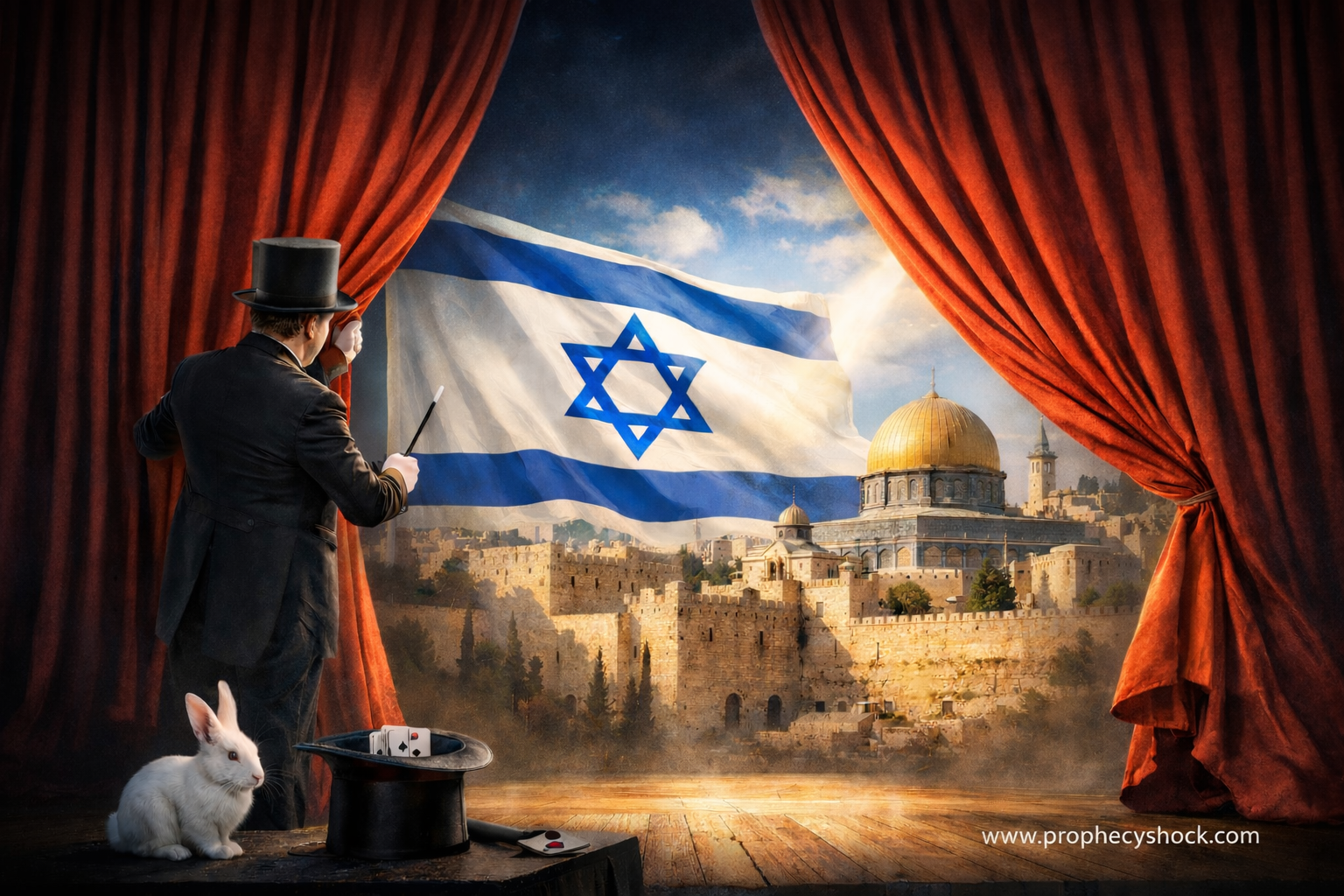
Pulling back the curtain on today’s headlines
Discerning the future from the writings of the past
Have you ever watched a magic trick which has left you scratching your head – only for the penny to drop once you saw how it was done? What initially looked impossible became relatively straightforward once the mechanism behind it was revealed.
The past few years have been a bit like that, for me.
Over that time it has been my privilege to write and speak about Israel and the Jewish people. Not just in the context of the events of 7 October 2023 – but going back much further than that. In fact, I’ve been writing on this topic since around 2017 and over that time I’ve built up an audience of people for whom my writing has clearly resonated.
My views, over that time, have been grounded on two consistent themes: that, globally, there is a rising moral vacuum that has given oxygen to a massive jump in the ancient stain of antisemitism that we’re seeing around the world; and that the right of the Jewish people to their own land is established in both recent law and accumulated history.
So, for some, I’m sure that my recent excursions into the topic of bible prophecy have seemed a bit strange.
And it’s not just the odd mention here and there – I’ve gone in boots-and-all and even published a book on the topic (Prophecy Shock, which, somewhat to my surprise, has just reached number one on Amazon in New Zealand and Australia).
I’m not oblivious to the fact that this is an uncomfortable topic for many people. If your worldview is not faith-based, prophecy – particularly bible prophecy – can just seem airy fairy – full of beasts, dark shadows and great claims that never seem to get any closer to actually happening. And even within the faith communities – Judaism and Christianity – the subject of prophecy is a minefield within a smorgasbord of competing opinions about what it even means.
So why wade into all of that when I had a perfectly good platform from which to speak about Israel and the Jewish people within a wider geopolitical context?
Because, for me, they’re the same thing. My ability to clearly articulate what was happening at any given time, as well as to anticipate what was likely to happen next, weren’t ‘lucky guesses’ – they were based on a solid understanding of the prophetic backdrop to all of this.
In other words, the views I’ve expressed publicly in support of Israel over the years have not been formed in isolation. They have emerged from a much longer process of study that goes back decades. So I’m not changing my direction – I’m just making much more explicit where that direction comes from.
But if prophecy is such a reliable indicator of these matters, why is it surrounded by so much confusion?
Talk to ten people about what prophecy actually means and you’ll get ten different answers. Within Judaism there are multiple positions – within Christianity there are even more – and for most Jews and Christians, the school of interpretation they follow comes down to the views they’ve absorbed from their Rabbi or Pastor, or through books that they’ve read, teaching that they’ve been exposed to or conversations with others.
Each of these systems for understanding the meaning of prophecy has its own internal logic, and each can appear persuasive. But they can’t all be correct – in fact, in many important respects they are mutually exclusive, which means that if one is right, the others are not, and it is entirely possible that none of them are right.
But if this field of study is so fractured – why am I making it the basis of my worldview? Am I smarter than everyone who has preceded me? Have I had some new spiritual revelation?
No, to both – in fact I’m in awe of some of the intellectual giants who have expounded on this topic over the centuries. Isaac Newton, Johannes Kepler, Francis Bacon, and other founders of modern science treated it as part of their search for order and truth. John Adams and Abraham Lincoln both framed national catastrophe in providential and near-prophetic terms. Winston Churchill viewed the modern Middle East, and the return of the Jews to their land, through a consciously biblical lens. Major historians such as Arnold Toynbee saw biblical prophecy as a framework for understanding the rise and collapse of civilisations. Writers including John Milton and Leo Tolstoy wrestled deeply with its moral and historical implications.
I pale into insignificance relative to these heavyweights and, in truth I haven’t introduced anything ‘new’ to this study at all. But I didn’t need to. Everything I needed to understand what prophecy actually means is right there in scripture for those who are prepared to stand back and see it. The many interpretative systems that we’ve inherit can be complicated, but the text itself is not.
What looks like confusion isn’t coming from the text, it’s coming from how we’ve learned to interpret it.
Strip that back, and the picture becomes much simpler: Prophecy is overwhelmingly about Israel and the Jews.
Not occasionally, not symbolically, and not as something that can be replaced – but as a central thread running through both the Old and New Testament.
So if my writings about Israel and the Jews sound prescient it’s not because I’m smart or because I’m particularly skilled at discerning political trends. It’s because the events taking place in todays headlines are the consequence of prophecies that were written over 2,500 years ago, which were fulfilled within living memory – and which speak to what’s happening right now. Not next week or in a future seven year sequence of calamities – but right now.
The implications of that understanding are staggering…..
Discover more from ashleychurch.com
Subscribe to get the latest posts sent to your email.
