
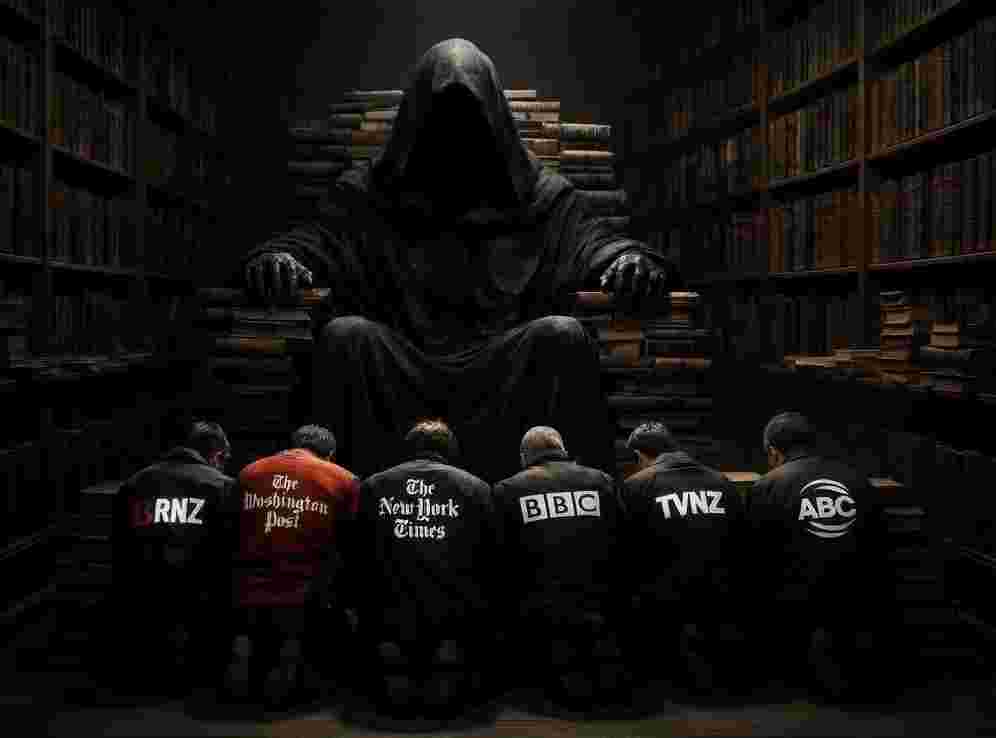
The most dangerous media organisation on Earth
The real threat is the one that you don't recognise
Most people in the Western world have now worked out that the old media priesthood can no longer be trusted – but there’s one media organisation, in particular, that constitutes a greater threat to free speech than, arguably, all of the others combined.
It isn’t the New York Times, the Washington Post, or even the BBC. Nor is it CBC, in Canada; the ABC, in Australia, or even TVNZ or RNZ here in New Zealand.
Yes, all of these organisations are now blatantly and openly biased in their ‘news’ coverage and all have them have long since given up any pretense of balance in favour of an extreme-leftwing ideological framing of issues. But we all know this. We’re now acutely aware that these platforms can no longer be trusted and we either ignore them or treat anything that they say with extreme caution.
That makes them far less dangerous than they once were.
But there is another media organisation that has escaped serious scrutiny and is still regarded as ‘authoritative’, ‘accurate’ and ‘neutral’. That makes it far more dangerous than any of these others.
That organisation is Wikipedia.
An encyclopedia or a media organisation?
Most of us regard Wikipedia as a trusted source of unbiased information – but, in practice, it is a kind of aggregator of consensus opinion. It compiles information on a subject by inviting input from anyone with an interest in that topic – then relies on the editing process to produce something that, in theory at least, approximates the truth.
But that model breaks down completely when the editing class itself becomes ideological. Once that happens, Wikipedia stops being an aggregator and starts becoming an instrument for narrative management – and that’s exactly what has happened on a wide range of politically, culturally and religiously sensitive topics.
What an encyclopedia is supposed to do
Wikipedia co-founder Larry Sanger (who has been estranged from Wikipedia since 2002) argues that, on controversial topics, a properly written encyclopedia article should be written in such a way that the reader cannot tell what side the writer is on.
It should map the terrain fairly, summarise the major views honestly, and let readers draw their own conclusions. Wikipedia’s own Neutral Point of View policy says that entries should represent significant viewpoints “fairly, proportionately, and, as far as possible, without editorial bias.”
But on some of the most contentious issues of our time, Wikipedia completely fails that test. On these issues Wikipedia does not present contested issues as contested issues. Instead, it presents one side of a debate as settled fact, and then frames anyone who disputes that view as fringe, immoral, ignorant or dishonest.
That is not neutrality, or balance – it’s activism dressed up as reference material.
Example 1: the “Gaza genocide” page
Take Wikipedia’s page on Gaza genocide. Even the title tells you that the editors have already made up their minds. Not “allegations of genocide in Gaza.” Not “debate over whether Israel’s conduct constitutes genocide.” Just Gaza genocide – as though the question has already been answered. The opening description goes further, describing the subject as the “ongoing, intentional and systematic destruction” of the Palestinian people by Israel.
Obviously I have a view on this. I can comprehensively demonstrate that there is no ‘genocide’ and that the use of that term is entirely political – but that’s not the point I am making here. The point is that there is huge, unresolved, debate on this matter and that a responsible encyclopedia would present the matter as ‘contested’ and acknowledge that there are strong arguments on both sides, that there are legal, political and military complexities, and that different governments, scholars and analysts interpret the issue very differently.
Wikipedia doesn’t do that. It has simply adopted a position and closed down all counterviews.
Example 2: Donald Trump vs Kamala Harris
Then there is the striking difference in the way that Wikipedia treats Donald Trump and Kamala Harris.
I’m no blind defender of Trump. I think he has been a extremely effective president in some respects and a poor and ineffective one in others. But again, that’s not the point. The issue is balance.
Trump’s Wikipedia page is structured in a way that makes the ideological posture of the editors unmistakable. Controversy, scandal, legal disputes, accusations, inflammatory rhetoric and investigations are not merely included – which would be entirely fair – they dominate the moral architecture of the article.
A reader doesn’t come away thinking, “Here is a balanced survey of a controversial political figure.” A reader comes away thinking, “I have just read a prosecution brief.”
Some of that criticism clearly belongs there – but the article gives no weight to any other view or to the reasons that tens of millions of Americans supported him. Nor does it acknowledge the policies that his supporters regard as achievements, the outcomes they consider successful, and the aspects of his presidency that even critics might concede were part of his record.
Now compare that with the Wikipedia page for Kamala Harris. The contrast is almost comical.
Her article foregrounds historical milestones, barriers broken, and the symbolism of her rise to office. Criticism, poor public reception, internal dysfunction, failed campaigning and broader dissatisfaction are present, but they are not given remotely the same narrative prominence.
The difference in tone is obvious. Trump’s page reads like a charge sheet. Harris’s page reads like a résumé.
Example 3: Israeli apartheid
For a third example, take Wikipedia’s page on Israeli apartheid.
Again, look at the title. Not “apartheid accusations against Israel.” Not “debate over whether Israeli policies amount to apartheid.” But Israeli apartheid – as though the label itself is already settled and universally accepted.
This is now par-for-the-course in Wikipedia’s treatment of issues relating to Israel. It doesn’t merely report the accusation. It absorbs it into the structure, language and assumptions of the article itself.
This means that the reader isn’t being informed about a debate – they’re being positioned on one ideological side without being told that this is happening.
This is not accidental drift
None of this is an accident. A detailed report by the American media company Pirate Wires argued that a relatively small coalition of around forty Wikipedia editors acted in concert to reshape thousands of Israel-related articles. According to that report, the group was involved in roughly 850,000 edits across nearly 10,000 articles dealing with Israel, Gaza, the Palestinians and broader Middle Eastern geopolitics.
If that reporting is substantially correct, then we are not looking at ordinary crowd-sourced editing. We are looking at the industrial-scale manipulation of one of the world’s most trusted information platforms.
And the alleged changes were not trivial. According to the report, they ranged from downplaying Jewish historical ties to the land of Israel, to sanitising references to atrocities committed during the October 7 Hamas attack, including rape and other acts of sexual violence, to softening coverage of figures such as Haj Amin al-Husseini, the Grand Mufti of Jerusalem who had ties to Nazi Germany, and diluting references to abuses by the Iranian regime.
Whether one accepts every conclusion of that report or not, the broader point is hard to escape: when a small number of highly active, ideologically aligned editors dominate large parts of the system, the so-called “consensus” that Wikipedia produces is no longer a neutral consensus at all. It is information manipulation.
Why this matters more than bias in the mainstream media
When the BBC pushes an extreme angle, people notice.
When the New York Times virtue signals, people notice.
When television news turns into tribal performance art, people definitely notice.
But Wikipedia is different. Wikipedia hides its bias behind a veneer of respectability and the myth of balanced community editing. Behind the reassuring tone of an encyclopedia.
It looks neutral when it isn’t.
And that’s why it is more dangerous than openly partisan media. Students use it. Teachers use it. Journalists start there. Casual readers trust it. Search engines elevate it. AI systems absorb and recycle its content.
Wikipedia is not just another site on the internet. It is part of the information infrastructure of modern life. So when bias takes root there, it sneaks into the public psyche in ways that other media could never hope to.
Alternatives are coming
Fortunately, there have already been attempts to challenge Wikipedia’s dominance. One is Justipedia, which aims to offer more reasoned and balanced entries. Elon Musk has also backed Grokipedia, which attempts to use AI to build a rival knowledge platform.
No doubt there will be many more – and AI will also increasingly challenge Wikipedia simply because AI systems can generate, summarise and update information almost instantly, without relying on armies of partisan volunteer editors.
That doesn’t mean AI is automatically better. It isn’t – it has its own distortions, blind spots and hallucinations and yes, even bias. But AI bias is at least somewhat different in character. It is often the product of training data, weighting problems or system constraints rather than the conscious ideological activism of a relatively small editorial class.
Neither problem is ideal. But only one of them currently presents itself to the world as a neutral encyclopedia while smuggling in political conclusions as fact.
So how should we respond?
Three responses seem obvious.
First, we should remind ourselves of what many of us already suspected: Wikipedia is not an encyclopedia in the authoritative sense, and it should never be treated as one.
Second, we should start treating Wikipedia as just another arm of the tainted ideological media ecosystem – particularly on politically charged issues, and especially in relation to Israel.
And third, if you’ve ever responded to one of Wikipedia’s pleading little pop-up messages asking you to support the noble cause of free knowledge, perhaps it’s time to stop – because these people are not neutral custodians of truth.
And because, when an organisation with that much reach, that much public trust, and that much hidden bias presents itself as an impartial guide to reality, it may well be the most dangerous media organisation on earth.
Discover more from ashleychurch.com
Subscribe to get the latest posts sent to your email.
