
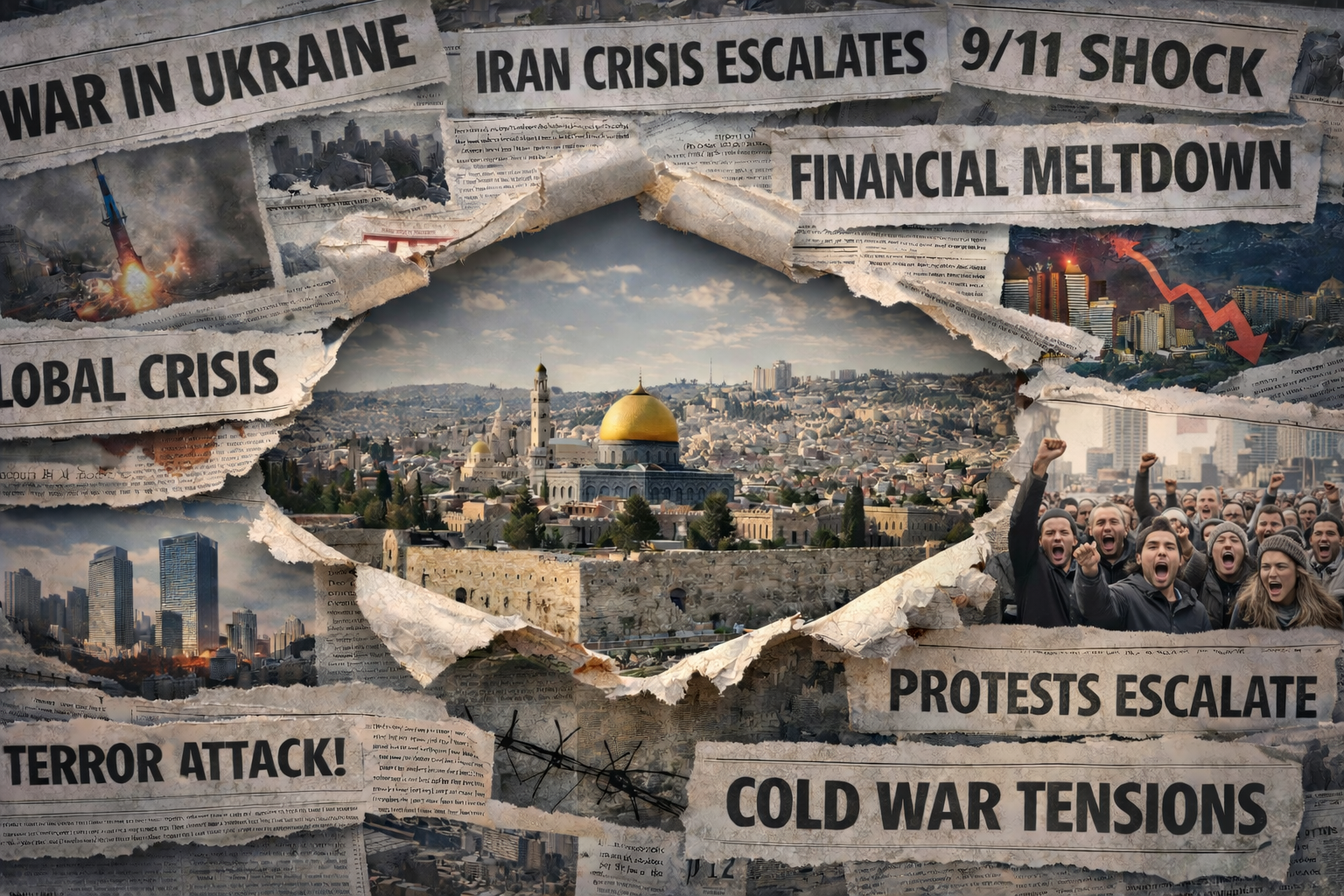
The Pattern Beneath the Headlines
Why it all comes back to the same small city
Right now, much of the world’s attention is focused on the events unfolding in Iran. We follow every development, debate the details, and argue it all through the lens of our own worldviews. As a result, today, in every sense, Iran is shaping the international narrative.
But go back six months, or a year, or five years, and the focus would have been on something completely different.
That’s the rhythm of modern history. One crisis replaces another. One global drama gives way to the next. And like obedient marionettes, we shift our attention to whatever event currently dominates the stage.
Since the end of the Second World War our attention has moved from the division of Europe after 1945, the Cuban Missile Crisis of 1962, the rise of the European Union, the collapse of the Soviet Union, the shock of 9/11 and the global war on terror, the financial crisis of 2008, the power conflict in Ukraine, and now the widening instability centred on Iran and the Middle East.
Each of these moments dominated the world’s attention in its time. Different crises, different catalysts, different outcomes – but when you step back and look at the past eighty years as a whole these events tell a single story. And it is not a story of progress.
For all the promises of a better world, the overall direction of history has been unmistakable: despite better health and greater economic prosperity societies are becoming less stable, institutions less trusted, politics more authoritarian, and culture increasingly detached from the moral framework that once restrained it.
In the West especially, the Judeo-Christian foundation that shaped our civilisation for centuries has been steadily dismantled. In its place two powerful forces have risen that appear to oppose each other – but, perversely, are working together (for now).
One seeks to increase the power of the State in in the name of religion or ideology.
The other rejects moral boundaries in the name of a form of ‘progress’ that requires total control over the thoughts and opinions of the masses.
Their goals are different but their effect is the same.
One elevates ideology.
The other dissolves moral restraint.
Both centralise power.
Together they are pushing societies toward something dark and evil. A world in which the will of the many is subjugated to the desires of the few.
And while all of this has been unfolding, the world has repeatedly found itself drawn back to the same place: Israel.
This is where the modern story really begins.
In 1948, Israel was reborn as a nation after over two thousand years. Nineteen years later, in 1967, Jerusalem returned to Jewish control during the Six-Day War.
At the time, those events looked like regional developments – important in the Middle East, but hardly central to the wider world. Yet, in the years since, Israel has remained strangely embedded in the centre of global affairs. Not always on the front page. Not always dominating international politics. But always there. Periodically returning to centre stage, then disappearing from the headlines as other international events have come and gone.
But as the decades have passed Israel’s pull on our attention has increased as – again and again – international angst gravitates back to the same place.
Jerusalem.
At first glance, that makes no sense. Jerusalem is a small city in a small country. Yet thousands of years ago the Bible described Jerusalem as exactly this kind of flashpoint.
In Zechariah 12:3, God says that Jerusalem will become “a heavy stone for all peoples; all who lift it will surely hurt themselves. And all the nations of the earth will gather against it.”
Looking at the world today and it is hard not to recognise that description.
This doesn’t mean that every conflict, revolution or political decision has been directly orchestrated by God. Human beings make their own choices. Nations pursue power. Leaders act out of ambition, fear and ideology and much of history has unfolded in ways that openly defy God’s warnings.
But something remarkable has still happened. Even when humanity acts against Him, the direction of history continues to move toward the closure that Scripture describes.
In the modern era, that started with the events of 1948 and 1967 – reopening a chapter of history that had appeared to be dormant for centuries.
Since then the world has been moving, step by step, toward a predetermined outcome – not the beginning of a new story but the continuation of one that has been unfolding for more than 2,500 years.
Yes, I know that many people dismiss Bible prophecy entirely, assuming it belongs in the realm of religious speculation. At the same time, many Christians have spent decades expecting events that Scripture never actually predicts – while completely overlooking remarkable fulfilments that have already taken place.
The result is confusion on both sides.
Sceptics believe prophecy has never come true while many believers are watching for the wrong things. And between those misunderstandings, one of the most extraordinary patterns in human history has gone largely unnoticed.
My upcoming book Prophecy Shock was written to bring that pattern into focus.
It explains how events stretching back more than two and a half thousand years have unfolded with remarkable precision – and why the turning points of 1948 and 1967 sit at the centre of the modern chapter of that story.
If you’d like to know when it launches, you can register for updates at: www.prophecyshock.com
This won’t commit you to anything – it will just allow me to send you a reminder a day or two before the book drops.
Because what looks like random chaos and social breakdown is actually a pattern that we simply haven’t recognised yet.
Discover more from ashleychurch.com
Subscribe to get the latest posts sent to your email.
